
How to Interpret ddPCR Results: Common Pitfalls and Troubleshooting
One of the most robust technologies for absolute measurement of nucleic acids is Droplet Digital PCR (ddPCR). Droplet digital PCR (ddPCR) is a highly sensitive technology that enables the detection of low abundance targets without the need of standard curves. It partitions a PCR reaction into thousands of nanolitre sized droplets and employs Poisson statistics to quantify the target. This makes it a vital tool for applications including rare mutation discovery, copy number variation (CNV) analysis, gene expression investigations, viral load monitoring, and gene-editing validation.
Although ddPCR provides exceptional precision, obtaining reliable quantitative data depends not only on experimental design but also on accurate interpretation of the results. However, misinterpretation of the droplet patterns, incorrect thresholds or failure to consider the sample quality issues may result in wrong results.
This article will take you through typical ddPCR outputs, how to recognize unusual droplet patterns, troubleshooting typical difficulties, and best practices to help ensure reliable and reproducible findings.
Understanding ddPCR Output
Most ddPCR analysis software presents results using one-dimensional (1D) or two-dimensional (2D) fluorescence amplitude plots. In these plots, every droplet is represented as a single data point, allowing researchers to distinguish positive droplets from negative droplets based on fluorescence intensity.
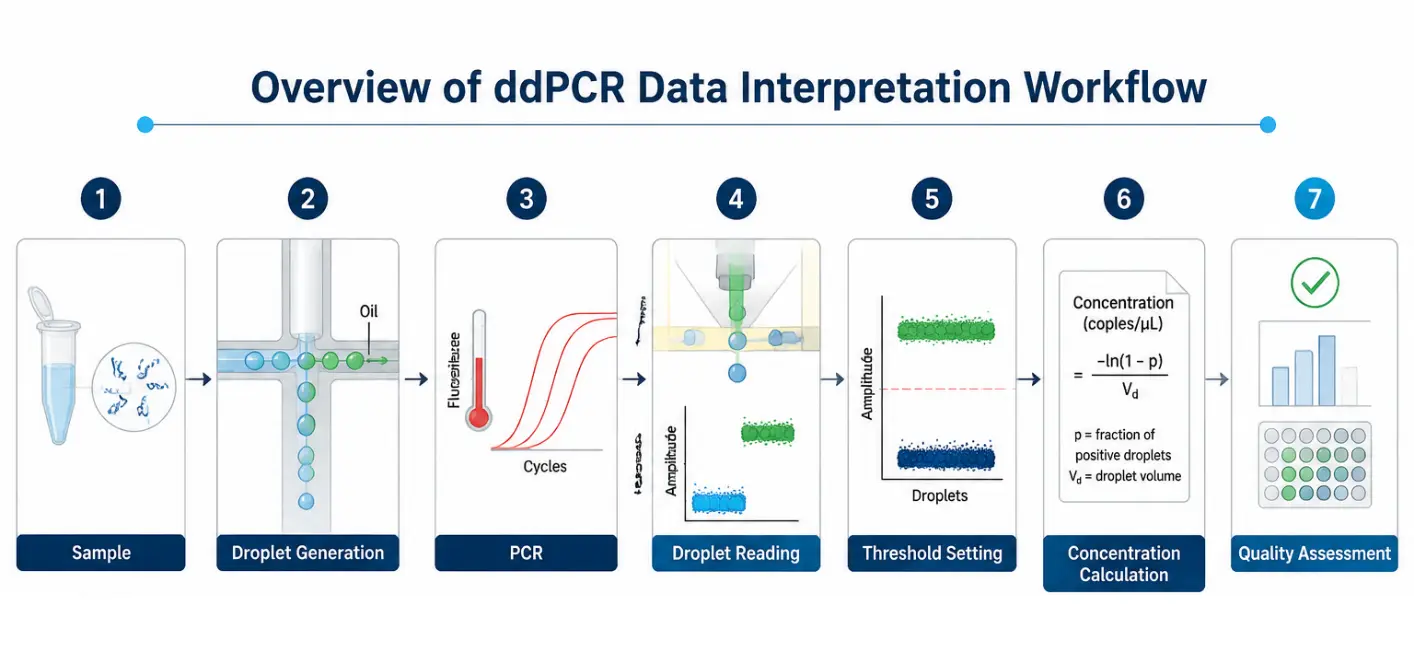
A typical ddPCR report includes several key parameters:
| Parameter | Description | What to Look For |
|---|---|---|
| Accepted Droplets | Number of droplets successfully analyzed | Generally >10,000 droplets |
| Positive Droplets | Droplets containing the target sequence | Depends on target abundance |
| Negative Droplets | Droplets without amplification | Expected in all assays |
| Threshold | Separates positive and negative droplets | Should clearly divide clusters |
| Copies/μL | Absolute target concentration | Primary quantitative result |
Among these metrics, the number of accepted droplets directly influences statistical confidence. Too few accepted droplets reduce quantification accuracy and increase variability.
How to Read Different Droplet Patterns
The fluorescence amplitude plot provides valuable information about assay quality. Recognizing characteristic droplet distributions is often the first step in troubleshooting unexpected results.
1. Clear Positive and Negative Clusters
The ideal ddPCR result displays two well-separated populations: a negative cluster with low fluorescence and a positive cluster with significantly higher fluorescence.
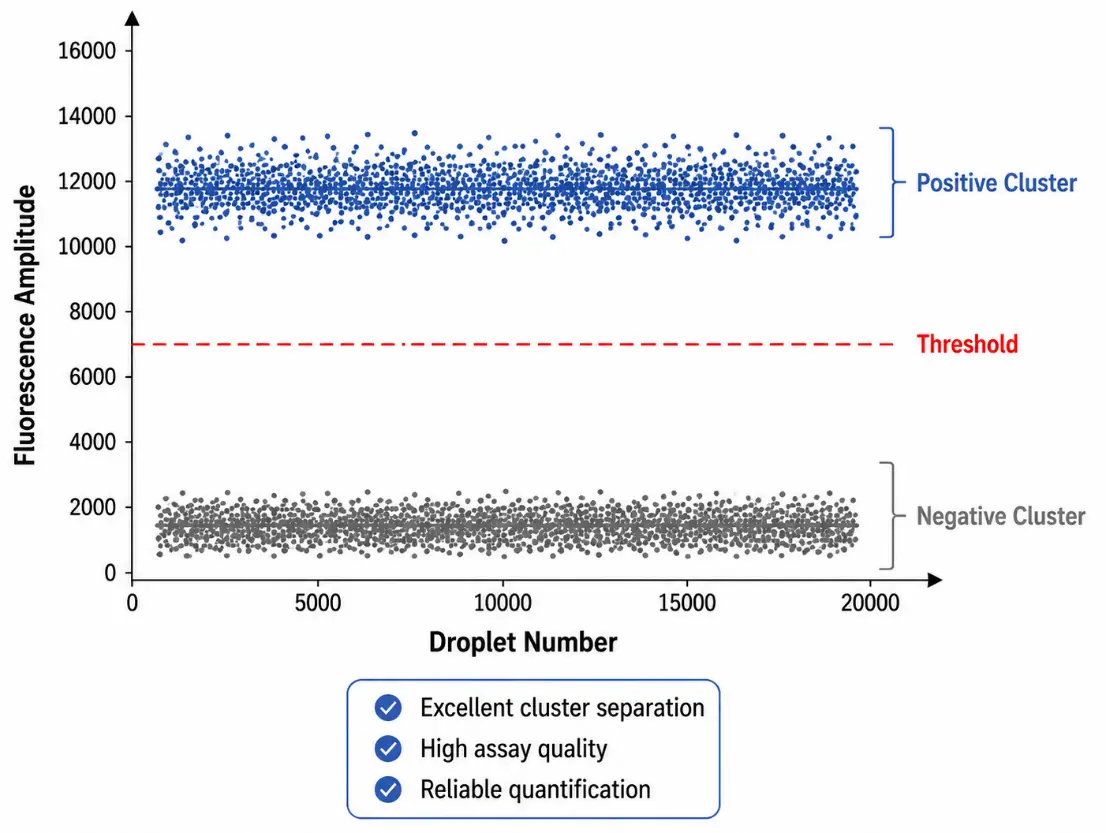
In most cases, automatic thresholding performs well for this type of data.
2. Rain Between Positive and Negative Clusters
One of the most frequently encountered issues is the appearance of droplets with intermediate fluorescence, commonly referred to as "rain."
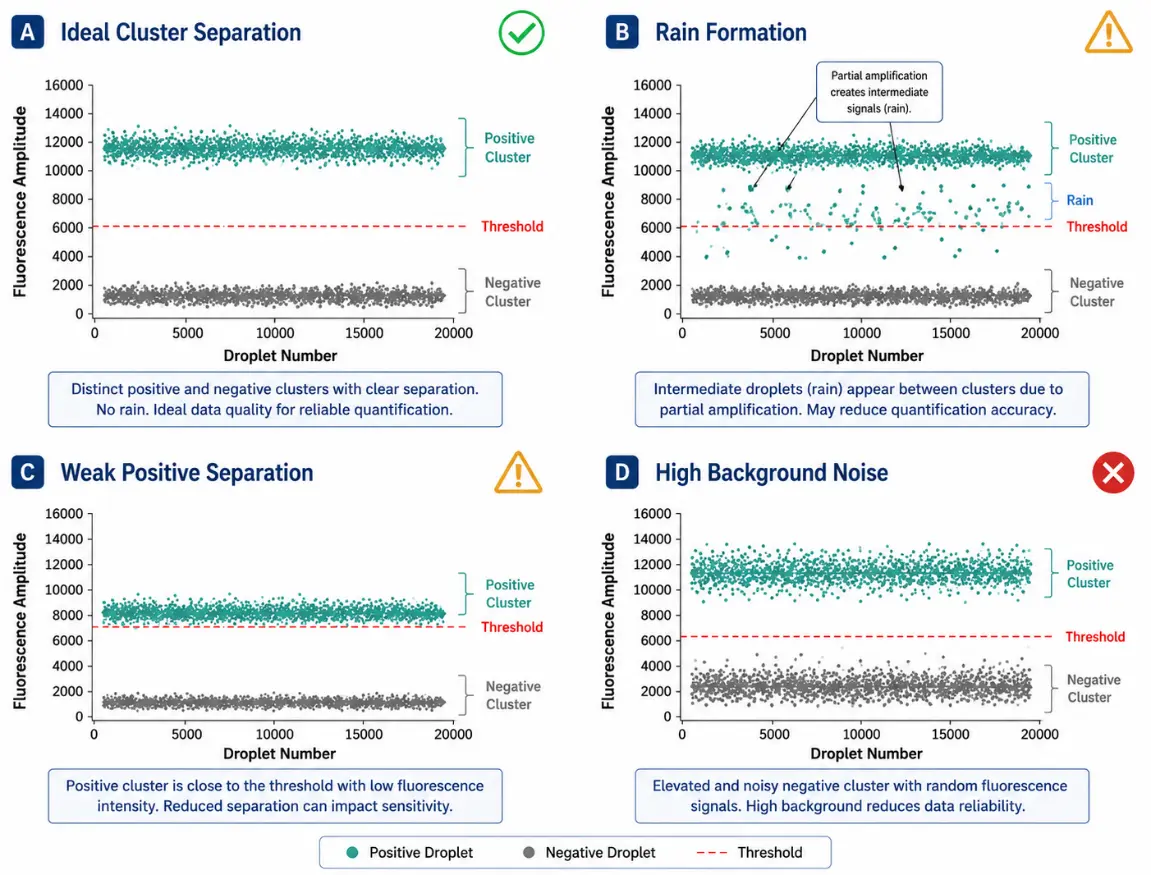
Although a small amount of rain is relatively common, excessive rain complicates threshold placement and may affect quantitative accuracy.
To minimize rain:
- Optimize primer and probe design.
- Perform annealing temperature optimization.
- Improve nucleic acid purity.
- Reduce template overload if necessary.
- Replace degraded reagents.
3. Weak Cluster Separation
Sometimes positive droplets exhibit only slightly higher fluorescence than negative droplets.
Possible causes include:
- Low probe fluorescence
- Inefficient amplification
- Inappropriate probe concentration
- Instrument calibration issues
Increasing probe concentration, optimizing PCR cycling conditions, or redesigning primers may improve cluster separation.
4. High Background Fluorescence
In some experiments, the negative cluster shifts upward, producing elevated background fluorescence.
Potential causes include:
- Sample contamination
- Autofluorescent contaminants
- Optical contamination in the droplet reader
- Reagent degradation
Routine instrument maintenance and the use of fresh reagents can often resolve this problem.
5. Setting the Correct Threshold
Threshold placement is one of the most important steps in ddPCR data analysis because it determines which droplets are classified as positive or negative.
Automatic Thresholding
Most commercial software provides automatic threshold selection based on fluorescence distribution.
Automatic thresholding is generally appropriate when:
- Positive and negative clusters are clearly separated.
- Minimal rain is present.
- Single-target assays are performed.
- Control samples behave as expected.
Its advantages include improved consistency and reduced operator bias.
6. Manual Thresholding
Manual adjustment becomes necessary when droplet distributions are ambiguous.
Manual thresholding is often recommended for:
- Rare mutation detection
- Low-copy targets
- CNV assays
- Multiplex experiments
- Samples with significant rain
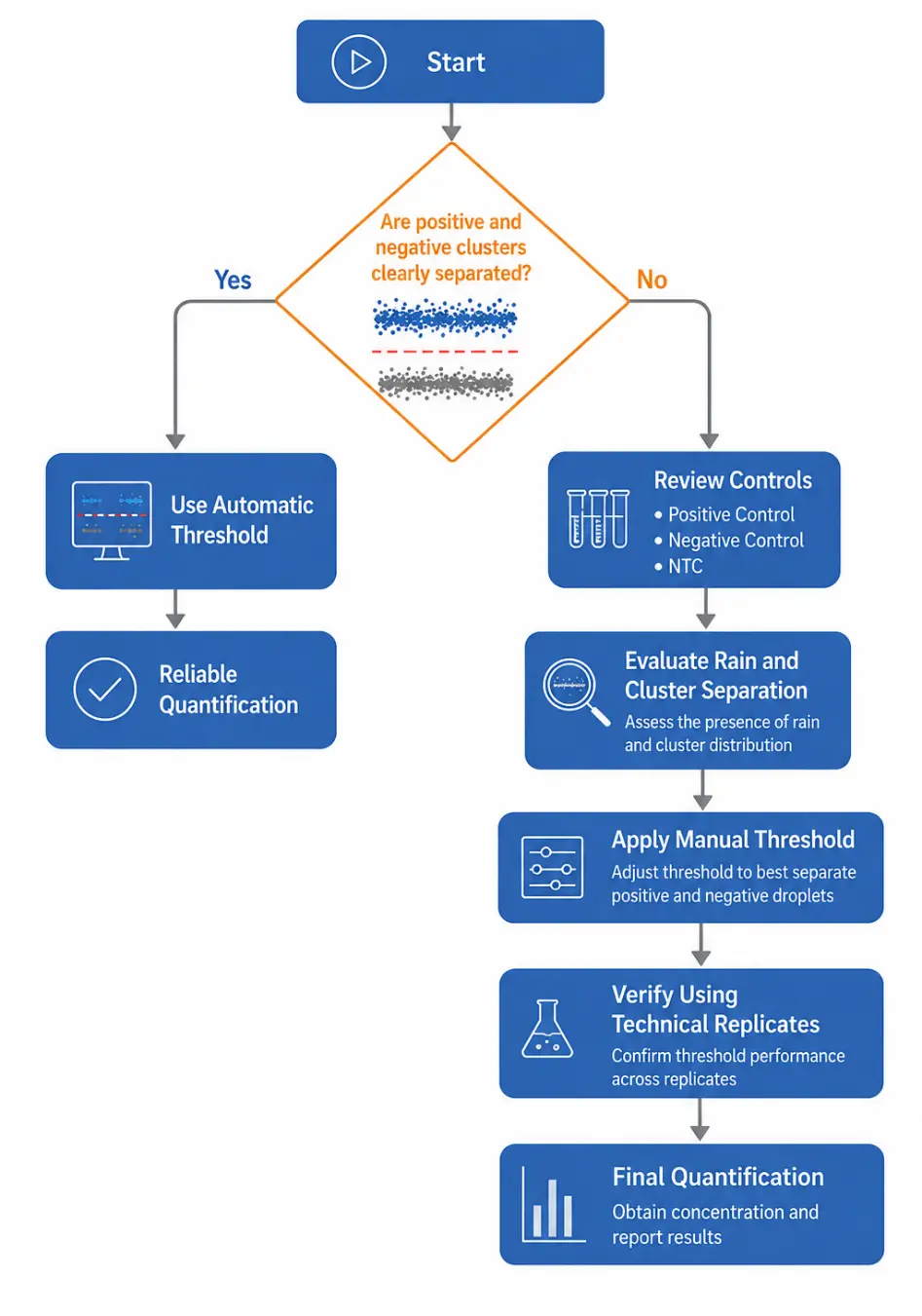
When adjusting thresholds manually, always compare experimental samples with positive controls, negative controls, and no-template controls (NTCs). Thresholds should never be placed arbitrarily to achieve desired results.
Common ddPCR Problems and Troubleshooting
Many experimental issues can be identified by examining droplet distribution together with assay statistics.
| Problem | Possible Cause | Recommended Solution |
|---|---|---|
| Low droplet count | Air bubbles, poor droplet generation | Reload cartridge and repeat droplet generation |
| Poor cluster separation | Primer/probe issues | Optimize assay design |
| Excessive rain | PCR inhibitors, degraded reagents | Improve sample purity and replace reagents |
| Unexpected positive droplets | Contamination | Replace reagents and include fresh NTCs |
| No positive droplets | PCR failure or incorrect assay design | Verify primers, probes, and thermal cycling |
| Variable replicates | Pipetting inconsistency | Mix samples thoroughly and improve technique |
| High coefficient of variation | Insufficient accepted droplets | Increase droplet number or repeat experiment |
When troubleshooting, avoid changing multiple experimental variables simultaneously. Optimizing one parameter at a time makes it easier to identify the true source of the problem.
Sample Quality Issues That Affect ddPCR Results
Even a well-designed assay cannot compensate for poor sample quality. High-quality nucleic acid preparation remains essential for accurate absolute quantification.
Degraded DNA or RNA
Fragmented nucleic acids reduce amplification efficiency and may underestimate target concentration.
Researchers should evaluate nucleic acid integrity using gel electrophoresis or automated electrophoretic systems before ddPCR analysis whenever possible.
PCR Inhibitors
Residual contaminants from nucleic acid extraction are a common source of amplification problems.
Typical inhibitors include:
- Phenol
- Ethanol
- Heparin
- Hemoglobin
- High salt concentrations
Additional purification steps or optimized extraction methods often improve assay performance.
Low Template Concentration
Although ddPCR is highly sensitive, extremely low template concentrations produce very few positive droplets, increasing uncertainty associated with Poisson-based calculations.
Whenever possible, increase nucleic acid input while remaining within the recommended loading range.
Excessive Template Input
Loading too much DNA can produce an overwhelming number of positive droplets, reducing quantification accuracy because insufficient negative droplets remain for reliable statistical analysis.
Diluting the sample before repeating the assay usually resolves this issue.
Essential Controls for Reliable ddPCR Experiments
Appropriate controls are indispensable for both assay validation and result interpretation.
| Control | Purpose |
|---|---|
| No Template Control (NTC) | Detect contamination |
| Positive Control | Confirm assay performance |
| Wild-Type Control | Validate mutation assays |
| Technical Replicates | Assess reproducibility |
| Reference Gene | Normalize CNV and expression studies |
Negative controls should consistently remain negative throughout the experiment. Even a few unexpected positive droplets in the NTC may indicate contamination and should prompt further investigation before interpreting experimental data.
Similarly, positive controls should produce the expected fluorescence pattern and concentration range. Unexpected control results often suggest reagent degradation or procedural errors.
Best Practices for Accurate ddPCR Data Interpretation
Consistent experimental procedures greatly improve data quality and reduce troubleshooting time.
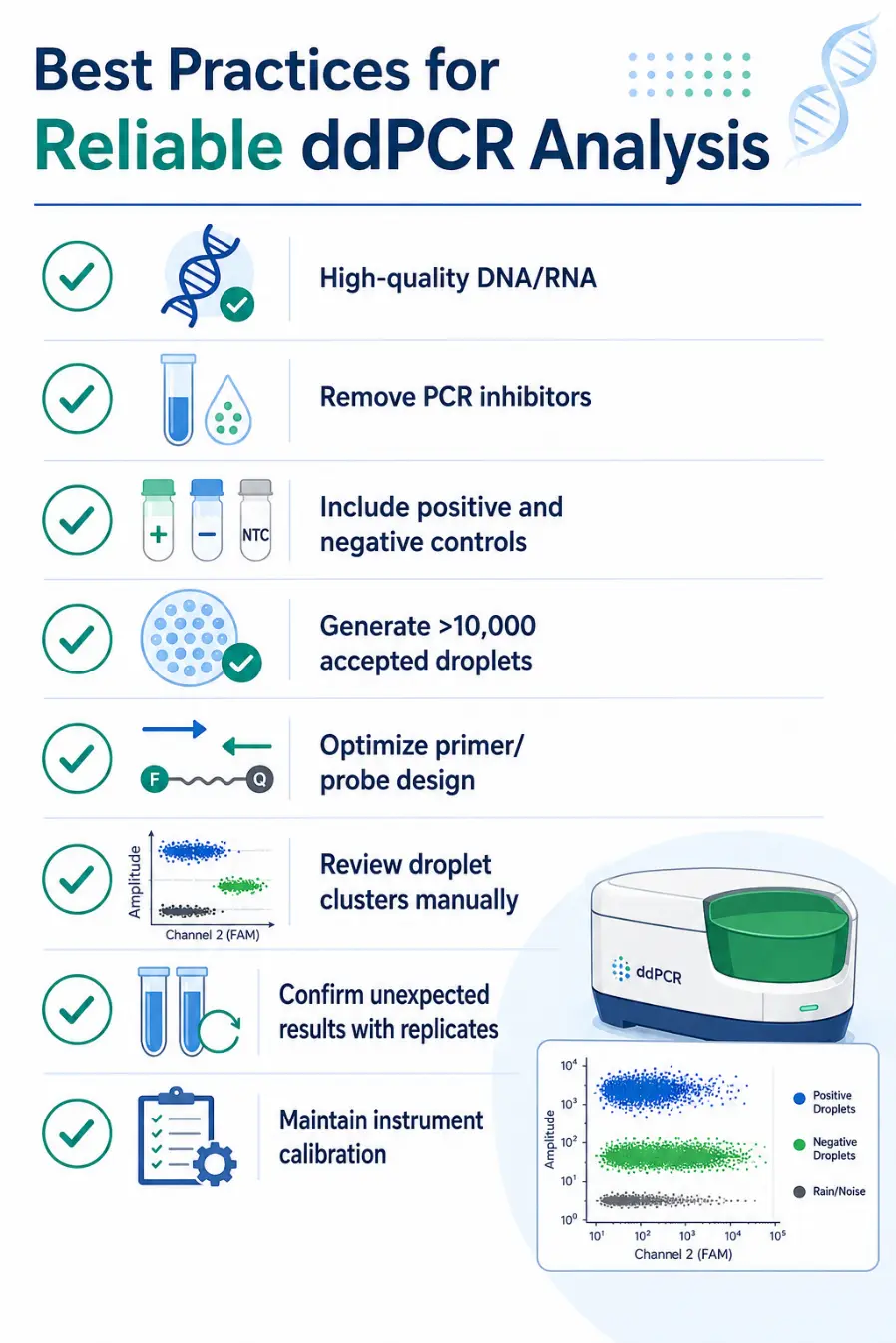
Following these practices not only improves data reliability but also simplifies comparison between independent experiments.
Conclusion
Droplet Digital PCR provides exceptional sensitivity and precision for absolute nucleic acid quantification, but obtaining trustworthy results requires more than successful PCR amplification. Accurate interpretation depends on careful evaluation of droplet distributions, appropriate threshold placement, sufficient accepted droplets, proper experimental controls, and high-quality sample preparation.
By recognizing common droplet patterns, understanding the causes of abnormal fluorescence distributions, and applying systematic troubleshooting strategies, researchers can minimize analytical errors and maximize the reproducibility of their ddPCR experiments. Establishing standardized analysis workflows and incorporating routine quality assessment into every experiment will ultimately improve confidence in ddPCR data across research and clinical applications.
Creative Bioarray Relevant Recommendations
| Products & Services | Description |
|---|---|
| Droplet Digital PCR (ddPCR) Service | Our experienced team at Creative Bioarray provides expert ddPCR analysis support with advanced technical capabilities and customized solutions for diverse molecular research applications. |