
G-402
Cat.No.: CSC-C9383L
Species: Homo sapiens (Human)
Source: Kidney
Culture Properties: monolayer
- Specification
- Background
- Scientific Data
- Q & A
- Customer Review
Isoenzyme: G6PD, B
Karyology: diploid
Histopathology: leiomyoblastoma, renal
Note: the line will grow in soft agar
The G-402 cell line is a human renal leiomyosarcoma line derived from a primary tumor of the left kidney of a 75-year-old patient. It is made up of elongated spindle-shaped fibroblast-like cells which form as adherent monolayers reflecting its smooth muscle origin. The line has the typical ultrastructure of smooth muscle cells, with numerous microfilaments with thick bodies and expresses smooth muscle actin (SMA) and desmin. G-402 cells are microsatellite stable (MSS) and contain a heterozygous missense mutation in the TP53 gene (p.Arg282Trp).
In culture G-402 cells are maintained in a nutritionally complete basal medium (e.g., DMEM or McCoy's 5A) supplemented with serum and L-glutamine, under standard conditions (37°C, 5% CO2). At 70-80% confluence they are sub-cultured in trypsin/EDTA, usually at a 1:3 to 1:6 ratio.
G-402 is commonly utilized in soft tissue sarcoma research, notably for investigating molecular drivers of leiomyosarcoma development, p53 pathway dysregulation and tumor cell invasion. It is also used in anti-angiogenic and anti-fibrotic drug screening and as a comparison model for the study of the differential biology between renal cell carcinoma and rare renal sarcomas and for the evaluation of targeted therapy for smooth muscle malignancies.
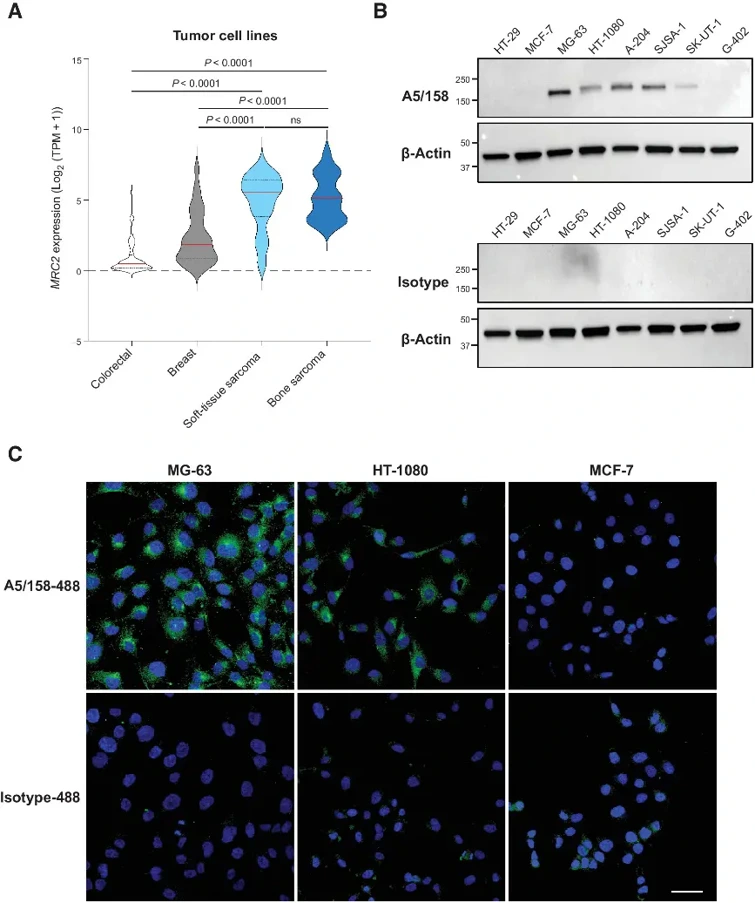
A5/158 Recognizes Endo180 Expressed on Sarcoma Cell Lines
Sarcoma patients face high relapse rates and poor metastatic survival, driven by molecular heterogeneity that complicates targeted therapy development. Evans et al. identifies Endo180 (MRC2), a constitutively recycling transmembrane receptor, as a promising pan-sarcoma target for antibody-drug conjugate (ADC) delivery.
Analysis of the Cancer Cell Line Encyclopedia (CCLE) confirmed significantly higher MRC2 expression in soft tissue and bone sarcoma cell lines compared to breast or colorectal cancer lines, consistent with IHC and gene-expression data from primary tumors (Fig. 1A). To validate the anti-Endo180 monoclonal antibody A5/158 for ADC development, they assessed its specificity across multiple sarcoma and control cell lines. Western blotting demonstrated that A5/158 detected Endo180 protein in sarcoma lines (MG-63, HT-1080, A-204, SJSA-1, SK-UT-1, G-402) but not in Endo180-negative epithelial controls (HT-29, MCF-7) (Fig. 1). The lower protein levels observed in SK-UT-1 and G-402 cells aligned with their reduced transcript expression in the CCLE dataset. These findings confirm the selective expression of Endo180 in sarcomas and validate the A5/158 antibody as a candidate for ADC development.
Ask a Question
Write your own review
- You May Also Need

Description: Rhabdoid tumor of kidney (formerly classified as Wilms' tumor)
Description: The cells express the transforming gene of adenovirus 5. Adenovirus 5 DNA from both the right and left ends of the viral genome are present. The line is excellent for titrating human adenoviruses. ...
- Adipose Tissue-Derived Stem Cells
- Human Neurons
- Mouse Probe
- Whole Chromosome Painting Probes
- Hepatic Cells
- Renal Cells
- In Vitro ADME Kits
- Tissue Microarray
- Tissue Blocks
- Tissue Sections
- FFPE Cell Pellet
- Probe
- Centromere Probes
- Telomere Probes
- Satellite Enumeration Probes
- Subtelomere Specific Probes
- Bacterial Probes
- ISH/FISH Probes
- Exosome Isolation Kit
- Human Adult Stem Cells
- Mouse Stem Cells
- iPSCs
- Mouse Embryonic Stem Cells
- iPSC Differentiation Kits
- Mesenchymal Stem Cells
- Immortalized Human Cells
- Immortalized Murine Cells
- Cell Immortalization Kit
- Adipose Cells
- Cardiac Cells
- Dermal Cells
- Epidermal Cells
- Peripheral Blood Mononuclear Cells
- Umbilical Cord Cells
- Monkey Primary Cells
- Mouse Primary Cells
- Breast Tumor Cells
- Colorectal Tumor Cells
- Esophageal Tumor Cells
- Lung Tumor Cells
- Leukemia/Lymphoma/Myeloma Cells
- Ovarian Tumor Cells
- Pancreatic Tumor Cells
- Mouse Tumor Cells