
SN12PM6
Cat.No.: CSC-C9612L
Species: Homo sapiens (Human)
Source: Kidney
Culture Properties: monolayer
- Specification
- Background
- Scientific Data
- Q & A
- Customer Review
Shipping Condition: Room Temperature
SN12PM6 is a human renal cell carcinoma (RCC) cell line with strong metastasis potential. It was obtained from the parental SN12C renal cancer cell line by in vivo selection, following serial passaging and isolation from metastatic lesions in nude mice. SN12PM6, as a metastatic variation, has a much higher invasive and metastatic ability than its parental counterpart and has become a widely used experimental model for the study of renal cancer progression and metastasis.
SN12PM6 cells grow as adherent monolayer and retains features of progressive renal cell cancer. This cell line has been widely used in research on tumor spread, angiogenesis, tumor-microenvironment interactions and molecular underpinnings of metastatic behavior. Preliminary experiments have shown that SN12PM6 has increased metastatic activity and overexpression of proangiogenic factors in some organ microenvironments, therefore providing an interesting model for the study of the link between tumor growth and angiogenesis.
Recent studies have used SN12PM6 cells to examine cancer stem cell related markers, mechanisms of treatment resistance, control via microRNA and signaling pathways implicated in renal tumor growth. The cell line has also been used in xenograft and metastatic tumor models to test potential anticancer drugs and targeted therapy techniques.
Carbazochrome Sodium Sulfonate (CBZ) Inhibits Renal Cell Carcinoma Bone Metastasis and Promotes Osteoblast Differentiation via BIGH3 Modulation
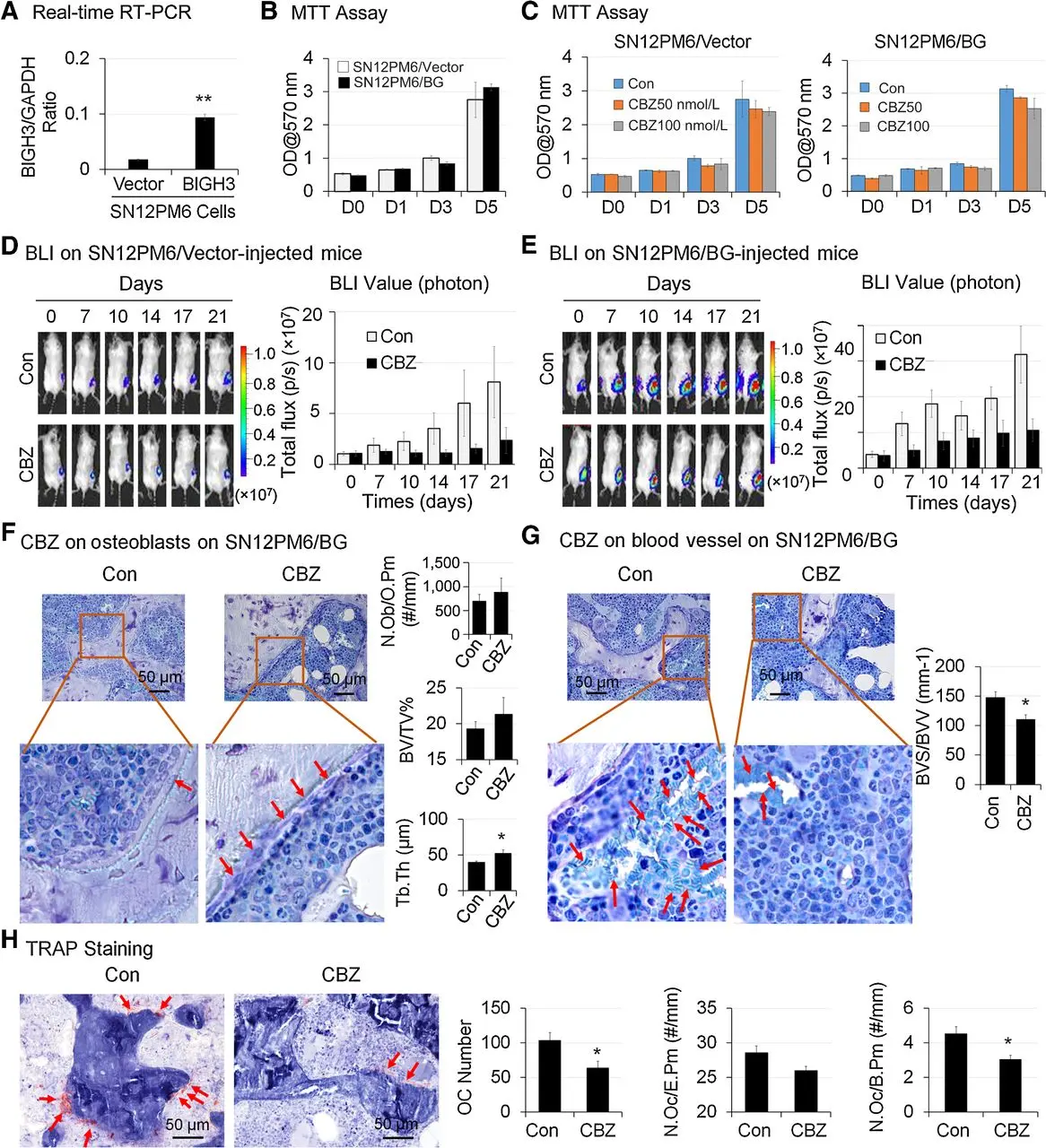
Renal cell carcinoma bone metastases (RCCBM) are primarily osteolytic, driven in part by tumor-secreted BIGH3 (TGFBI), which suppresses osteoblast (OSB) differentiation. To test whether BIGH3 modulation could alter tumor behavior, human SN12PM6 cells—which normally express low levels of BIGH3—were engineered to overexpress BIGH3 (SN12PM6/BG). Overexpression was confirmed by real-time RT-PCR (Fig. 1A), with no significant effect on cell proliferation (Fig. 1B). In vitro treatment with carbazochrome sodium sulfonate (CBZ; 50 or 100 nmol/L) for up to 5 days did not inhibit the growth of either SN12PM6/Vector or SN12PM6/BG cells (Fig.1C).
In vivo, mice received intrafemoral injections of SN12PM6/Vector or SN12PM6/BG cells. After 2 weeks of tumor establishment, CBZ treatment was administered for 21 days. Bioluminescence imaging (BLI) showed progressive tumor growth in control groups, whereas CBZ significantly reduced BLI signals in both cell lines (Fig. 1D, E), indicating inhibition of tumor growth in bone.
Bone histomorphometry of SN12PM6/BG-bearing femurs revealed that CBZ treatment increased OSB numbers per osteoid perimeter (N.Ob/O.Pm), bone volume (BV/TV%), and trabecular thickness (Tb.Th) (Fig. 1F). CBZ also reduced blood vessel density (BVS/BVV) (Fig. 1G) and significantly decreased osteoclast numbers (Oc Number, N.Oc/B.Pm), with a trend toward reduced osteoclasts per erosion perimeter (N.Oc/E.Pm) (Fig. 1H).
These findings demonstrate that CBZ suppresses RCCBM progression in bone by promoting OSB differentiation, inhibiting angiogenesis, and reducing osteoclastogenesis, independently of direct effects on tumor cell proliferation. This highlights CBZ as a potential therapeutic agent for mitigating the osteolytic bone microenvironment in renal cell carcinoma.
Ask a Question
Write your own review
- You May Also Need
Description: Rhabdoid tumor of kidney (formerly classified as Wilms' tumor)
Description: The cells express the transforming gene of adenovirus 5. Adenovirus 5 DNA from both the right and left ends of the viral genome are present. The line is excellent for titrating human adenoviruses. ...
Description: Species: human - female, 9 months old, CaucasianIsoenzyme: G6PD, BKaryology: diploidHistopathology: leiomyoblastoma, renalNote: the line will grow in soft agar
- Adipose Tissue-Derived Stem Cells
- Human Neurons
- Mouse Probe
- Whole Chromosome Painting Probes
- Hepatic Cells
- Renal Cells
- In Vitro ADME Kits
- Tissue Microarray
- Tissue Blocks
- Tissue Sections
- FFPE Cell Pellet
- Probe
- Centromere Probes
- Telomere Probes
- Satellite Enumeration Probes
- Subtelomere Specific Probes
- Bacterial Probes
- ISH/FISH Probes
- Exosome Isolation Kit
- Human Adult Stem Cells
- Mouse Stem Cells
- iPSCs
- Mouse Embryonic Stem Cells
- iPSC Differentiation Kits
- Mesenchymal Stem Cells
- Immortalized Human Cells
- Immortalized Murine Cells
- Cell Immortalization Kit
- Adipose Cells
- Cardiac Cells
- Dermal Cells
- Epidermal Cells
- Peripheral Blood Mononuclear Cells
- Umbilical Cord Cells
- Monkey Primary Cells
- Mouse Primary Cells
- Breast Tumor Cells
- Colorectal Tumor Cells
- Esophageal Tumor Cells
- Lung Tumor Cells
- Leukemia/Lymphoma/Myeloma Cells
- Ovarian Tumor Cells
- Pancreatic Tumor Cells
- Mouse Tumor Cells