
143B
Cat.No.: CSC-C9149W
Species: Homo sapiens (Human)
Source: Bone
Morphology: mixed
- Specification
- Background
- Scientific Data
- Q & A
- Customer Review
The 143B cell line is a highly tumorigenic and metastatic human osteosarcoma line derived from the HOS (TE85, clone F-5) parental cells through stable transfection with an activated KRAS oncogene. Originally established from a 13-year-old female osteosarcoma patient, this KRAS-transformed derivative exhibits an aggressively malignant phenotype that faithfully models the lethal progression of osteosarcoma.
A defining advantage of 143B cells is their exceptional metastatic proclivity. When injected into immunocompromised mice—either orthotopically into the tibia or systemically via the left cardiac ventricle—they robustly generate osteolytic bone lesions and consistently colonize the lungs, thereby recapitulating the organotropism of clinical osteosarcoma. This spontaneous and experimental metastatic capacity makes the line a superior tool for dissecting the mechanisms of tumor cell dissemination, bone homing, and osteoclast-driven bone destruction. The cells can be readily engineered to stably express luciferase or fluorescent reporters, enabling sensitive, non-invasive bioluminescence imaging of primary tumor growth and micrometastatic burden over time.
Furthermore, 143B retains the intrinsic osteoblastic features of its origin, expressing bone-specific markers such as alkaline phosphatase and bone sialoprotein, and actively interacting with the bone microenvironment. Coupled with its rapid, reproducible in vitro growth and well-characterized genetic background, the 143B line offers an indispensable, highly reproducible preclinical platform for evaluating anti-metastatic therapies and bone-targeted agents in osteosarcoma.
Core Molecular Clock Factors Regulate Osteosarcoma Stem Cell Survival and Behavior via CSC/EMT Pathways and Lipid Droplet Biogenesis
The circadian clock, an intrinsic 24 h cellular timekeeping system, regulates fundamental biological processes, including tumor physiology and metabolism. Cancer stem cells (CSCs), a subpopulation of cancer cells with self-renewal and tumorigenic capacities, are implicated in tumor initiation, recurrence, and metastasis. Despite growing evidence for the circadian clock’s involvement in regulating CSC functions, its precise regulatory mechanisms remain largely unknown. Here, using a human osteosarcoma (OS) model (143B), we have shown that core molecular clock factors are critical for OS stem cell survival and behavior via direct modulation of CSC and lipid metabolic pathways.
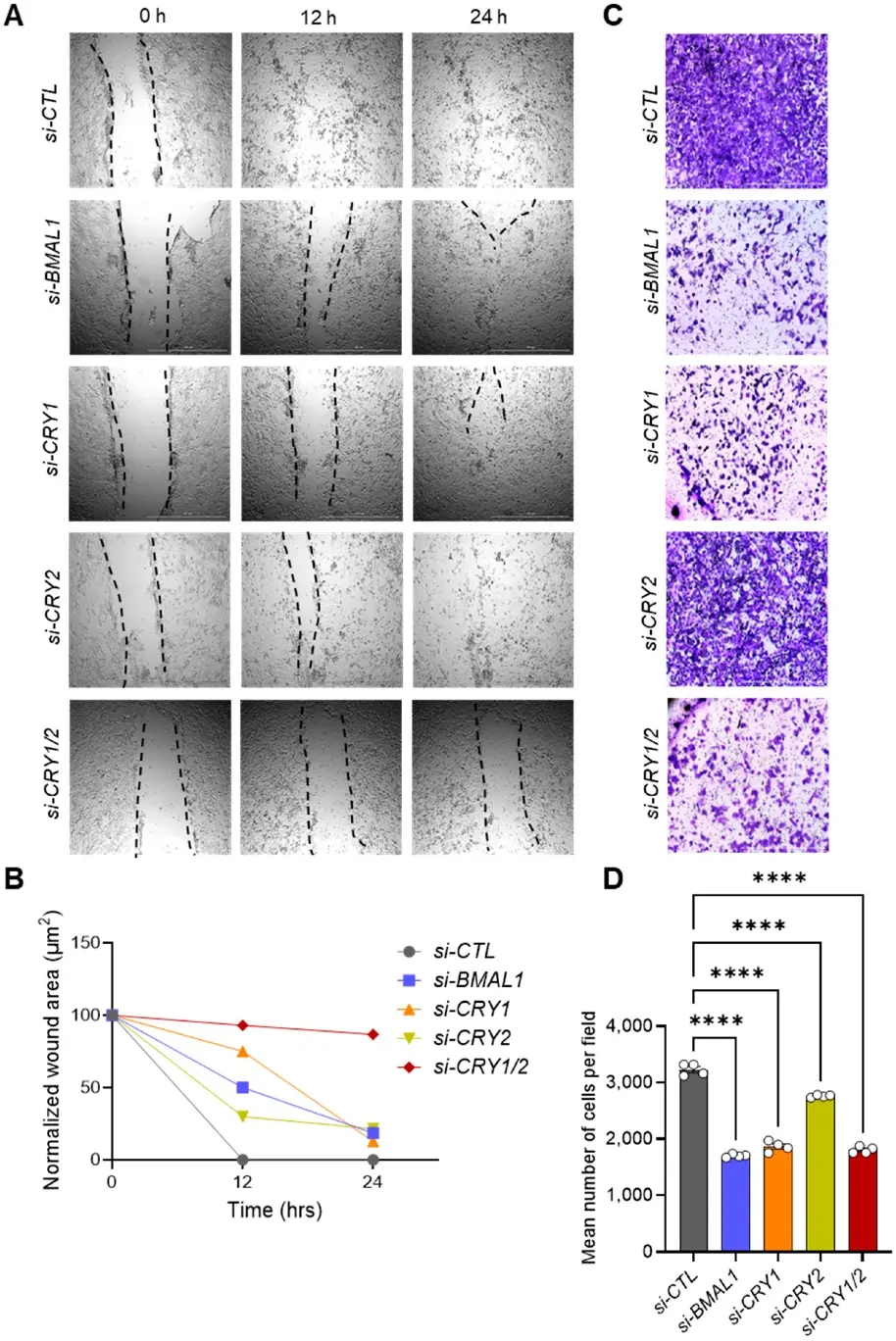
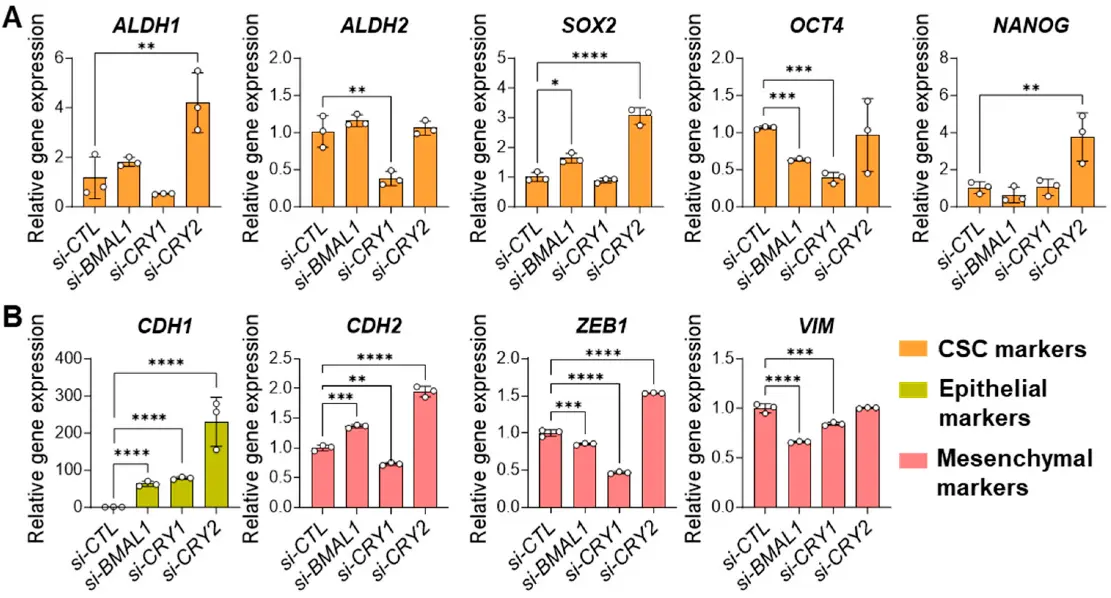
In single-cell-derived spheroid formation assays, 143B OS cells exhibited robust spheroid-forming capacity under 3D culture conditions. Furthermore, siRNA-mediated depletion of core clock components (i.e., BMAL1, CLOCK, CRY1/2, PER1/2) significantly reduced spheroid formation in 143B CSCs isolated from in vivo OS xenografts. We also found that knockdown of BMAL1, CLOCK, or CRY1/2 markedly impaired the migration and invasion capacities of 143B CSCs. At the molecular level, silencing of BMAL1, CLOCK, or CRY1/2 distinctly altered the expression of genes associated with stem cell properties and the epithelial–mesenchymal transition (EMT) in 143B CSCs. In addition, disruption of BMAL1, CLOCK, or CRY1/2 expression significantly reduced lipid droplet formation by downregulating the expression of genes involved in lipogenesis (e.g., DGAT1, FASN, ACSL4, PKM2, CHKA, SREBP1), which are closely linked to CSC/EMT processes. These findings highlight the critical role of the molecular circadian clock in regulating CSC properties and metabolism, underscoring the therapeutic potential of targeting the core clock machinery to enhance OS treatment outcomes.
Ask a Question
Write your own review
- You May Also Need
Description: Cell line was derived from the tumor material xenografted in immuno-deficient mice; tumor material: primary pediatric embryonal rhabdomyosarcoma exhibiting moderate histological differentiation
Description: Human cell line derived from epithelioid sarcoma. Derived from a different patient from the patient of HS-ES-2M, 2R cell lines.
Description: Established from the bone marrow metastasis of a 17-year-old man with undifferentiated (standard classification) or unclassified (Palmer classification) alveolar rhabdomyosarcoma; cells were ...
Description: Human cell line derived from epithelioid sarcoma. Derived from a different patient from the patient of HS-ES-1 cell line.
- Adipose Tissue-Derived Stem Cells
- Human Neurons
- Mouse Probe
- Whole Chromosome Painting Probes
- Hepatic Cells
- Renal Cells
- In Vitro ADME Kits
- Tissue Microarray
- Tissue Blocks
- Tissue Sections
- FFPE Cell Pellet
- Probe
- Centromere Probes
- Telomere Probes
- Satellite Enumeration Probes
- Subtelomere Specific Probes
- Bacterial Probes
- ISH/FISH Probes
- Exosome Isolation Kit
- Human Adult Stem Cells
- Mouse Stem Cells
- iPSCs
- Mouse Embryonic Stem Cells
- iPSC Differentiation Kits
- Mesenchymal Stem Cells
- Immortalized Human Cells
- Immortalized Murine Cells
- Cell Immortalization Kit
- Adipose Cells
- Cardiac Cells
- Dermal Cells
- Epidermal Cells
- Peripheral Blood Mononuclear Cells
- Umbilical Cord Cells
- Monkey Primary Cells
- Mouse Primary Cells
- Breast Tumor Cells
- Colorectal Tumor Cells
- Esophageal Tumor Cells
- Lung Tumor Cells
- Leukemia/Lymphoma/Myeloma Cells
- Ovarian Tumor Cells
- Pancreatic Tumor Cells
- Mouse Tumor Cells