
ESO-26
Cat.No.: CSC-C0686
Species: Homo sapiens (Human)
Source: Esophagus
Morphology: ovoid cells growing semiadherently, singly or in clumps
- Specification
- Background
- Scientific Data
- Q & A
- Customer Review
Immunology: cytokeratin +, cytokeratin-7 +, cytokeratin-8 +, cytokeratin-17 -, cytokeratin-18 +, cytokeratin-19 +, desmin -, endothel -, EpCAM +, GFAP -, neurofilament -, vimentin -
Viruses: PCR:
ESO-26 is a rigorously authenticated human esophageal adenocarcinoma (EAC) cell line established in 2000 from the primary tumor (Stage IV, pT4N1M1) of a 56-year-old Caucasian male patient. As one of only nine EAC lines whose identity has been verified against original patient material through STR profiling, p53 mutation analysis, and xenograft histology, ESO-26 offers exceptional model fidelity.
Molecularly, the line harbors pathogenic TP53 (C742T) and SMAD4 mutations, faithfully recapitulating key driver alterations observed in approximately 69% and 13% of primary EACs, respectively. It displays a hypodiploid karyotype and robust expression of epithelial differentiation markers including cytokeratins 7/8/18/19, EpCAM, and SOX9, alongside demonstrated tumorigenicity and a doubling time of 35–50 hours.
Critically, ESO-26 is supported by publicly available whole-genome sequencing data and integrated into major pharmacogenomic resources including CellMinerCDB, GDSC, and Broad Achilles CRISPR-Cas9 screens. This comprehensive molecular annotation enables precise experimental design, robust genotype-phenotype analysis, and high-throughput therapeutic screening. With authenticated origin, defined oncogenic drivers, and multi-platform omics characterization, ESO-26 stands as a robust, clinically representative platform for advancing mechanistic and translational research in gastroesophageal adenocarcinoma.
Trophoblast Cell Surface Antigen 2 (TROP2) as a Predictive Bio-Marker for the Therapeutic Efficacy of Sacituzumab Govitecan in Adenocarcinoma of the Esophagus
The Trophoblast cell surface antigen 2 (TROP2) is expressed in many carcinomas and may represent a target for treatment. Sacituzumab govitecan (SG) is a TROP2–directed antibody-drug conjugate (ADC). Nearly nothing is known about the biological effectiveness of SG in esophageal adenocarcinoma (EAC).
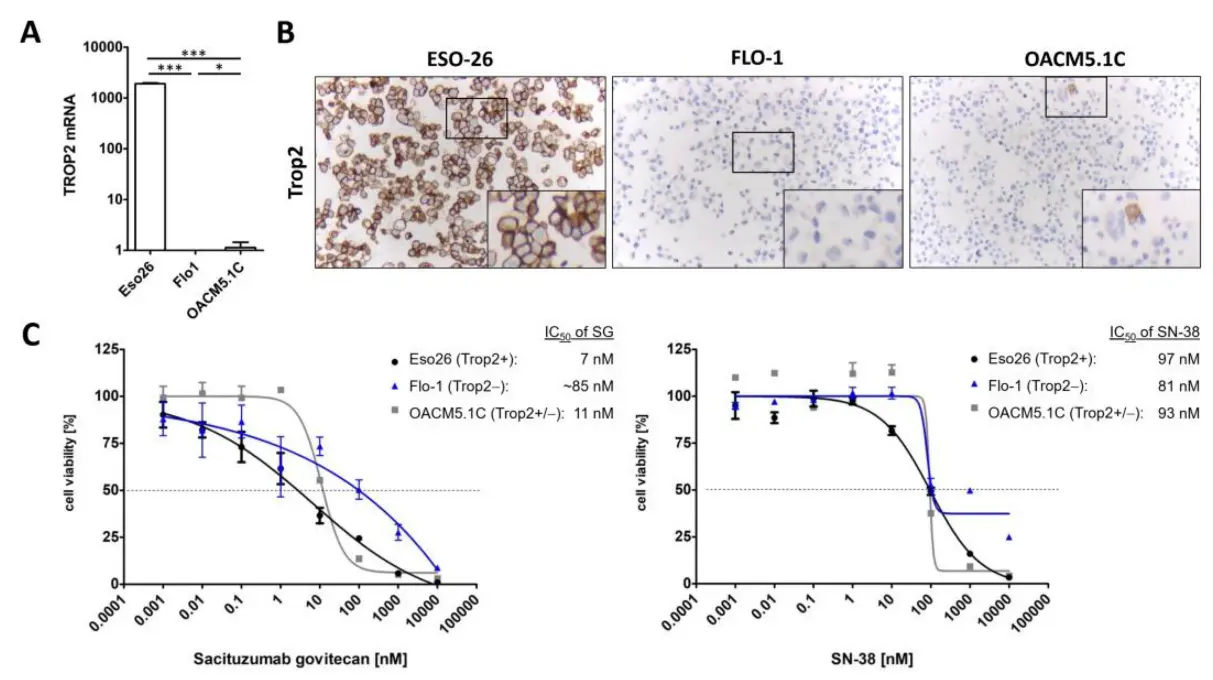
Established esophageal adenocarcinoma cell lines Eso26, OACM 5.1C and Flo1 were used as a model to demonstrate the relevance of TROP2 expression levels to the effectiveness of treatments with sacituzumab govitecan (SG). Analysis of the TROP2 expression in these cells showed that Eso26 homogenously expresses high levels of TROP2 mRNA and protein, while Flo1 lacks TROP2 expression. OACM 5.1C shows a low-level mRNA expression as well as just a few TROP2-positive tumor cells (Fig. 1A, B). The dilution series of SG showed a ~15-fold decreased response for the TROP2 negative cell line Flo1 compared to TROP2 positive Eso26 (Fig. 1C). SN-38, the active compound of the antibody–drug conjugate SG alone, has little effect equally on both cell lines, demonstrating the protein-dependence of SG. The FLO-1 cell line has a special delayed growth behavior with rapid progression compared to the early onset Eso26 with a similar rapid progression. Together, in vitro experiments show differential efficacy of SG to inhibit EAC cell lines with a positive correlation to TROP2 expression levels.
Ask a Question
Write your own review
- You May Also Need
Description: Human moderately differentiated squamous cell carcinoma cell line established from esophageal cancer.
Description: Human moderately differentiated squamous cell carcinoma cell line established from esophageal cancer.
Description: Human moderately differentiated squamous cell carcinoma cell line established from esophageal cancer.
Description: Human squamous cell carcinoma from oral cavity via mouse transplantation.
Description: Human squamous cell carcinoma cell line established from recurrent cancer (esophageal cancer).
- Adipose Tissue-Derived Stem Cells
- Human Neurons
- Mouse Probe
- Whole Chromosome Painting Probes
- Hepatic Cells
- Renal Cells
- In Vitro ADME Kits
- Tissue Microarray
- Tissue Blocks
- Tissue Sections
- FFPE Cell Pellet
- Probe
- Centromere Probes
- Telomere Probes
- Satellite Enumeration Probes
- Subtelomere Specific Probes
- Bacterial Probes
- ISH/FISH Probes
- Exosome Isolation Kit
- Human Adult Stem Cells
- Mouse Stem Cells
- iPSCs
- Mouse Embryonic Stem Cells
- iPSC Differentiation Kits
- Mesenchymal Stem Cells
- Immortalized Human Cells
- Immortalized Murine Cells
- Cell Immortalization Kit
- Adipose Cells
- Cardiac Cells
- Dermal Cells
- Epidermal Cells
- Peripheral Blood Mononuclear Cells
- Umbilical Cord Cells
- Monkey Primary Cells
- Mouse Primary Cells
- Breast Tumor Cells
- Colorectal Tumor Cells
- Esophageal Tumor Cells
- Lung Tumor Cells
- Leukemia/Lymphoma/Myeloma Cells
- Ovarian Tumor Cells
- Pancreatic Tumor Cells
- Mouse Tumor Cells