
Mouse Placental Chorionic Trophoblast Cells
Cat.No.: CSC-C5421S
Species: Mouse
Source: Chorion; Placenta
Cell Type: Trophoblast
- Specification
- Background
- Scientific Data
- Q & A
- Customer Review
Mouse placental chorionic trophoblast cells from Creative Bioarray are isolated from the mouse placental tissue. The method we use to isolate mouse placental chorionic trophoblast cells was developed based on a combination of established and our proprietary methods. The mouse placental chorionic trophoblast cells are characterized by immunofluorescence with antibodies specific to pan-cytokeratin (PCK). Each vial contains 0.5x10^6 cells per ml and is delivered frozen.
Mouse Placental Chorionic Trophoblast Cells are cells that originate from trophoblast cells. They are chorionic cells collected from the placenta of mice. The chorionic trophoblasts are specialized cells of the trophectoderm that are derived from the inner cell mass. Chorionic trophoblast cells are responsible for much of the organization of the placenta during development. These cells can usually be grown as an adherent cell line that resembles epithelial cells and can grow to confluence as a monolayer with tight junctions between the cells. They express cytokeratin-7 (CK7), E-cadherin, GATA3, and trophoblast transcription factors including CDX2 and ELF5. Depending on how they are cultured, mouse placental chorionic trophoblast cells can also be differentiated into syncytiotrophoblast-like cells or invasive trophoblast cells.
Mouse placental chorionic trophoblast cells have been used to study placental development and can serve many purposes. As stated before, they have been used to study proliferation, differentiation, invasion, and cellular signaling pathways of trophoblast cells. These cells secrete hormones and help maintain maternal immune privilege. Disorders that they can help study include preeclampsia, intrauterine growth restriction (IUGR), and placental insufficiency. They can also be used to study maternal-fetal exchange, transport across the placenta, toxicology including drug toxicity, xenobiotics, and microbiome studies.
Trem2 Modulates the Migration, Invasion, and Proliferation of Trophoblast Cells
Decidual macrophages are essential for normal pregnancy but are key targets of Toxoplasma gondii (T. gondii) in adverse pregnancy outcomes. Trem2, a macrophage surface receptor, recognizes pathogens, but its role in T. gondii infection remains unclear. Wang's team investigated how Trem2 regulates decidual macrophage function during T. gondii infection and its potential as a therapeutic target.
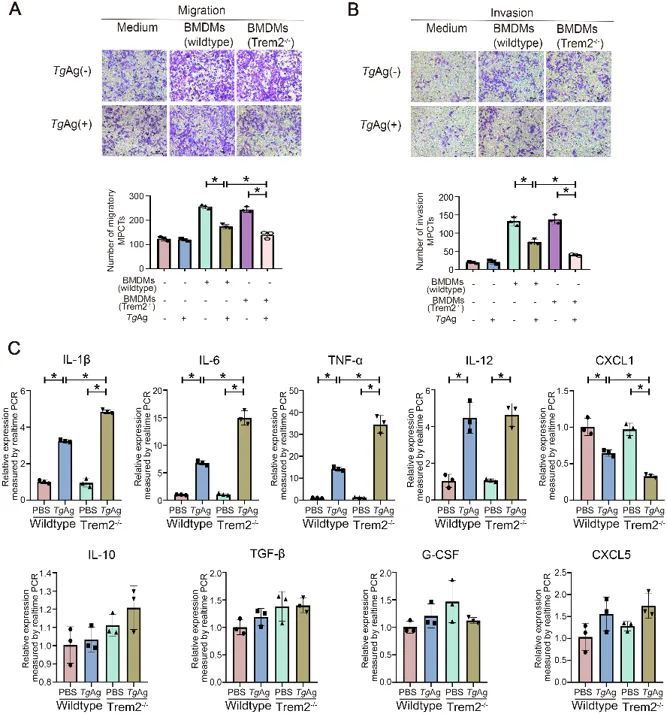
Trem2 deficiency in bone marrow-derived macrophages (BMDMs) enhanced T. gondii antigen (TgAg)-induced trophoblast inhibition, with elevated pro-inflammatory cytokines (IL-1β, IL-6, TNF-α) but reduced CXCL1. To confirm Trem2's role in TgAg-mediated macrophage-trophoblast crosstalk, BMDMs from Trem2⁻/⁻ mice were co-cultured with mouse placental chorionic trophoblast cells (MPCTs), followed by migration and invasion assays (Fig. 1A, B). Consistently, macrophages promoted trophoblast migration and invasion, whereas TgAg alone had no direct effect on trophoblast behavior. However, TgAg inhibited trophoblast function by modulating macrophages. Notably, Trem2 deficiency in macrophages heightened TgAg's inhibitory effects on trophoblast migration and invasion. These results confirm that Trem2 deficiency aggravates TgAg-induced impairment of macrophage-trophoblast crosstalk.
Ask a Question
Write your own review
Description: C57BL/6-GFP Mouse Skeletal Muscle Microvascular Endothelial Cells from Creative Bioarray are isolated from C57BL/6-Tg (CAG-EGFP) 1Osb/J mouse skeletal muscle tissue of pathogen-free laboratory mice. ...
Description: eNOS KO Mouse Stomach Epithelial Cells from Creative Bioarray are isolated from stomach tissue of pathogen-free laboratory mice. eNOS KO Mouse Stomach Epithelial Cells are grown in a T25 tissue ...
Description: eNOS KO Mouse Liver Fibroblasts from Creative Bioarray are isolated from liver tissue of pathogen-free laboratory mice. eNOS KO Mouse Liver Fibroblasts are grown in T75 tissue culture flasks ...
Description: C57BL/6-GFP Mouse Corneal Epithelial Cells from Creative Bioarray are isolated from C57BL/6-GFP-Tg(CAG-EGFP)1Osb/J mouse corneal tissue of pathogen-free laboratory mice. C57BL/6-GFP Mouse Corneal ...
Description: BALB/c Mouse Retinal Microvascular Endothelial Cells from Creative Bioarray are isolated from retinal tissue of pathogen-free laboratory mice. BALB/c Mouse Retinal Microvascular Endothelial Cells are ...