
Normal PB CD4+/CD45RO+ Memory T Cells
Cat.No.: CSC-C4432X
Species: Human
Source: Peripheral Blood; Blood
Cell Type: T Cell; Lymphocyte
- Specification
- Background
- Scientific Data
- Q & A
- Customer Review
Normal PB CD4+/CD45RO+ Memory T Cells are human memory T cells from peripheral blood of healthy donors. These cells are CD4 positive and carry the memory related marker CD45RO, defining a population of antigen experienced T cells that have already been exposed to immunological activation. CD45RO+ memory T cells are more susceptible to antigen re-exposure than naïve T cells and can rapidly activate effector activities upon activation.
The normal PB CD4+/CD45RO+ Memory T Cells are frequently utilized to study the mechanisms of the adaptive immunity, T-cell memory formation and immune control. They can be used to study antigen memory responses, cytokine production, T cell activation and signal transduction pathways. These cells are also used in research on vaccine-induced immunity, infectious illnesses, inflammation, autoimmune disorders and cancer immunology.
Recent studies have demonstrated that human CD4+ memory T lymphocytes have unique transcriptional, epigenetic and metabolic features that contribute to their long-term maintenance and functional responsiveness. They are often used in investigations to examine the maintenance of immunological memory, cell metabolism and T cell subset development under controlled culture conditions.
Tissue-Resident Memory T Cells Show Site-Specific Distribution and Stable Clonality with Aging
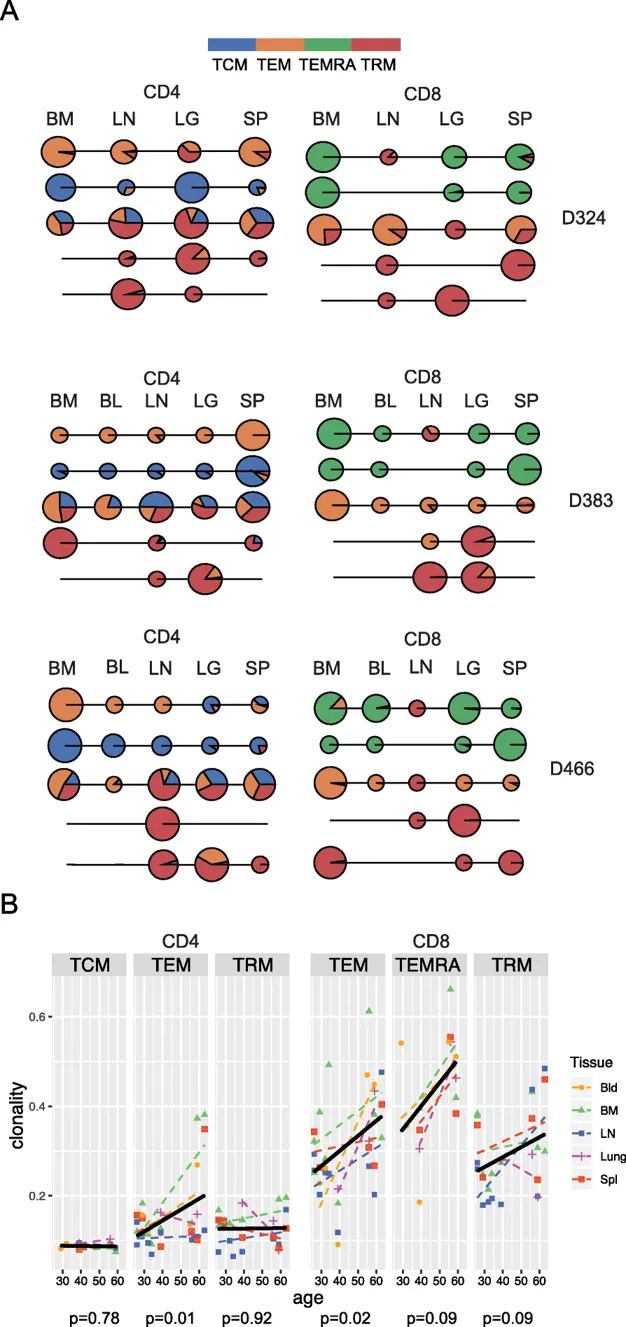
The relationship between circulating and tissue-resident T cell subsets in humans remains incompletely understood. To address this, Miron et al. analyzed TCR clonal distribution across multiple tissues (lung, BM, LN, spleen) from three donors.
Line-circle plots tracking large individual clones revealed distinct patterns (Fig. 1A). Circulating TEM/TCM (CD4⁺) and TEMRA/TEM (CD8⁺) clones were often shared across sites, whereas TRM clones were predominantly enriched in single tissues-lung, BM, LN, or spleen-suggesting site-specific clonal maintenance.
To assess TRM stability, they examined clonality changes with age. Consistent with blood, CD4⁺ and CD8⁺ TEM clonality increased significantly with age across all sites (Fig. 1B). In contrast, CD4⁺TRM and CD8⁺TRM clonality remained constant with aging, as did CD4⁺TCM. This absence of age-associated clonal expansion indicates that tissue-resident memory T cells are stably maintained without ongoing homeostatic proliferation, supporting their role as durable, localized cellular reservoirs for long-term immunological memory.
Ask a Question
Write your own review
Description: NPB CD4+ Helper T cells are negatively isolated from mononuclear cells using an indirect immunomagnetic CD4+ T cell labeling system.
Description: Cord Blood-Pan T cells are negatively isolated from mononuclear cells, using an indirect immunomagnetic Pan T labeling system.
Description: First, NPB-CD4+ T Cells are negatively isolated using immunomagnetic CD4+ isolation kit from mononuclear cells. Next, CD45RO MicroBeads are used to deplete the CD45RO+ cell population, leaving an ...
Description: Chronic Lymphoid Leukemia-PB-CD19+/CD5+ B cells are isolated from Chronic Lymphoid Leukemia bone marrow mononuclear cells using a direct immunomagnetic CD19+ Micro- Bead labeling system. Available in ...
Description: Untouched NPB-CD19+ B Cells are negatively isolated from mononuclear cells using an indirect immunomagnetic labeling system.
Description: NPB-CD19+/CD27+ memory B cells are negatively isolated from Mononuclear Cells using immunomagnetic isolation system to deplete non-memory B cells