
BFTC-905
Cat.No.: CSC-C0413
Species: Homo sapiens (Human)
Source: Bladder
Morphology: epitheloid cells growing adherently in monolayers, forming large islets
Culture Properties: monolayer
- Specification
- Background
- Scientific Data
- Q & A
- Customer Review
Immunology: cytokeratin +, cytokeratin-7 +, cytokeratin-8 +, cy
BFTC-905 is a well-characterized human bladder carcinoma cell line established in 1990 from a grade III papillary transitional cell carcinoma of the urinary bladder in a 51-year-old female patient. The cells exhibit an adherent, epithelioid morphology, forming large islets in monolayer culture. Karyotypically, BFTC-905 displays a hyperdiploid/hypotriploid profile with multiple structural aberrations, including i(5p), loss of 9p, and a unique homogeneously staining region at 11q13-amplification of which has been detected in 20% of transitional cell carcinomas. Genetically, the cell line harbors a heterozygous NRAS Q61L mutation and a homozygous TP53 splice acceptor mutation.
A defining advantage of BFTC-905 is its derivation from a non-invasive papillary carcinoma, making it a rare and valuable model for studying early-stage bladder cancer progression. Notably, BFTC-905 has been developed into a unique progression series comprising three daughter lines-BFTC-905-compact, BFTC-905-diffuse, and BFTC-905-diffuse M-which exhibit dynamic changes in E-cadherin expression and complex karyotypic evolution. The diffuse M variant acquired anchorage-independent growth in soft agar, while all three lines remained non-invasive. This progression series, unparalleled among published bladder cancer models, offers critical insights into early transformation events.
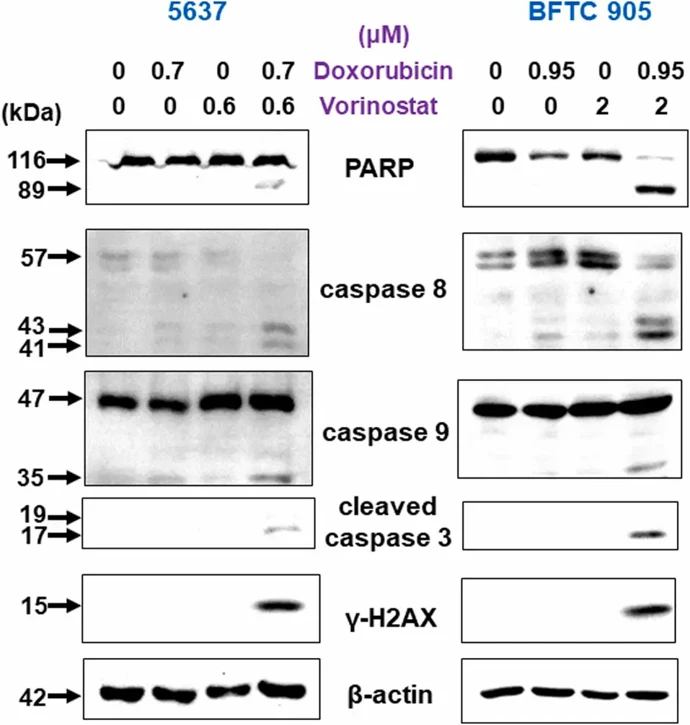
The Synergistic Cytotoxicity of Combining Doxorubicin with Vorinostat Induces Cell Death Via the Apoptotic Pathway
Doxorubicin is one of the effective cytotoxic drugs used in intravesical and systemic therapy, but its cardiotoxicity and nephrotoxicity limit therapeutic dosages. Vorinostat is an anticancer drug used to treat cutaneous T-cell lymphoma, and it demonstrates potent combination effects in various anticancer treatments. We aim to investigate the combined effects and mechanisms of doxorubicin and vorinostat in human bladder cancer cells.
Human bladder cancer cells (5637 and BFTC 905) were used in this study. Under the combined doses of 0.7 μM doxorubicin and 0.6 μM vorinostat in 5637 cells, and 0.95 μM doxorubicin and 2 μM vorinostat in BFTC 905 cells, we examined the apoptotic-related factors by Western blot. These factors included cleaved caspase-8, cleaved caspase-9, cleaved caspase-3, poly(ADP-ribose) polymerase (PARP) and a marker for DNA strand break, γ-H2AX. It shows that only the combined treatment induced significant cleavage of PARP (89 kDa), caspase 8 (43 kDa and 41 kDa), caspase 9 (35 kDa), and caspase 3 (19 kDa and 17 kDa) (Fig. 1). The combined treatment also induced γ-H2AX (15 kDa) expression, indicating that DNA strands were broken (Fig. 1). These findings suggest that the combination of doxorubicin with vorinostat could potentially serve as a new treatment regimen for urothelial bladder cancer, for avoiding the high-dose side effect of doxorubicin.
Ask a Question
Write your own review
- You May Also Need
Description: Contains the unusual type A isoenzyme of glucose-6-phosphate dehydrogenase.
Description: Species: human - male, 44 years old, CaucasianTumorigenecity: yes, in mice and hamstersIsoenzyme: G6PD, BProduction: fibrinolytic activityHistopathology: carcinomaNote: the cells will grow in soft ...
Description: Species: human - female, 58 years old, CaucasianTumorigenecity: yes, in mice and hamstersIsoenzyme: G6PD,BProduction: fibrinolytic activity; interferonHistopathology: carcinoma; cancer; Grade 3Note: ...
Description: Established from the bladder tumor of an 84-year-old Caucasian woman following transurethral tumor resection in 1977
Description: Species: human - male, 58 years old, Caucasian, SwedishTumorigenecity: noIsoenzyme: Me-2, 1-2; PGM3, 2; PGM1, 1; ES-D, 1; AK-1, 1; G6PD, B; GLO-1Histopathology: carcinoma, transitional cell
Description: Derived from malignant ascitic fluid of a 75-year-old man with urinary bladder carcinoma in 1988; described as being of epithelial origin with morphologically distinct cells (polygonal to ...
- Adipose Tissue-Derived Stem Cells
- Human Neurons
- Mouse Probe
- Whole Chromosome Painting Probes
- Hepatic Cells
- Renal Cells
- In Vitro ADME Kits
- Tissue Microarray
- Tissue Blocks
- Tissue Sections
- FFPE Cell Pellet
- Probe
- Centromere Probes
- Telomere Probes
- Satellite Enumeration Probes
- Subtelomere Specific Probes
- Bacterial Probes
- ISH/FISH Probes
- Exosome Isolation Kit
- Human Adult Stem Cells
- Mouse Stem Cells
- iPSCs
- Mouse Embryonic Stem Cells
- iPSC Differentiation Kits
- Mesenchymal Stem Cells
- Immortalized Human Cells
- Immortalized Murine Cells
- Cell Immortalization Kit
- Adipose Cells
- Cardiac Cells
- Dermal Cells
- Epidermal Cells
- Peripheral Blood Mononuclear Cells
- Umbilical Cord Cells
- Monkey Primary Cells
- Mouse Primary Cells
- Breast Tumor Cells
- Colorectal Tumor Cells
- Esophageal Tumor Cells
- Lung Tumor Cells
- Leukemia/Lymphoma/Myeloma Cells
- Ovarian Tumor Cells
- Pancreatic Tumor Cells
- Mouse Tumor Cells