
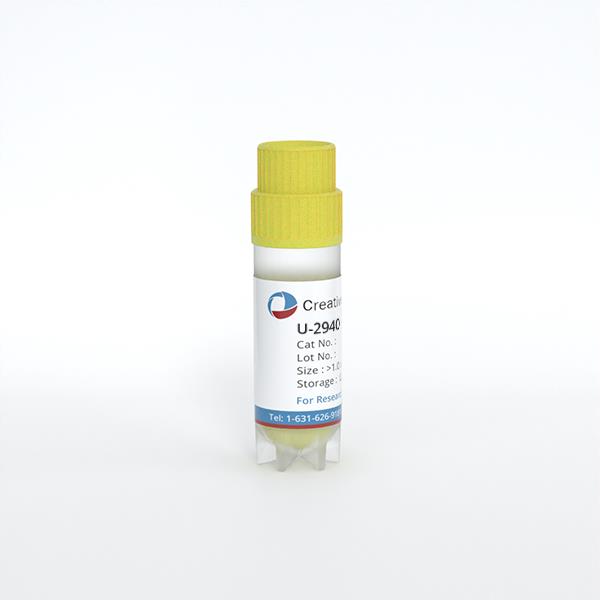
U-2940
Cat.No.: CSC-C0625
Species: Homo sapiens (Human)
Source: Pleural Effusion
Morphology: small round cells growing singly and in clusters in suspension
Culture Properties: suspension
- Specification
- Background
- Scientific Data
- Q & A
- Customer Review
Immunology: CD3 -, CD10 -, CD13 -, CD19 +, CD20 +, CD34 -, CD37 +, cyCD79a +, CD80 +, CD138 -, HLA-DR +, sm/cyIgG +, sm/cyIgM -, sm/cykappa +, cm/cylambda -
Viruses: PCR: EBV -, HBV -, HCV -, HIV
The U-2940 cell line is a human B-cell lymphoma line established in 1991 from the pleural effusion of an 18-year-old female patient. The patient had previously been diagnosed with Hodgkin lymphoma and treated with chemotherapy before developing diffuse large B-cell lymphoma (DLBCL). Recent molecular characterization classifies U-2940 as a Primary Mediastinal B-cell Lymphoma (PMBL) model.
Morphologically, the cells are small, round lymphocytes that grow in suspension, either singly or in clusters. They exhibit a mature B-cell phenotype, expressing markers such as CD19, CD20, CD37, cyCD79a, and HLA-DR, while testing negative for CD3, CD10, CD34, and CD138. The cell line is Epstein-Barr virus (EBV) negative and displays microsatellite instability. It possesses a hypodiploid karyotype with specific chromosomal deletions and rearrangements, including a homozygous microdeletion of the SOCS1 locus.
Culturally, U-2940 cells are maintained in a nutrient-rich basal medium supplemented with serum under standard conditions (37°C, 5% CO₂). With a doubling time of approximately 50 hours, they are sub-cultured via centrifugation and resuspension. U-2940 is a valuable tool for researching B-cell lymphomagenesis, genetic instability, and evaluating targeted therapies for PMBL and related lymphoid malignancies.
PMBL Harbors Widespread CN-LOH Events in Addition to Copy Number Alterations
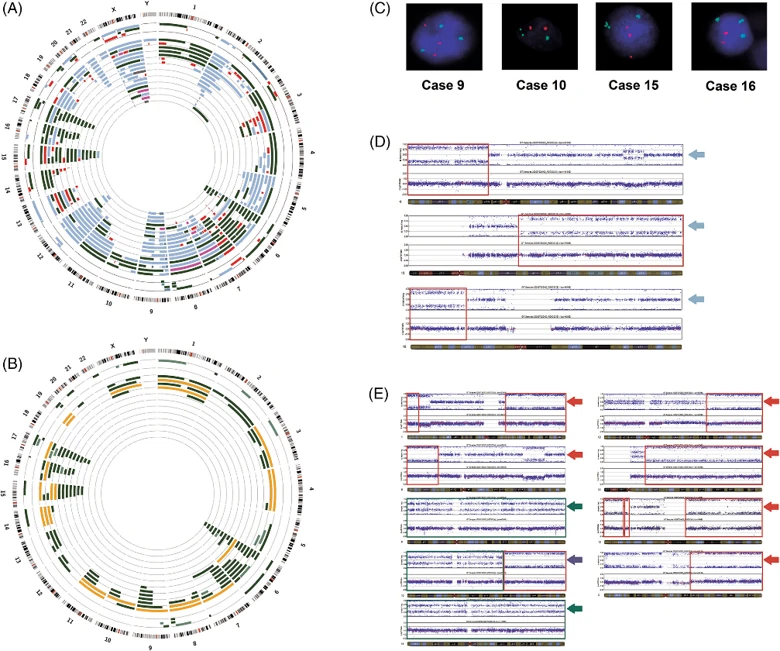
Primary mediastinal B-cell lymphoma (PMBL) is characterized by complex genomic alterations, yet the role of copy-neutral loss of heterozygosity (CN-LOH) remains undefined. Tuveri et al. characterized the CN-LOH architecture in PMBL using SNP array (SNPa) analysis of two cell lines and 33 patient samples (22 female, 11 male; mean age 34.3), distinguishing it from diffuse large B-cell lymphoma (DLBCL).
SNPa detected 12 extra-large CN-LOH regions in both Karpas 1106P and U-2940 cell lines. In patient specimens, 275 genomic imbalances were identified (gains > losses; prevalent at 9p24, 2p16, 12q). Crucially, 133 somatic CN-LOH segments were found, with 91% (30/33) of diagnostic samples harboring extra-large CN-LOH (>25 Mb) affecting all chromosomes except 18, 21, and 22 (Fig.1A, B). These lesions predominantly involved chromosomal segments (82%) rather than whole chromosomes (18%). FISH validation clarified ambiguous aberrations in samples with low tumor purity, confirming 5 CN-LOH and 6 gain regions (Fig. 1C).
Analysis of B-allele frequencies revealed that 11 cases shared identical CN-LOH values (suggesting a single hit or clonal selection), while 17 cases exhibited two distinct values, indicating sequential CN-LOH events (Fig. 1D, E). Segmental CN-LOH were predominantly associated with the first hit, whereas whole-chromosome CN-LOH occurred more frequently in subclonal events. These data highlight CN-LOH as a major mechanism driving homozygosity of recessive mutations in PMBL.
Ask a Question
Write your own review
- You May Also Need
Description: Established in 2007 from the bone marrow mononuclear cells of an 82-year-old Japanese man with diffuse large B-cell lymphoma in the leukemic phase
Description: Established from the bone marrow of a 28-year-old man who developed the terminal leukemic phase of lymphosarcoma in 1976
Description: This cell line was derived from the bone marrow aspirate of a 59 year old male with erythroleukemia that became acute myelogenous leukaemia.The cells form colonies in soft-agar in the presence of ...
Description: Established from the pleural effusion of a 24-year-old woman with recurrent anaplastic large cell lymphoma (ALCL); cells were described to clonally derive from T-lineage lymphoid cells and to be ...
Description: Established from a 37-year-old man at second (refractory/terminal) relapse of Hodgkin lymphoma (nodular sclerosing -> lymphocyte depleted/stage IIISA -> stage IV) after both combined chemo- and ...
Description: Established from the peripheral blood of a 10-year-old Caucasian boy with acute lymphoblastic leukemia (pre B-ALL) at diagnosis in 1993
- Adipose Tissue-Derived Stem Cells
- Human Neurons
- Mouse Probe
- Whole Chromosome Painting Probes
- Hepatic Cells
- Renal Cells
- In Vitro ADME Kits
- Tissue Microarray
- Tissue Blocks
- Tissue Sections
- FFPE Cell Pellet
- Probe
- Centromere Probes
- Telomere Probes
- Satellite Enumeration Probes
- Subtelomere Specific Probes
- Bacterial Probes
- ISH/FISH Probes
- Exosome Isolation Kit
- Human Adult Stem Cells
- Mouse Stem Cells
- iPSCs
- Mouse Embryonic Stem Cells
- iPSC Differentiation Kits
- Mesenchymal Stem Cells
- Immortalized Human Cells
- Immortalized Murine Cells
- Cell Immortalization Kit
- Adipose Cells
- Cardiac Cells
- Dermal Cells
- Epidermal Cells
- Peripheral Blood Mononuclear Cells
- Umbilical Cord Cells
- Monkey Primary Cells
- Mouse Primary Cells
- Breast Tumor Cells
- Colorectal Tumor Cells
- Esophageal Tumor Cells
- Lung Tumor Cells
- Leukemia/Lymphoma/Myeloma Cells
- Ovarian Tumor Cells
- Pancreatic Tumor Cells
- Mouse Tumor Cells