
Volume of Distribution vs. Clearance
In pharmacokinetics, volume of distribution (Vd) and clearance (CL) are two fundamental parameters used to characterize the disposition of a drug in the body. Although both influence drug concentration over time, they describe different processes: Vd reflects the apparent extent of drug distribution, while CL indicates how efficiently the body eliminates a drug.
Understanding the differences between these parameters is essential for interpreting pharmacokinetic profiles, predicting drug half-life, and evaluating candidate compounds during drug development. This article explains how Vd and CL are defined, how they interact, and how they are assessed in DMPK studies.
What Are Volume of Distribution and Clearance?
Volume of Distribution (Vd)
Volume of distribution is an apparent pharmacokinetic parameter that describes the relationship between the total amount of drug in the body and its concentration in plasma. It helps indicate the extent to which a drug distributes beyond the bloodstream into tissues.
Vd is calculated using the following equation:
Vd =Abody / Cp
Where:
- (Vd): Apparent volume of distribution
- (Abody): Total amount of drug in the body
- (Cp): Plasma drug concentration
Vd is commonly expressed in liters (L) or liters per kilogram (L/kg).
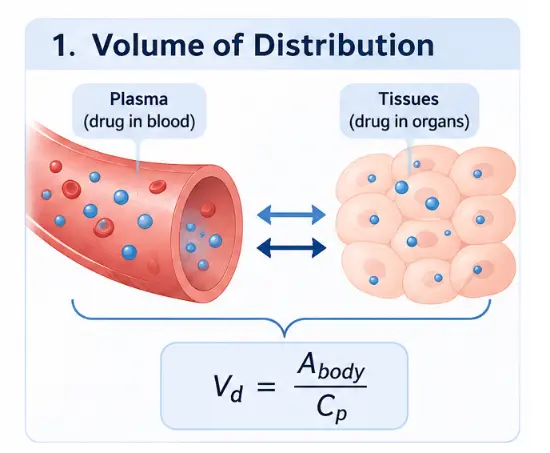
A relatively low Vd may indicate that a drug remains primarily in the bloodstream, whereas a higher Vd may suggest greater distribution into tissues or extensive tissue binding. However, Vd is an apparent volume rather than a measurement of actual anatomical space.
Several factors influence Vd, including plasma protein binding, tissue binding, lipophilicity, ionization, and membrane permeability.
Clearance (CL)
Clearance describes the apparent volume of plasma or blood from which a drug is completely removed per unit of time. It reflects the overall efficiency of drug elimination through metabolic and excretory pathways.
Clearance can be expressed as:
CL = Elimination Rate / Cp
For intravenous administration under linear pharmacokinetic conditions, systemic clearance can also be calculated as:
CL = DoseIV / AUC0-∞
Where:
(CL): Systemic clearance
(DoseIV): Intravenous dose
(AUC0-∞): Area under the plasma concentration-time curve from time zero to infinity
Clearance is typically expressed in mL/min, L/h, or mL/min/kg.
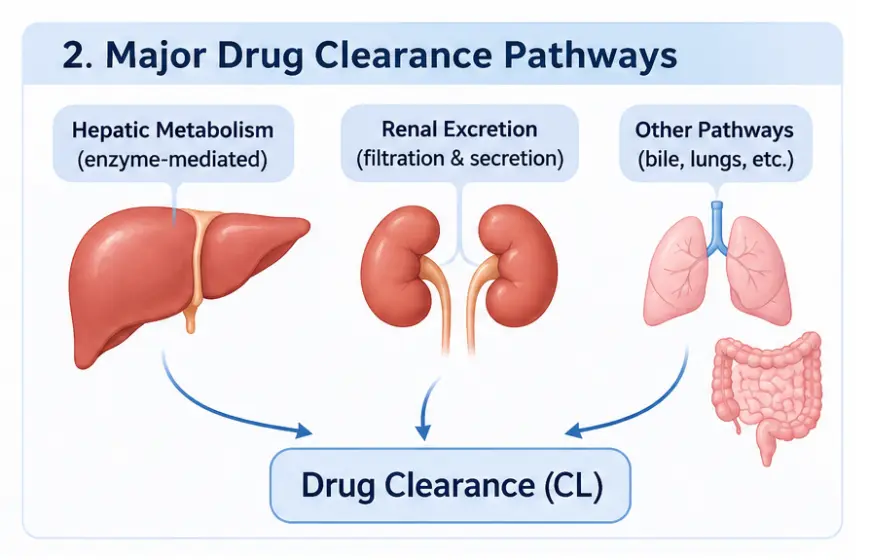
Drug clearance primarily occurs through hepatic metabolism and renal excretion, although extrahepatic metabolism and other elimination pathways may also contribute. Enzyme activity, organ function, transporter activity, and plasma protein binding can all influence clearance.
Volume of Distribution vs. Clearance: Key Differences
Although Vd and CL are both used to describe drug disposition, they represent distinct pharmacokinetic properties.
| Comparison | Volume of Distribution (Vd) | Clearance (CL) |
|---|---|---|
| Main function | Describes apparent drug distribution | Describes drug elimination efficiency |
| Physiological meaning | Relationship between drug amount in the body and plasma concentration | Apparent volume of plasma or blood cleared per unit time |
| Typical units | L, L/kg | L/h, mL/min, mL/min/kg |
| Major influencing factors | Plasma protein binding, tissue binding, lipophilicity, membrane permeability | Enzyme activity, organ function, transporters, protein binding |
| PK significance | Influences distribution and elimination half-life | Determines systemic drug elimination and exposure |
| Common assessment | Pharmacokinetic concentration data | Plasma concentration-time profiles and AUC |
The key distinction is that Vd describes where a drug distributes, whereas CL describes how efficiently it is eliminated.
These parameters are not directly interchangeable. A drug with a high Vd does not necessarily have a high clearance, and a low clearance does not automatically indicate a small Vd. Their relationship depends on the compound's physicochemical properties, biological interactions, and elimination pathways.
How Vd and CL Work Together to Determine Drug Half-Life
Although c and CL describe different processes, they are closely related through the elimination half-life of a drug.
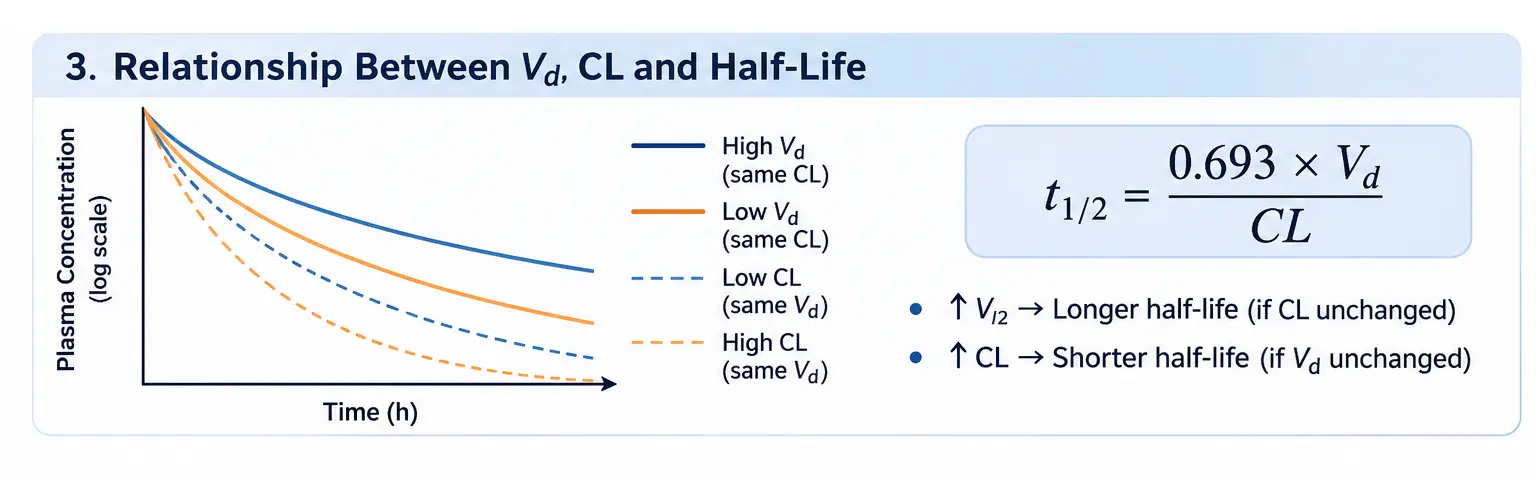
For a drug following linear pharmacokinetics in an appropriate one-compartment model, the relationship is:
t1/2 = (0.693 × Vd) / CL
Where:
- (t1/2): Elimination half-life
- (Vd): Apparent volume of distribution
- (CL): Systemic clearance
This equation shows that half-life depends on both the extent of distribution and the rate of elimination.
- Increased Vd with unchanged CL: More drug is distributed outside the plasma compartment, generally resulting in a longer half-life.
- Decreased Vd with unchanged CL: A smaller apparent distribution volume generally results in a shorter half-life.
- Increased CL with unchanged Vd: Faster elimination generally shortens the half-life.
- Decreased CL with unchanged Vd: Slower elimination generally prolongs the half-life.
For example, consider two compounds with similar clearance but different distribution characteristics. If Compound A has a higher Vd than Compound B, Compound A would generally have a longer elimination half-life under the same pharmacokinetic assumptions.
However, in multicompartment models, the terminal half-life may also be influenced by distribution between plasma and tissues. Therefore, the equation should be interpreted in the context of the selected pharmacokinetic model.
How Are Vd and CL Evaluated in Drug Development?
Vd and CL are commonly derived from pharmacokinetic studies that characterize drug concentration changes over time. These studies help researchers understand systemic exposure, distribution behavior, and elimination characteristics.
Pharmacokinetic Studies
A typical in vivo PK study involves several steps:
- Compound administration: The test compound is administered to an appropriate animal model, often including an intravenous dosing group for systemic clearance assessment.
- Sample collection: Blood samples are collected at predefined time points after administration.
- Bioanalysis: Plasma drug concentrations are quantified, commonly using LC-MS/MS.
- PK analysis: Concentration-time profiles are generated, and parameters such as AUC, CL, Vd, and half-life are calculated using non-compartmental analysis (NCA) or appropriate compartmental models.
For intravenous administration, systemic clearance is calculated from dose and AUC. Vd can be estimated using PK parameters, with the specific calculation depending on the model and definition used. For example, in non-compartmental analysis, the terminal-phase volume of distribution (Vz) is commonly calculated as:
Vz = CL / λz
Where (λz) is the terminal elimination rate constant.
Factors Influencing Vd and CL
Understanding the factors that influence these parameters helps explain differences in pharmacokinetic behavior between compounds.
Factors influencing Vd include:
- Plasma protein binding and tissue binding
- Lipophilicity and ionization state
- Membrane permeability
- Tissue composition and physiological characteristics
Factors influencing CL include:
- Hepatic metabolic enzyme activity
- Renal filtration and active secretion
- Drug transporter activity
- Plasma protein binding
- Hepatic and renal function
In vitro ADME assays can provide complementary information during early drug development. For example, microsomal stability studies help assess metabolic stability and potential hepatic metabolic liabilities, while hepatocyte assays provide broader information on cellular drug metabolism. Plasma protein binding studies help characterize the unbound fraction, which can influence both distribution and elimination.
These in vitro assessments support pharmacokinetic interpretation and prediction but cannot independently replace in vivo determination of Vd and systemic CL.
Why Vd and CL Matter in Drug Candidate Selection
Evaluating Vd and CL together provides a more complete understanding of a candidate compound's pharmacokinetic properties.
Drug Exposure
Clearance is a major determinant of systemic drug exposure. Under linear intravenous conditions, lower clearance generally corresponds to higher AUC at the same dose. Vd provides complementary information about the relationship between plasma concentration and the amount of drug distributed throughout the body.
Dosing Strategy
Vd and CL jointly influence elimination half-life, which is an important consideration when determining dosing intervals and maintaining appropriate drug exposure. Other factors, including bioavailability, absorption, and the therapeutic window, must also be considered.
Candidate Optimization
During lead optimization, differences in Vd and CL may help identify potential pharmacokinetic limitations. For example, a compound with rapid clearance may require further investigation into metabolic stability, while an unexpectedly high Vd may indicate extensive tissue distribution. Whether these characteristics are desirable depends on the intended therapeutic target and development strategy.
By integrating Vd, CL, half-life, AUC, and other ADME properties, researchers can compare candidate compounds and make more informed decisions during drug selection.