
In Vitro ADME vs In Vivo PK: Why Do Results Diverge?
A compound can show favorable permeability, metabolic stability, and protein binding in vitro, yet demonstrate unexpectedly high clearance, low exposure, or a short half-life in vivo. This apparent mismatch is common in drug discovery and does not necessarily indicate that an individual assay has failed.
The reason is that in vitro ADME assays examine specific drug disposition processes under controlled conditions, while in vivo pharmacokinetics (PK) reflects their combined effects within a physiological system. Absorption, metabolism, transport, distribution, excretion, protein binding, and species-specific biology can all influence the final concentration-time profile.
Understanding where this translation gap occurs is important for interpreting PK results and determining which additional studies can explain unexpected in vivo behavior.
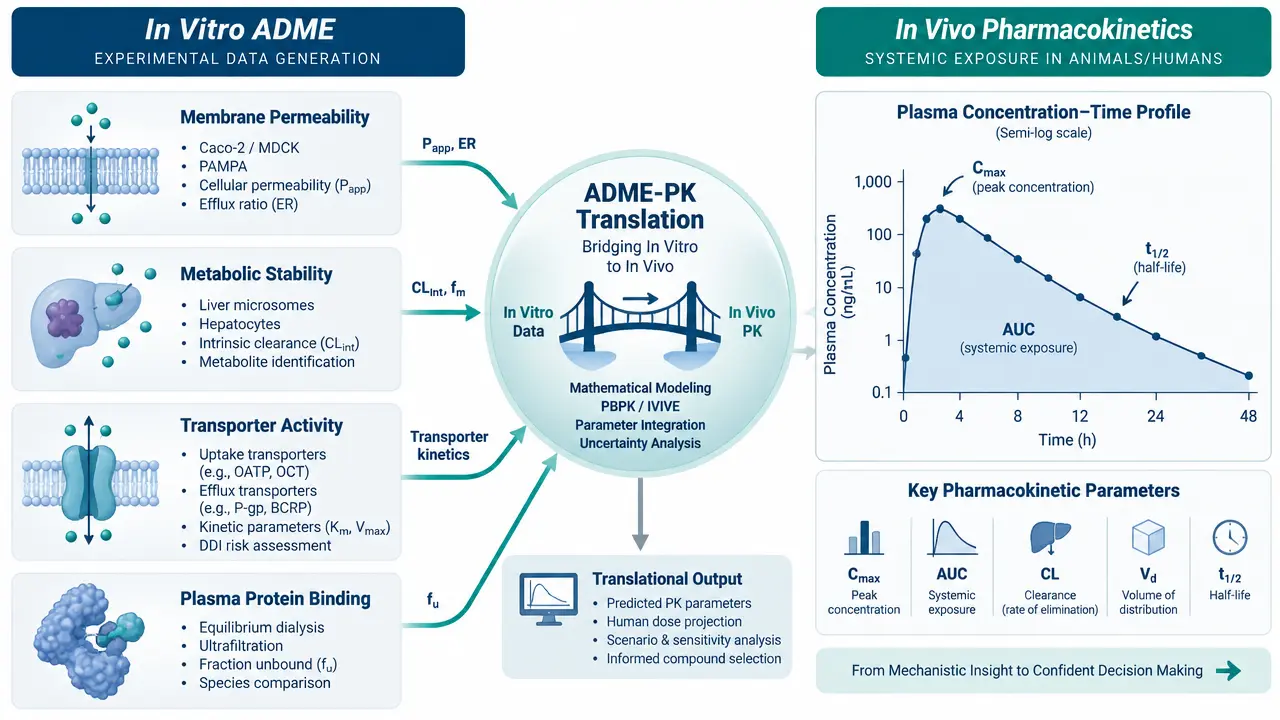
In Vitro ADME and In Vivo PK: What Does Each Tell You?
In vitro ADME studies provide mechanistic information about individual processes that influence drug disposition. Depending on the development stage, these studies may assess permeability, solubility, metabolic stability, transporter activity, plasma protein binding, or other properties.
In vivo PK, in contrast, describes the integrated behavior of a compound following administration. Key parameters such as clearance (CL), volume of distribution (Vd), exposure (AUC), maximum concentration (Cmax), and half-life (t½) reflect the combined contribution of multiple processes.
| In Vitro ADME | In Vivo PK |
|---|---|
| Individual disposition processes | Integrated drug disposition |
| Controlled experimental conditions | Physiological environment |
| Permeability, stability, binding, transport | AUC, Cmax, CL, Vd, t½ |
| Mechanistic information | Observed systemic exposure |
Therefore, in vitro ADME should not be viewed as a direct substitute for in vivo PK. Instead, it provides the mechanistic building blocks needed to anticipate, interpret, and refine PK behavior.
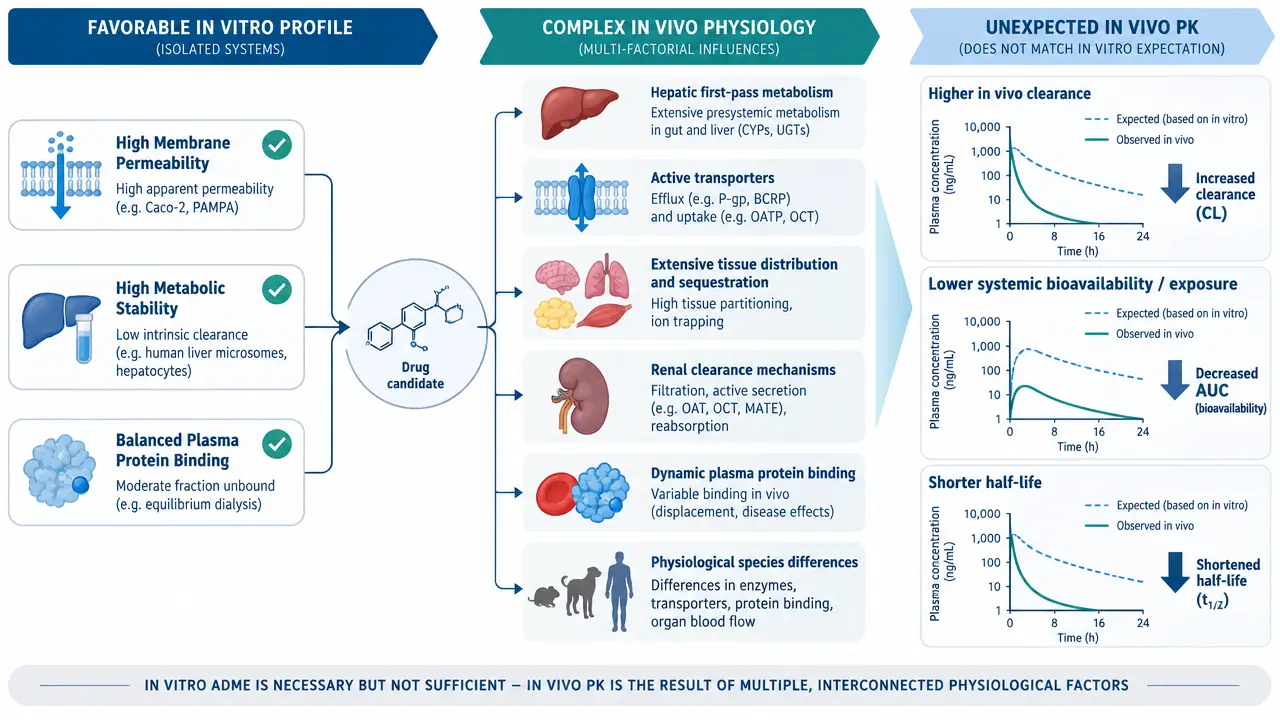
When Do In Vitro ADME and In Vivo PK Diverge?
1. Good Metabolic Stability but High In Vivo Clearance
A compound may show good stability in liver microsomes or hepatocytes but still exhibit higher-than-expected clearance in vivo.
One reason is that metabolic stability assays primarily characterize specific metabolic processes under defined conditions. They do not necessarily capture every route contributing to systemic elimination.
Renal clearance, active tubular secretion, transporter-mediated elimination, extrahepatic metabolism, and species-specific metabolic pathways may all contribute. Differences in plasma protein binding can also affect the fraction of unbound compound available for elimination.
This is why:
Low intrinsic clearance in vitro does not necessarily translate into low total clearance in vivo.
When this discrepancy occurs, additional hepatocyte studies, transporter evaluation, renal clearance assessment, or metabolite profiling may help determine which elimination pathway is contributing to the observed PK profile.
2. Good Permeability but Low Oral Exposure
High permeability is generally considered favorable for oral absorption, but it does not guarantee high oral bioavailability.
A compound must first dissolve and remain sufficiently stable in the gastrointestinal environment before reaching the intestinal epithelium. Efflux transporters can limit net absorption, while intestinal and hepatic first-pass metabolism can substantially reduce systemic exposure.
A simplified oral disposition pathway is:
Oral Dose → Dissolution → Intestinal Absorption → Intestinal First-Pass → Hepatic First-Pass → Systemic Exposure
Consequently, a compound with strong permeability may still show low oral exposure because of poor solubility, rapid intestinal metabolism, efflux, or high hepatic extraction.
This is an important distinction when interpreting permeability data: permeability is one component of absorption and bioavailability, not a standalone predictor of oral exposure.
3. Favorable ADME Results but Unexpected Half-Life
Half-life is often associated with metabolic stability, but it is determined by more than metabolism alone.
A useful relationship is:
t½ ≈ 0.693 × Vd / CL
Changes in either clearance or volume of distribution can therefore alter half-life.
For example, a compound with reasonable metabolic stability may still have a short half-life if systemic clearance is high. Conversely, extensive tissue distribution can increase the apparent volume of distribution and contribute to a longer half-life.
Plasma protein binding and tissue binding can further influence distribution and the relationship between circulating concentrations and total drug exposure.
When half-life does not match expectations from in vitro ADME data, evaluating clearance together with distribution and binding characteristics can provide a more complete explanation.
4. Species Differences Break the Translation
ADME-to-PK translation can also be affected by species-specific biology. Metabolic enzymes, transporters, plasma protein binding, renal function, and physiological parameters can differ substantially between experimental species.
As a result, an in vitro result generated using one biological system may not fully represent the dominant disposition mechanism in another species.
Species differences are particularly important when extrapolating PK findings toward human exposure. Cross-species ADME data, together with in vivo PK and appropriate PK modeling, can help distinguish compound-specific liabilities from species-dependent effects.
How to Investigate an ADME–PK Mismatch
When in vivo PK differs from expectations, repeating a broad ADME panel is not always the most informative approach. The first step is to identify the specific PK feature that diverged and then select studies that address the most likely mechanism.
| Observed PK Result | Potential Cause | Useful Follow-Up |
|---|---|---|
| High clearance | Metabolism, renal elimination, transport | Hepatocyte stability, CYP, transporter studies |
| Low oral exposure | Solubility, permeability, efflux, first-pass effect | Solubility, permeability, transporter assays |
| Short half-life | High CL or altered Vd | Protein/tissue binding, PK assessment |
| Nonlinear exposure | Saturable metabolism or transport | Dose-range PK, transporter/metabolism studies |
| Unexpected metabolites | Uncaptured metabolic pathways | Metabolite identification |
This diagnostic approach helps connect the observed PK phenotype with the underlying ADME mechanism.
For example, unexpectedly high clearance may prompt investigation of hepatic metabolism, renal elimination, or active transport. Low oral exposure may instead point toward solubility, permeability, efflux, or first-pass effects. Unexpected metabolites may require broader metabolic profiling rather than additional stability testing alone.
The objective is not simply to obtain more data, but to obtain the right data to explain the PK result.
From In Vitro ADME to In Vivo PK: A Translational Approach
Effective DMPK strategies integrate ADME studies rather than treating each assay as an isolated endpoint.
A typical translational workflow may include:
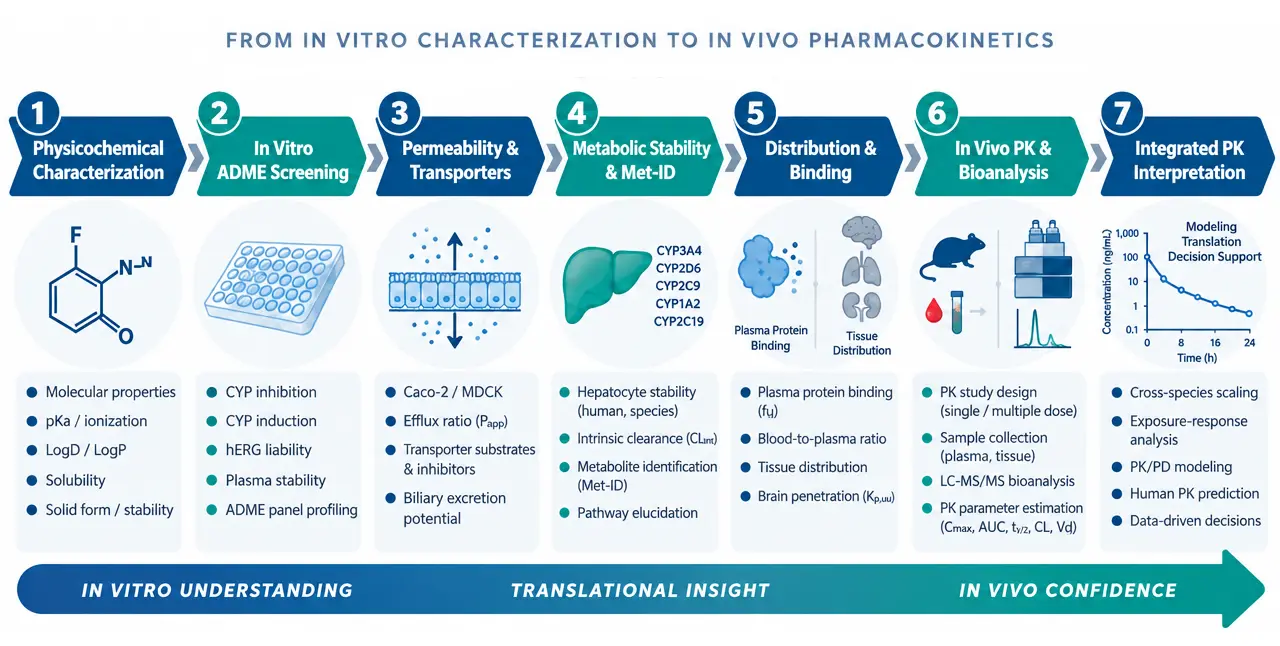
When discrepancies arise, targeted follow-up studies can then be used to refine the interpretation. This iterative approach can support compound prioritization, clarify unexpected PK behavior, and improve the translation of preclinical ADME findings into later development decisions.
Key Takeaways
- In vitro ADME and in vivo PK answer different questions. ADME studies characterize individual disposition processes, while PK captures their integrated outcome.
- Good in vitro results do not guarantee favorable in vivo exposure. Clearance, transport, distribution, binding, and species-specific factors can alter the final PK profile.
- An ADME–PK mismatch can be informative. It may reveal a disposition mechanism that was not captured by an individual assay.
- Follow-up studies should be hypothesis-driven. The most useful experiment depends on whether the observed issue involves clearance, exposure, half-life, nonlinearity, or metabolite formation.
Ultimately, the goal is not to make in vitro ADME and in vivo PK look identical, but to understand why they differ and what that difference means for compound development.
Frequently Asked Questions
Can in vitro ADME predict in vivo PK?
In vitro ADME data can support PK prediction, but they do not capture every physiological factor involved in drug disposition. Their value is strongest when multiple ADME parameters are integrated with physicochemical properties, species information, and PK modeling.
Why can in vitro clearance differ from in vivo clearance?
In vitro clearance estimates may not capture renal elimination, active transport, extrahepatic metabolism, tissue distribution, or species-specific physiology. These factors can contribute substantially to total in vivo clearance.
Does high permeability guarantee good oral bioavailability?
No. Oral bioavailability can also be limited by solubility, dissolution, intestinal stability, efflux transport, intestinal metabolism, and hepatic first-pass extraction.
What should I investigate when in vivo PK is worse than expected?
The appropriate follow-up depends on the specific PK discrepancy. High clearance, low oral exposure, short half-life, nonlinear PK, and unexpected metabolites each point toward different ADME investigations.
Understand the Gap Between ADME and PK
When in vitro ADME results do not translate as expected into in vivo PK, integrated DMPK studies can help identify the underlying mechanism and guide the next experimental step.
Explore our ADME and PK services to build a more translational drug disposition strategy.
Creative Bioarray Relevant Recommendations
| Products & Services | Description |
|---|---|
| Safety Evaluation Services | Creative Bioarray stands as a premier provider of comprehensive safety evaluation studies, adeptly serving a diverse spectrum of industries. Our expertise extends to a broad range of product categories, encompassing pharmaceuticals, cosmetics, and personal care items within the realm of daily chemical products, as well as disinfectants and food products |
| Drug Metabolism and Pharmacokinetics (DMPK) | Creative Bioarray provide comprehensive in vitro and in vivo DMPK solutions to support lead optimization, candidate selection, and regulatory submissions, accelerating the path from discovery to clinical development |