
From Shake Flask to Bioreactor: 7 Scale-Up Risks
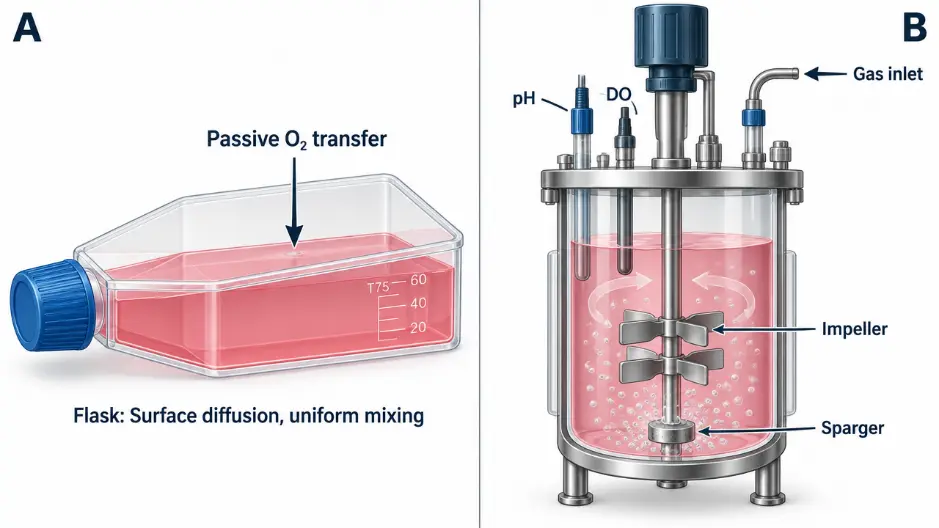
In a shake flask, culture feels deceptively simple: passive gas exchange at the surface, near-uniform mixing from orbital shaking, and the operator’s intuition filling in for any missing control loop. Move that same process into a stirred-tank bioreactor and the rules change completely. The bioreactor is not a "bigger flask." It is an actively controlled hydrodynamic system where impellers, spargers, pH loops, and CO₂ stripping reshape the cellular microenvironment.
Scale-up doesn’t fail because the biology mutates. It fails because the physics of the microenvironment is silently redesigned. You are not scaling volume—you are scaling a fluid-dynamic state.
Here are the seven things that break first.
1. Oxygen transfer collapses before cells ever look hypoxic
In a shake flask (250 mL, ~20% fill, 200–250 rpm), kLa typically sits at 20–80 h⁻¹ through surface diffusion alone. In a 2 L stirred tank with sparging, kLa jumps to 50–300 h⁻¹—but it is no longer passive, and it no longer scales intuitively.
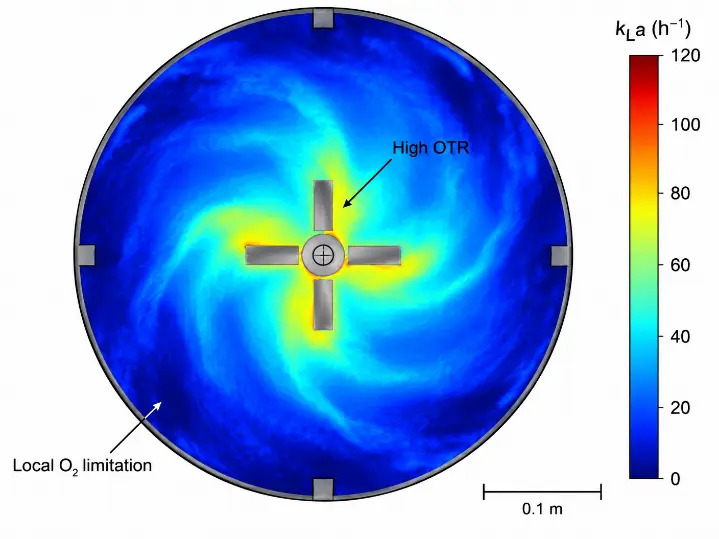
The failure mode is subtle:
- DO probe reads "fine" at the setpoint (e.g., 30% air saturation)
- But local OTR < OUR at peak VCD in zones away from the impeller
- Cells slip into silent oxygen limitation → lactate accumulates, oxidative stress rises, productivity drops
Oxygen transfer rate is:
OTR = kLa · (C* − C_L)
kLa depends on agitation (P/V) and aeration (superficial gas velocity, sparge geometry). It does not scale linearly with volume. A flask-optimized process rarely survives on "same rpm, same vvm."
Fix: Characterize kLa at the target scale (gassing-out or sulfite method), match OTR to the peak oxygen uptake rate (OUR), and use a scale-down model that recreates the same transient oxygen zones—not just the average DO.
2. CO₂ accumulates and rewrites your critical quality attributes
Flasks strip CO₂ effortlessly through the headspace. Large vessels don’t. As working volume grows, surface-area-to-volume ratio falls and hydrostatic pressure at the bottom of the tank raises CO₂ solubility.
Typical consequences:
- Dissolved pCO₂ climbs to 120–150 mmHg (near mammalian IC₅₀ for growth inhibition)
- Intracellular acidosis even when bulk pH looks controlled
- pH controller fights back with base addition → osmolality drift
Modality-specific damage:
| Modality | What drifts |
|---|---|
| CHO / IgG | Galactosylation, sialylation, Fc functionality |
| AAV / LV | Full-to-empty capsid ratio, infectivity, genome integrity |
| CAR-T / MSC | Activation phenotype, differentiation state, potency |
Fix: Decouple O₂ control from CO₂ stripping. Use headspace sweep, larger-bore sparger for CO₂ removal, air overlay, or active CO₂ venting. Trend dissolved pCO₂ online—not just pH.
3. Mixing time creates microenvironments, not macro-averages
In a flask, blending happens in seconds. In a 50–2000 L STR, mixing time stretches to 30–180 seconds. The pH and DO probes report a tank-average lie; the cells live locally.
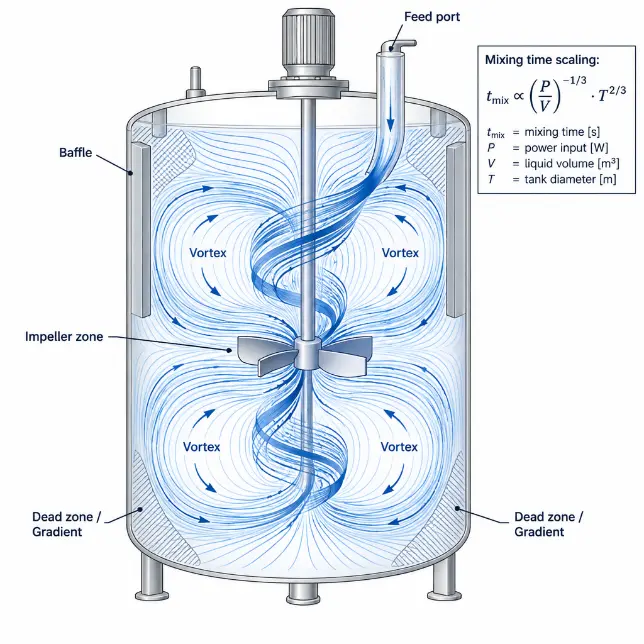
What actually happens:
- Base addition near a probe creates a transient high-pH zone before distribution
- Feed bolus creates a glucose spike at the inlet, starvation elsewhere
- Nutrient/pH/osmolarity gradients push subpopulations into different metabolic states
Mixing time scales roughly as:
t_mix ∝ (P/V)^(−1/3) · T^(2/3)
So constant P/V still lengthens mixing at scale.
Fix: CFD-informed impeller selection, feed ports placed in high-shear/zonal-mixing regions, tracer tests to map dead zones, and distributed addition points. Don’t trust a single central probe.
4. Shear damage shows up as "viability loss," not lysis
Flask shear is negligible. Bioreactor shear comes from three sources:
- Impeller tip speed (π·N·Dᵢ)
- Kolmogorov eddies smaller than the cell/bead
- Bubble rupture at the gas–liquid interface (often the worst offender)
Mammalian cells lack a cell wall, so the damage is sub-lethal first:
- Slower growth, secretory shift, detached microcarriers
- Morphology change, debris, reduced viability over time
- Viral vector particles sheared during sparge
Typical limits:
- Mammalian suspension: tip speed < 1.0–1.5 m/s (CHO can tolerate ~2 m/s with protectants)
- Microcarrier-adherent: bead collision + detachment risk
- AAV/LV: bubble rupture degrades capsids and envelopes
Fix: Cap tip speed as a constraint (not a target), use hydrofoil/low-shear impellers, add Pluronic F-68 (0.5–1 g/L), consider microsparger vs. drilled-hole trade-offs, and run CFD shear mapping. For perfusion, watch recirculation shear across hollow-fiber cartridges (~1000 s⁻¹ is not free).
6. Feeding strategy stops working (batch logic ≠ fed-batch dynamics)
Flask feeds are usually empirical top-ups guided by observation. Bioreactor feeding interacts with mixing, DO, pCO₂, osmolality, and pump accuracy.
Common breakdowns:
- Lactate/ammonia accumulation because feed timing ignores metabolic phase
- Overfeed → osmolality stress; underfeed → premature stationary phase
- Perfusion: bleed rate and cell-specific perfusion rate (CSPR) miscalibrated
- Feed pumps at large scale have hold-up volume and gravimetric error the bench didn’t have
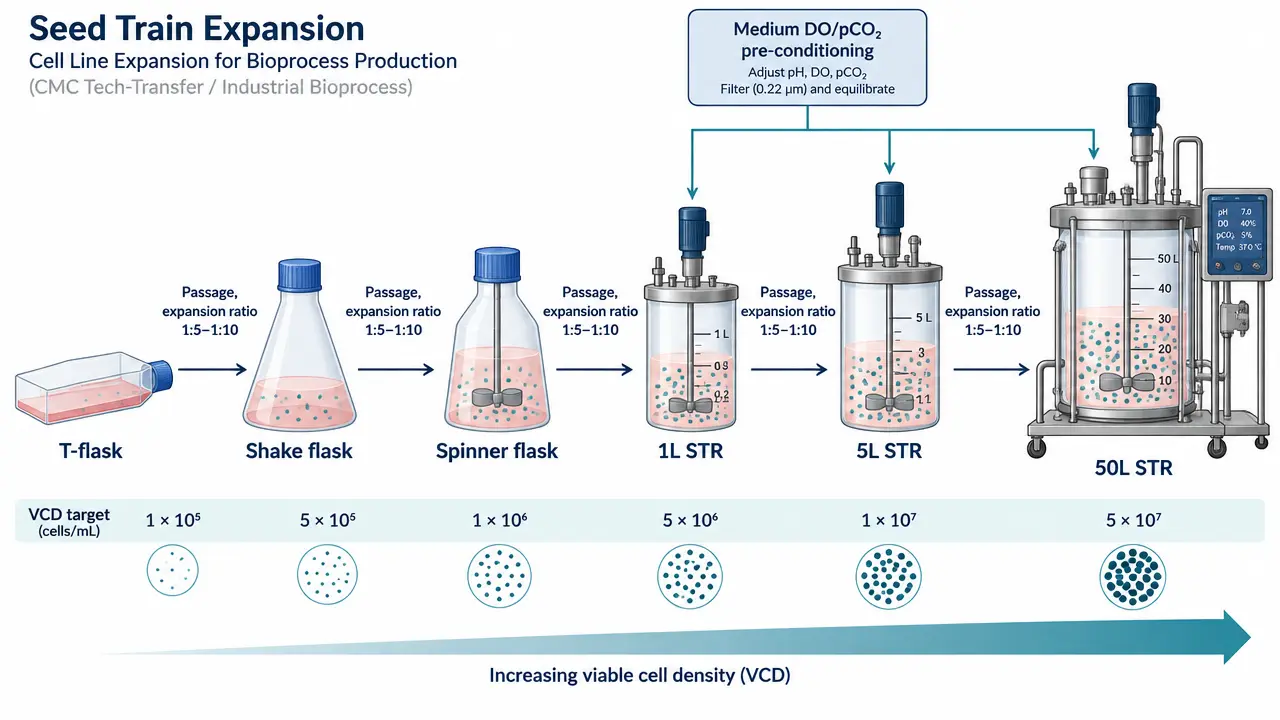
Specific rates (q_glucose, q_lactate, q_product) must be re-baselined at 1–5 L, not carried over from flask curves.
Fix: Run DoE at bench scale separating growth phase vs. production phase. Control temperature shift, pH setpoint, and feed ramp independently. Verify pump calibration and feed-line hold-up before trusting CSPR.
7. Product quality drifts even when titer looks fine
This is the silent failure for CMC and regulatory teams.
You can hit the same IgG titer and still lose:
- Galactosylation/sialylation distribution
- Charge variants
- Aggregate/Fragment ratio
Same for vectors and cell therapy:
- AAV: same genome titer, worse transduction efficiency
- LV: same TU/mL, reduced infectivity
- CAR-T: same expansion, shifted phenotype/potency
All six prior failures converge here. Under QbD, comparability is not "same titer"—it is "same CQA distribution within defined ranges."
Key CQAs to lock before scale:
- Glycoform profile (mAb)
- Full/empty ratio + infectivity (AAV/LV)
- Phenotype markers + cytotoxicity (CAR-T/MSC)
- Host-cell protein, aggregate level, osmolality
Fix: Build a qualified scale-down model that reproduces large-scale transients (two-compartment systems, matched kLa + tip speed + mixing time), then use PAT on metabolites and product attributes—not just off-line titer.
Why "constant X" never fully works
No single scale-up criterion preserves every dimensionless group. The trade-off table is non-negotiable:
| Criterion held constant | What it protects | What it breaks |
|---|---|---|
| P/V | Mixing, turbulence | Tip speed ↑ → shear |
| Tip speed | Shear sensitivity | P/V ↓ → mixing & OTR |
| kLa | Oxygen transfer | CO₂ stripping, foam, energy |
| Mixing time | Homogeneity | P/V explodes (impractical) |
| Reynolds number | Flow regime | Not physically achievable at all scales |
Real practice: hybrid criterion—tip-speed ceiling + P/V window + kLa target + CO₂ stripping verification, validated in a scale-down model.