
Cell Density vs. Confluency: How to Optimize Cell Growth
Cell growth does not always follow the expected pattern. Cells may proliferate too slowly, reach confluency sooner than planned, or grow unevenly across a culture plate. In many cases, cell seeding density, culture conditions, and passaging time are worth reviewing. Understanding the difference between cell density and confluency can help researchers monitor cell growth, adjust culture conditions, and maintain more consistent experimental results.
Cell Density vs. Confluency: What Should You Measure?
Cell density and confluency are related but describe different aspects of a cell culture.
- Cell density refers to the number of cells per unit area or volume. It is commonly expressed as cells/cm² for adherent cultures or cells/mL for suspension cultures.
- Cell confluency refers to the percentage of the available culture surface covered by adherent cells. For example, 50% confluency means that approximately half of the growth surface is covered.
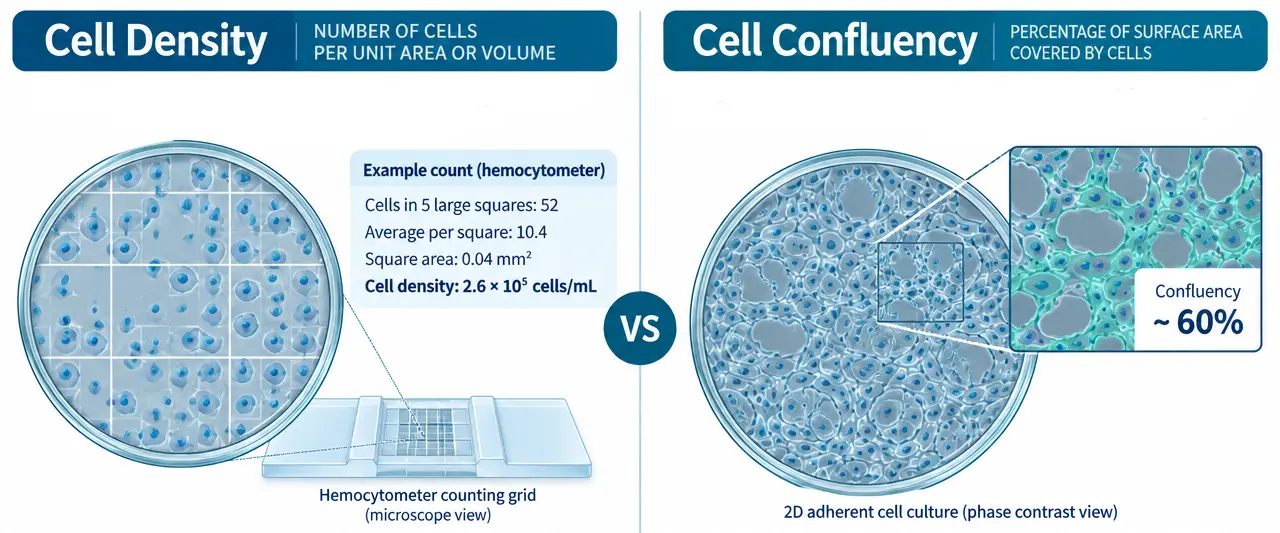
These measurements are useful at different stages of cell culture. Cell density helps determine how many cells to seed, while confluency provides a quick visual estimate of how an adherent culture has developed.
However, the two measurements are not interchangeable. Cells of different sizes or morphologies may occupy different amounts of surface area even when present at similar densities. Confluency alone therefore cannot establish the exact number of cells or confirm that a culture is healthy.
For suspension cells, cell concentration, viability, and growth rate are generally more informative than confluency.
How to Assess Cell Growth Under the Microscope
Confluency is useful for monitoring adherent cells, but it should not be the only indicator of culture quality. Before changing the seeding density or passaging the cells, examine several features together.
| What to check | What to look for | Why it matters |
|---|---|---|
| Confluency | Percentage of the surface covered by cells | Helps assess growth progress and passage timing |
| Cell morphology | Typical shape, size, attachment, and appearance | Unexpected changes may indicate culture stress or other problems |
| Growth trend | Changes in coverage over time | Helps distinguish normal growth from delayed proliferation |
| Cell distribution | Even coverage versus clusters or empty areas | May reveal uneven seeding or attachment |
| Culture condition | Medium appearance, turbidity, and other abnormalities | Helps identify conditions that require further investigation |
Practical tip: Observe cells at consistent intervals and, where possible, use similar microscope settings and representative fields. Record images alongside confluency estimates so that growth can be compared over time.
If cells look abnormal despite apparently adequate confluency, do not assume that the culture is ready for passage. Check the cell line's expected morphology, recent handling history, medium condition, and possible contamination. Unexpected turbidity or other signs of contamination should be investigated promptly.
When Should You Passage Cells?
For adherent cells, passaging is generally performed when the culture reaches the appropriate confluency and the cells remain in a suitable growth state.
A confluency of approximately 70–90% is often used as a reference range for some commonly cultured adherent mammalian cells. However, this is not a universal threshold. Some primary cells require earlier passaging, while other cell types tolerate higher confluency. The recommended endpoint depends on the cell line and experimental purpose.
Use the following workflow to assess whether cells are ready for passage.
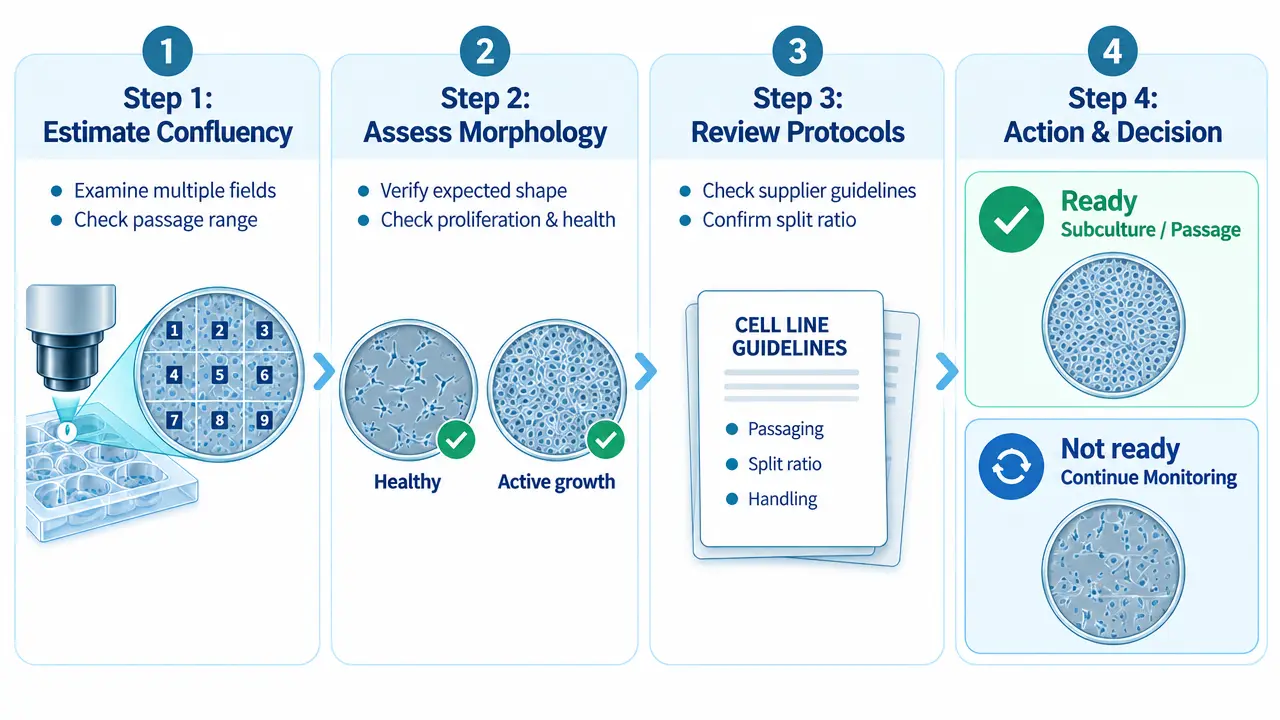
Step 1: Estimate confluency.
Examine representative areas of the culture vessel rather than relying on a single field. Check whether the culture is approaching the recommended passage range.
Step 2: Assess morphology and growth.
Confirm that cells retain their expected appearance and show an appropriate growth pattern. A high confluency estimate does not necessarily mean that the cells are healthy or actively proliferating.
Step 3: Check cell-specific recommendations.
Review the supplier's culture protocol, including recommended passage conditions and split ratios. Consider whether the cells are primary, immortalized, or otherwise sensitive to prolonged culture.
Step 4: Passage or continue monitoring.
If the cells meet the recommended criteria, proceed with the established subculture protocol. If they are not ready, continue monitoring and follow the appropriate feeding schedule.
Waiting until a culture reaches 100% confluency is not always advisable. Some cells may undergo contact inhibition, altered morphology, differentiation, or slower growth after prolonged overgrowth. For primary cells in particular, the supplier's recommended passage conditions should take priority.
How to Adjust Cell Seeding Density for Better Growth
If cells repeatedly grow too slowly or reach confluency earlier than expected, review the initial seeding density before making changes to the culture protocol.
Start by checking the initial cell number
Record the number of viable cells seeded, the culture vessel's growth area, and the culture conditions. If only the volume of cell suspension was recorded, the actual number of cells seeded may be unclear.
Cell viability also matters. A suspension containing many nonviable cells may deliver fewer viable cells than expected, even when the total cell count appears adequate.
Adjust the density based on observed growth
If cells remain sparse and grow slowly:
- Check cell viability and attachment after seeding.
- Review the culture medium, incubation conditions, and passage history.
- Confirm that the cells are suitable for the current culture conditions.
- If these factors are acceptable, test a modestly higher seeding density.
If cells reach high confluency too quickly:
- Check whether the initial cell number was higher than intended.
- Review the observed growth rate and planned passage interval.
- Consider reducing the seeding density or checking the culture more frequently.
If cell coverage is uneven:
- Mix the cell suspension gently and consistently before dispensing.
- Use a consistent seeding procedure across wells.
- Ensure that the culture plate is placed on a level surface.
- Check whether cells settle during dispensing or form aggregates.
Use a small-scale experiment to find a suitable density
When the appropriate seeding density is uncertain, test several densities while keeping other conditions as consistent as possible. Compare morphology, confluency over time, growth rate, and the endpoint relevant to the planned experiment.
For example, if a culture reaches excessive confluency before the intended assay, compare lower starting densities and record the time required to reach the target state. This provides a more useful basis for adjustment than changing the seeding density repeatedly without documenting the results.
Calculate the number of cells to seed
For adherent cells, the required cell number can be estimated using the target seeding density and the growth area of the culture vessel.
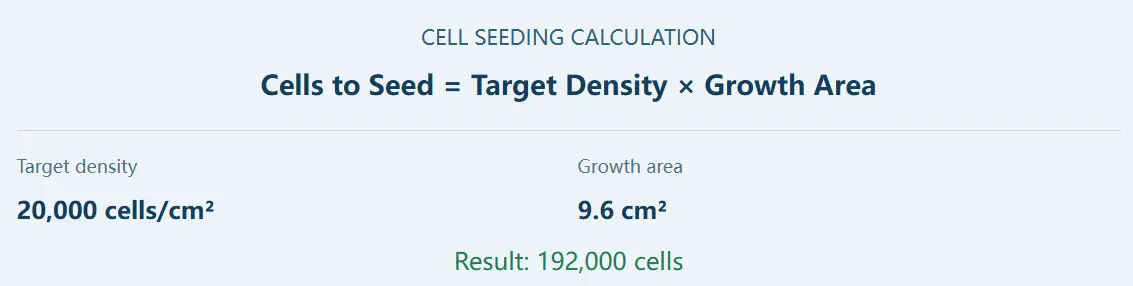
This example illustrates the calculation method only. The appropriate target density must be determined for the specific cell line and experiment.
Common Cell Growth Problems and How to Troubleshoot Them
Cell growth problems can have several causes. Use the observed pattern to guide troubleshooting rather than assuming that confluency alone explains the problem.
| Observed problem | Possible causes | Recommended checks |
|---|---|---|
| Cells grow too slowly | Low viability, poor attachment, unsuitable culture conditions, or passage-related changes | Check viability, morphology, medium, incubation conditions, and passage history |
| Cells become overconfluent quickly | High initial seeding density or faster-than-expected proliferation | Verify the seeded cell number and growth trend; adjust density or monitoring frequency |
| Cells grow unevenly | Inconsistent cell distribution, settling during dispensing, or uneven attachment | Review suspension mixing, dispensing technique, and plate positioning |
| Cells stop proliferating at high confluency | Contact inhibition in susceptible cells, prolonged culture, or unfavorable culture conditions | Check cell-line characteristics, culture duration, morphology, and medium condition |
| Cell morphology changes unexpectedly | Culture stress, overgrowth, altered conditions, or possible contamination | Compare with reference morphology and review handling and culture records |
How to Track Cell Density and Confluency Consistently
Consistent records make it easier to identify changes in growth and reproduce culture conditions across experiments.
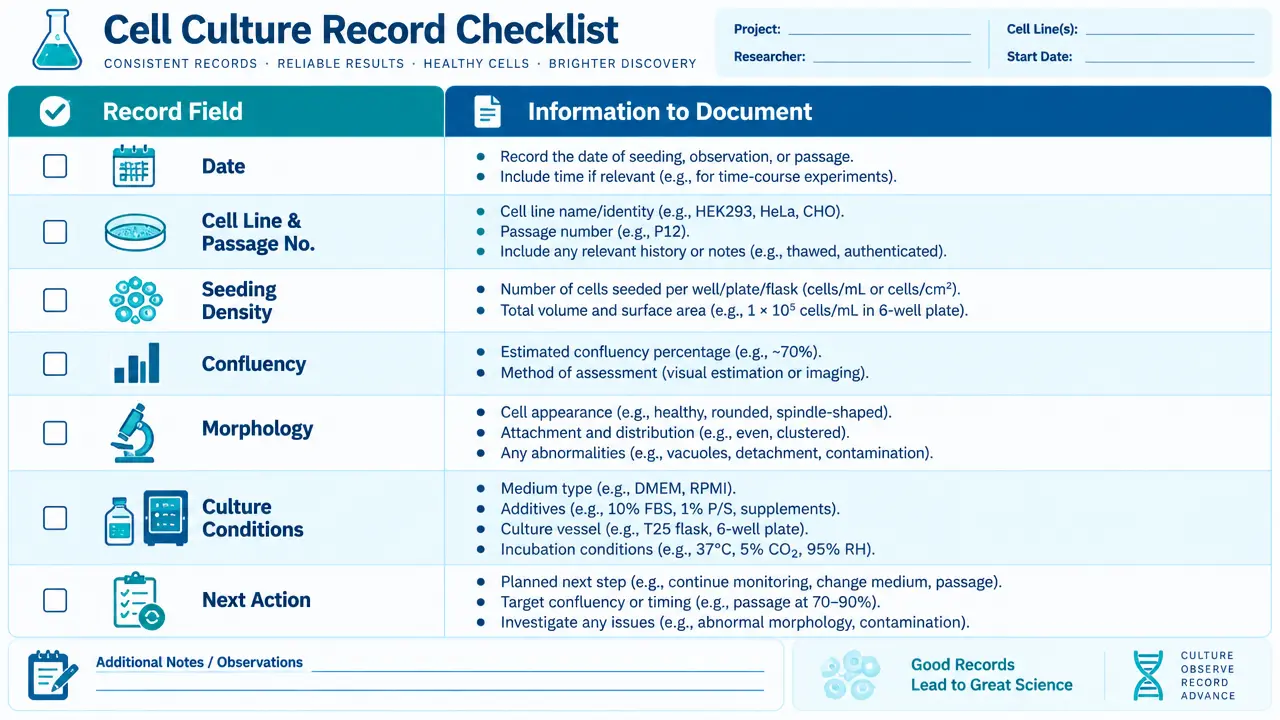
Whenever possible, record confluency at consistent intervals and retain representative microscope images. Comparing the time required to reach a particular growth stage can help identify changes in proliferation or culture performance.
For experiments sensitive to cell state, also consider whether cells are being used at comparable passage numbers and confluency levels. Standardizing these factors can reduce avoidable variability between experiments.