
MTT vs. CCK-8 vs. CellTiter-Glo: Which Assay Should You Choose?
Cell viability assays are essential tools for evaluating cell proliferation, cytotoxicity, and drug responses in vitro. Among the most widely used methods, MTT, CCK-8, and CellTiter-Glo assays offer different approaches to assessing cellular viability. Although all three generate signals associated with viable cells, they differ in detection principles, sensitivity, workflow, and experimental compatibility.
Understanding these differences can help researchers select the most appropriate assay for their cell models and research objectives.
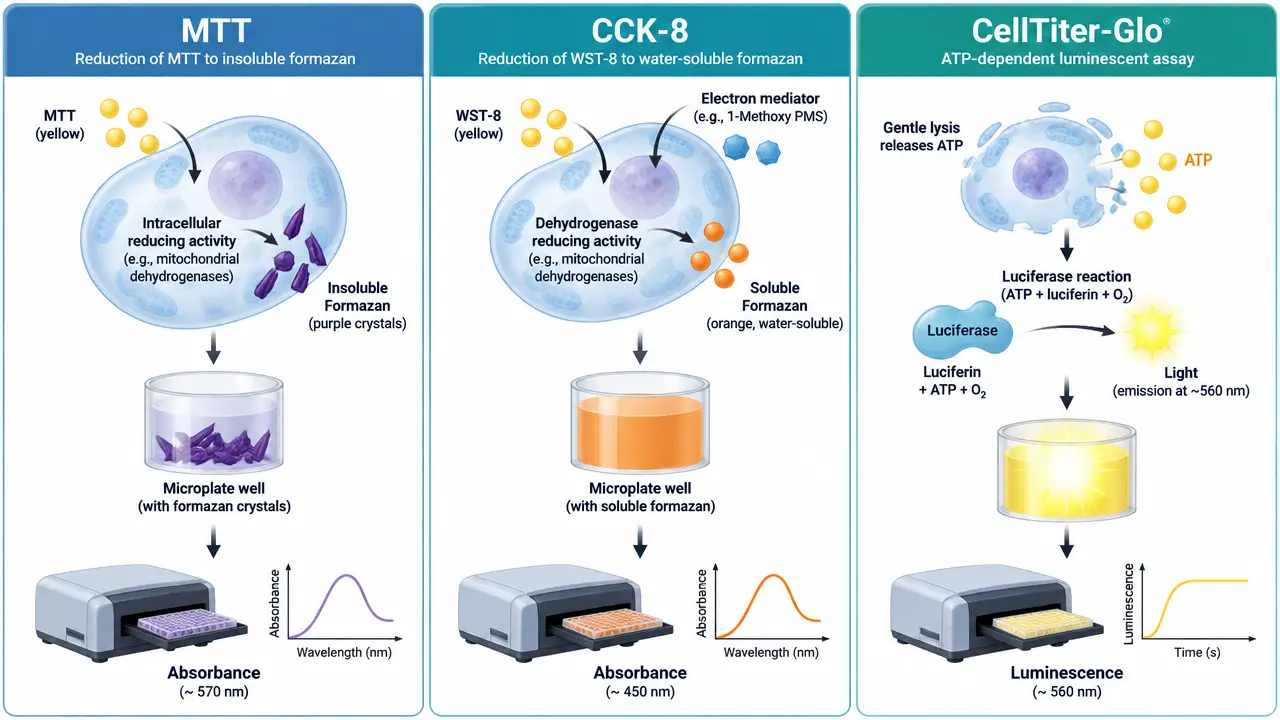
Understanding the Principles of Three Cell Viability Assays
MTT Assay: Colorimetric Detection of Cellular Reducing Activity
The MTT assay is based on the reduction of yellow tetrazolium salt MTT (3-(4,5-dimethylthiazol-2-yl)-2,5-diphenyltetrazolium bromide) into insoluble purple formazan crystals by cellular reducing systems. Following incubation, the crystals are dissolved using an appropriate solubilization reagent, and absorbance is typically measured at approximately 570 nm.
MTT is an established, cost-effective method for conventional endpoint cell viability and proliferation studies. However, the additional crystal dissolution step increases handling requirements and may introduce variability.
CCK-8 Assay: WST-8-Based Colorimetric Detection
The Cell Counting Kit-8 (CCK-8) assay uses WST-8, a water-soluble tetrazolium salt. In the presence of cellular dehydrogenase-associated reducing activity and an electron mediator, WST-8 is converted into a water-soluble orange formazan product.
The absorbance is generally measured at 450 nm. Unlike MTT, CCK-8 does not require crystal dissolution, offering a simpler workflow and relatively high sensitivity. It is particularly suitable for routine cell proliferation and cytotoxicity studies.
CellTiter-Glo Assay: ATP-Based Luminescence Detection
CellTiter-Glo measures cellular ATP, an indicator of metabolically active cell populations. The reagent lyses cells and releases ATP, which drives a luciferase-catalyzed reaction that generates a luminescent signal.
Light output is measured using a luminometer or a compatible multimode microplate reader. Its high sensitivity, homogeneous workflow, and compatibility with automated screening make it particularly useful for high-throughput drug discovery.
MTT vs. CCK-8 vs. CellTiter-Glo: Key Differences
| Comparison Criteria | MTT | CCK-8 | CellTiter-Glo |
|---|---|---|---|
| Detection principle | Tetrazolium reduction | WST-8 reduction | ATP-dependent luminescence |
| Signal | Purple formazan | Orange formazan | Luminescence |
| Detection method | Colorimetric | Colorimetric | Luminescent |
| Typical readout | ~570 nm | ~450 nm | Relative light units (RLU) |
| Additional processing | Crystal dissolution | Generally none | Cell lysis by reagent |
| Sensitivity | Moderate | Relatively high | High |
| Workflow | Moderate complexity | Simple | Simple |
| Relative reagent cost | Generally low | Moderate | Generally higher |
| HTS suitability | Limited to moderate | Suitable | Particularly suitable |
In brief:
- MTT: A cost-effective option for conventional endpoint cell viability studies.
- CCK-8: A convenient choice for routine cell proliferation and cytotoxicity testing.
- CellTiter-Glo: Well suited for sensitive measurements and high-throughput screening.
These comparisons are general guidelines. Actual assay performance depends on cell type, experimental conditions, reagent formulation, and detection equipment.
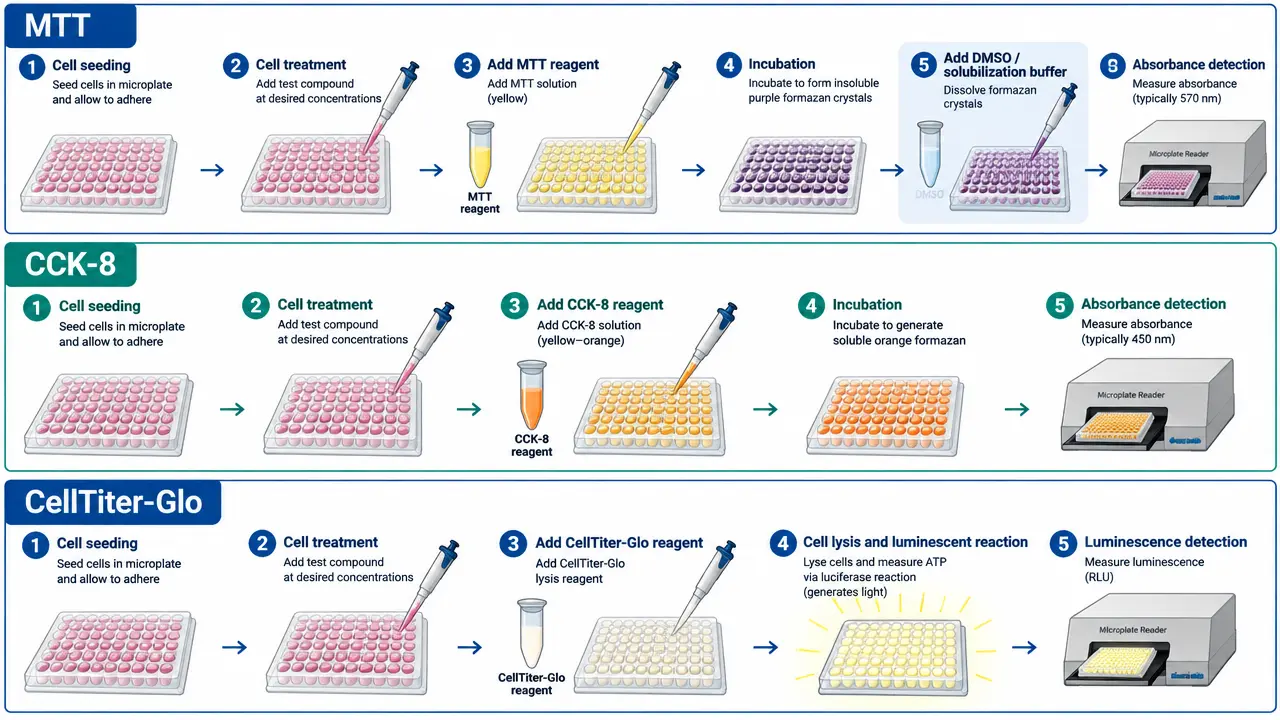
Advantages and Limitations of Each Assay
Choosing an assay requires considering not only its advantages but also potential sources of experimental interference.
MTT Assay
- Advantages: Established methodology, relatively low reagent cost, and compatibility with conventional absorbance readers.
- Limitations: Requires formazan dissolution, involves additional handling, and may be affected by chemical reducing agents or colored test compounds.
CCK-8 Assay
- Advantages: Water-soluble formazan eliminates the dissolution step; relatively high sensitivity; simple workflow; suitable for routine viability and proliferation measurements.
- Limitations: Signal reflects cellular reducing activity rather than direct cell counts. Reducing compounds and certain test substances may interfere with WST-8 reduction.
CellTiter-Glo Assay
- Advantages: High analytical sensitivity, rapid homogeneous detection, and suitability for automated high-throughput screening.
- Limitations: Requires luminescence detection equipment, generally involves higher reagent costs, and may be affected by compounds that alter ATP levels or inhibit luciferase activity.
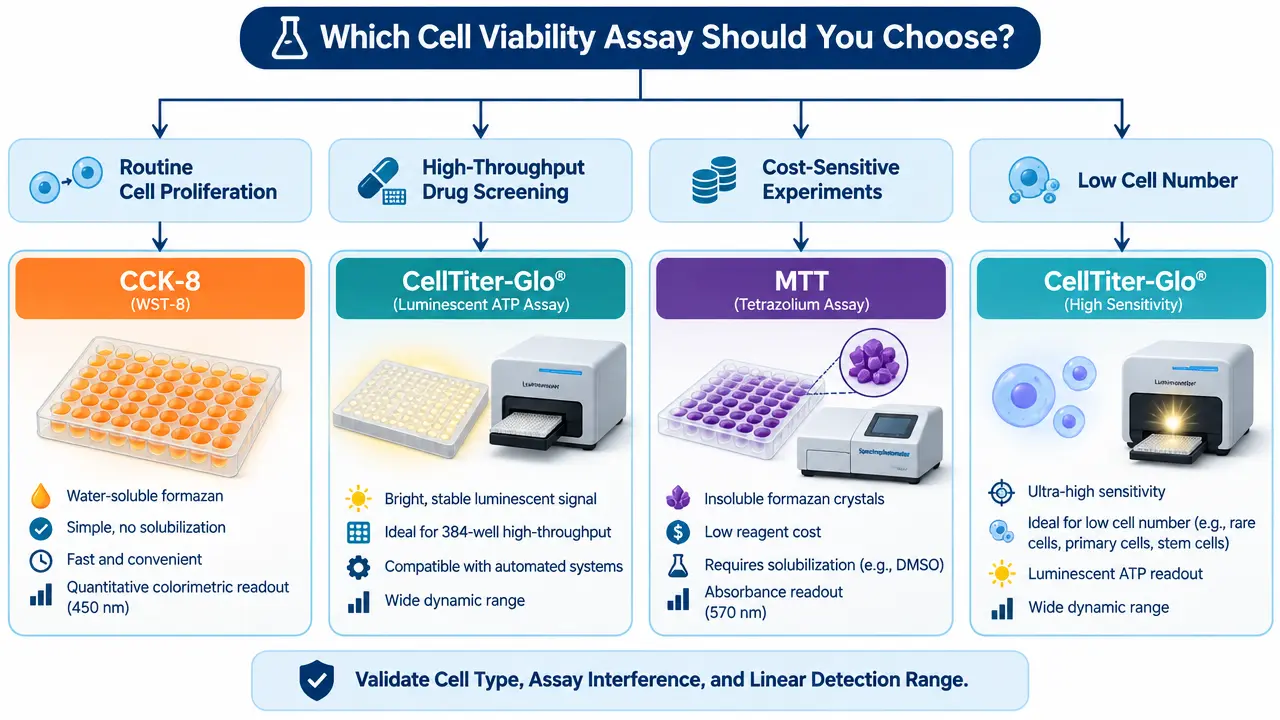
Which Assay Is Best for Your Experimental Application?
The optimal assay depends on the biological question, experimental model, and available laboratory resources.
| Experimental Application | Suggested Assay | Key Consideration |
|---|---|---|
| Routine cell proliferation studies | CCK-8 | Simple workflow and convenient absorbance detection |
| Drug cytotoxicity evaluation | CCK-8 or CellTiter-Glo | Consider compound-related interference |
| High-throughput drug screening | CellTiter-Glo | Sensitive, homogeneous, and automation-friendly |
| Low-cell-number assays | CellTiter-Glo | High analytical sensitivity |
| Cost-sensitive experiments | MTT | Economical for established workflows |
For conventional cell proliferation studies, CCK-8 offers a practical balance between sensitivity and convenience. For drug screening involving large compound libraries or limited cell numbers, CellTiter-Glo may provide advantages. MTT remains a useful alternative when cost and established laboratory protocols are priorities.
Critical Factors to Consider Before Choosing an Assay
Several experimental factors can influence assay performance and data reliability.
Cell Type and Metabolic Activity
Different cell types exhibit distinct metabolic profiles, dehydrogenase activities, and intracellular ATP levels. These differences can affect assay signals independently of cell number.
Cell Seeding Density and Linear Detection Range
Optimize cell density and incubation time for each cell model. Excessive cell numbers or prolonged incubation may lead to signal saturation and unreliable quantification.
Compound-Related Interference
Antioxidants and reducing agents may interfere with tetrazolium-based assays, while colored compounds can affect absorbance measurements. Certain compounds may also inhibit luciferase activity or alter ATP levels. Appropriate cell-free compound controls are recommended.
Detection Equipment and Experimental Throughput
MTT and CCK-8 require absorbance-based plate readers, whereas CellTiter-Glo requires luminescence detection capability. Instrument availability, sample volume, automation requirements, and reagent consumption should all inform assay selection.
Common Mistakes That Can Affect Cell Viability Assay Results
Even an appropriately selected assay may produce misleading results if experimental conditions are not properly controlled.
- Excessive cell density: May cause signal saturation. Establish cell number-response curves before testing.
- Inconsistent incubation time: Can introduce signal variability. Standardize reagent incubation conditions.
- Ignoring compound interference: May produce false-positive or false-negative results. Include cell-free compound controls where appropriate.
- Inadequate background correction: Can distort viability calculations. Include appropriate reagent blanks and control wells.
- Using signals outside the linear range: Reduces quantitative reliability. Validate the assay's linear response under the intended conditions.
Importantly, MTT, CCK-8, and CellTiter-Glo are indirect indicators of cell viability rather than direct cell-counting methods. Changes in metabolic activity or ATP content do not necessarily indicate proportional changes in viable cell numbers. When biological interpretation is critical, complement these assays with direct cell counting, membrane integrity, or apoptosis measurements.
Frequently Asked Questions
Q1. Is CCK-8 more sensitive than MTT?
Generally, CCK-8 offers higher sensitivity than conventional MTT assays and requires less sample processing. However, actual performance depends on cell type, seeding density, and incubation conditions.
Q2. What is the main difference between CCK-8 and CellTiter-Glo?
CCK-8 uses WST-8 reduction to generate a colorimetric signal, whereas CellTiter-Glo measures ATP through a luciferase-based luminescence reaction.
Q3. Can these assays be used for suspension cells?
Yes. All three methods can be adapted for suspension cells, provided that cell distribution, sedimentation, mixing, and assay-specific incubation conditions are appropriately controlled.
Q4. Which assay is best for high-throughput screening?
CellTiter-Glo is particularly suitable because of its sensitivity, homogeneous workflow, and compatibility with automated microplate screening.
Q5. Do cell viability assays directly measure living cell numbers?
No. These assays measure cellular reducing activity or ATP-associated signals. Direct cell counting or complementary viability measurements may be necessary for accurate biological interpretation.
Q6. Can CCK-8 or MTT be used for repeated measurements?
Both are primarily endpoint assays. Although CCK-8 is generally less disruptive to cells than MTT, repeated measurements require validation of reagent exposure and effects on subsequent cellular functions.
Creative Bioarray Relevant Recommendations
| Products & Services | Description |
|---|---|
| Cell Viability Assay Kit | Creative Bioarray offers cell viability assay kits such as SuperQuick® Calcein AM Cell Viability Assay Kit, SuperQuick® Live/Dead Cell Viability Assay Kit. |
| Cell Viability Assays | Creative Bioarray provides various options for cell viability assays and compound profiling service based on cell viability with sensitive and accurate result, including MTT/MST/WST-8/WST-1/CKK-8 assays, Trypan Blue assays, Calcein-AM assays, Fluorescent reactive dye assays, Single/Two color viability assays and Microplate cell viability assays. |