
Drug Clearance: From In Vitro Testing to In Vivo Prediction
Introduction
Drug clearance is a key pharmacokinetic parameter that describes how efficiently a drug is eliminated from the body. It influences systemic drug exposure, elimination half-life, and dosing requirements, making it an important consideration during drug discovery and development.
Early assessment of drug clearance helps researchers identify metabolic liabilities, compare candidate compounds, and predict their potential in vivo behavior. By combining in vitro metabolic stability assays with in vitro-in vivo extrapolation (IVIVE) and pharmacokinetic studies, researchers can gain a better understanding of drug disposition and support candidate selection.
Understanding Drug Clearance
Drug clearance (CL) refers to the apparent volume of plasma or blood from which a drug is completely removed per unit of time. It is commonly expressed in mL/min or L/h and reflects the efficiency of drug elimination rather than the actual volume of fluid removed.
The major elimination pathways include:
- Hepatic Clearance: Drug metabolism and, for some compounds, biliary excretion in the liver.
- Renal Clearance: Drug elimination through glomerular filtration, tubular secretion, and reabsorption.
- Extra-Renal Clearance: Elimination through other pathways, including extrahepatic metabolism.
Total body clearance represents the combined contribution of these pathways:
CLtotal = CLhepatic + CLrenal + CLother
Clearance is closely related to other pharmacokinetic parameters. For an intravenously administered drug exhibiting linear pharmacokinetics:
CL=DoseIV / AUC0-∞
Clearance also influences elimination half-life in combination with the volume of distribution:
t1/2=(0.693 × Vd) / CL
Therefore, higher clearance generally results in lower systemic exposure at a given IV dose, while its effect on half-life also depends on drug distribution.
Several factors influence clearance, including CYP450 enzyme activity, liver and kidney function, plasma protein binding, drug lipophilicity, transporter interactions, and genetic variability. These factors should be considered when interpreting clearance data and predicting drug behavior.
In Vitro Assessment of Drug Clearance
In vitro clearance assays are widely used in early ADME screening to evaluate metabolic stability and identify compounds that may undergo rapid metabolism. Liver microsomes and hepatocytes are two commonly used experimental systems.
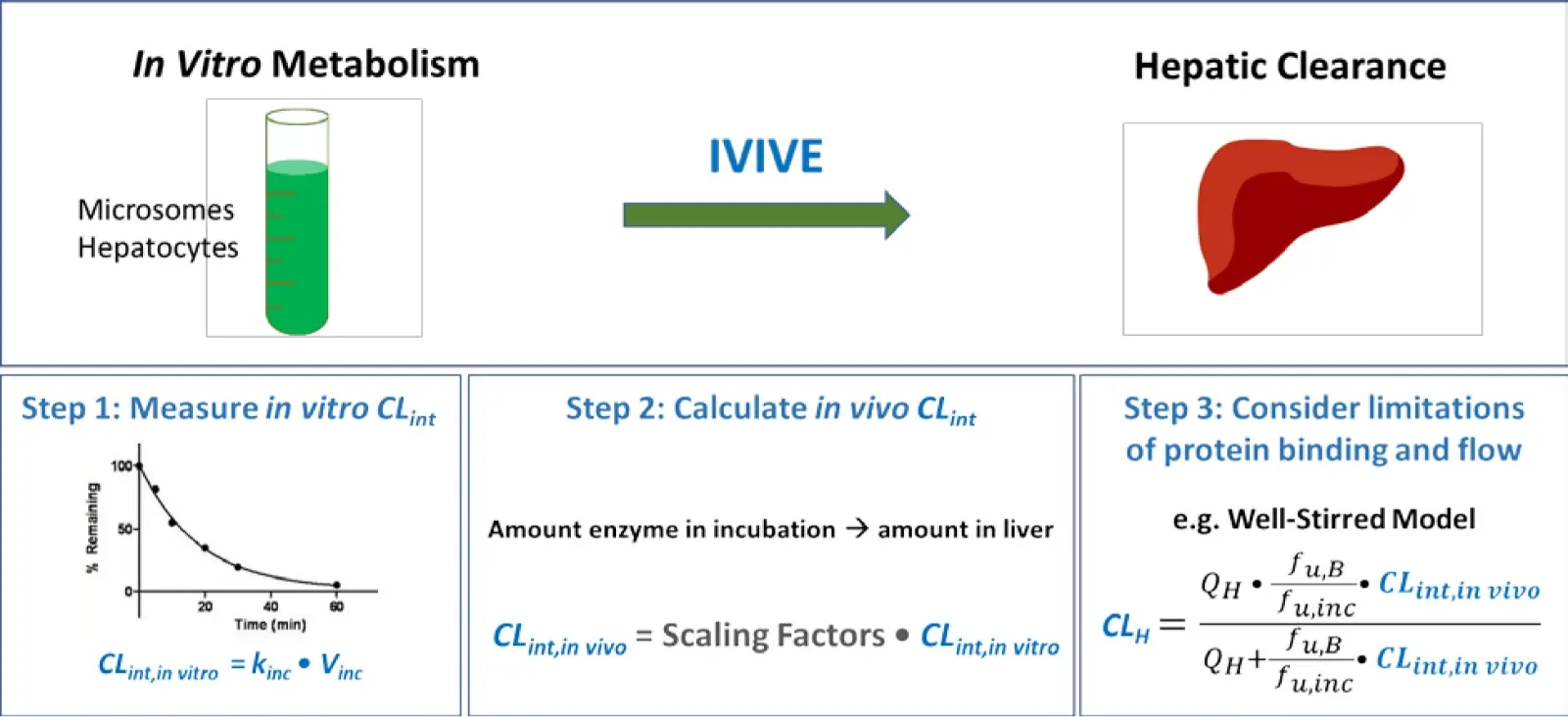
Liver Microsomal Stability Assay
Liver microsomes contain membrane-associated drug-metabolizing enzymes, particularly CYP450 enzymes. In a typical assay, a test compound is incubated with liver microsomes in the presence of an NADPH-generating system. The remaining parent compound is measured at different time points, commonly using LC-MS/MS.
The depletion profile is used to estimate in vitro half-life and intrinsic clearance (CLint), providing an indication of the compound's metabolic stability. This assay is particularly useful for early-stage screening of CYP-mediated metabolism.
Hepatocyte Stability Assay
Hepatocytes provide a more comprehensive cellular system for drug metabolism assessment. Unlike microsomes, intact hepatocytes retain multiple Phase I and Phase II metabolic pathways, along with certain cellular uptake and efflux processes.
Monitoring parent compound depletion in hepatocyte incubations helps evaluate metabolic stability and provides complementary information when microsomal assays do not fully explain a compound's metabolic behavior.
Other supporting assays can further characterize drug disposition. Plasma stability assays evaluate compound degradation in plasma, metabolite identification studies investigate metabolic pathways, and transporter assays help assess transporter-mediated drug uptake and elimination.
From Intrinsic Clearance to In Vivo Prediction
In vitro metabolic stability results do not directly represent clearance in an intact organism. To translate these findings into in vivo predictions, researchers commonly use intrinsic clearance (CLint) and in vitro-in vivo extrapolation (IVIVE).
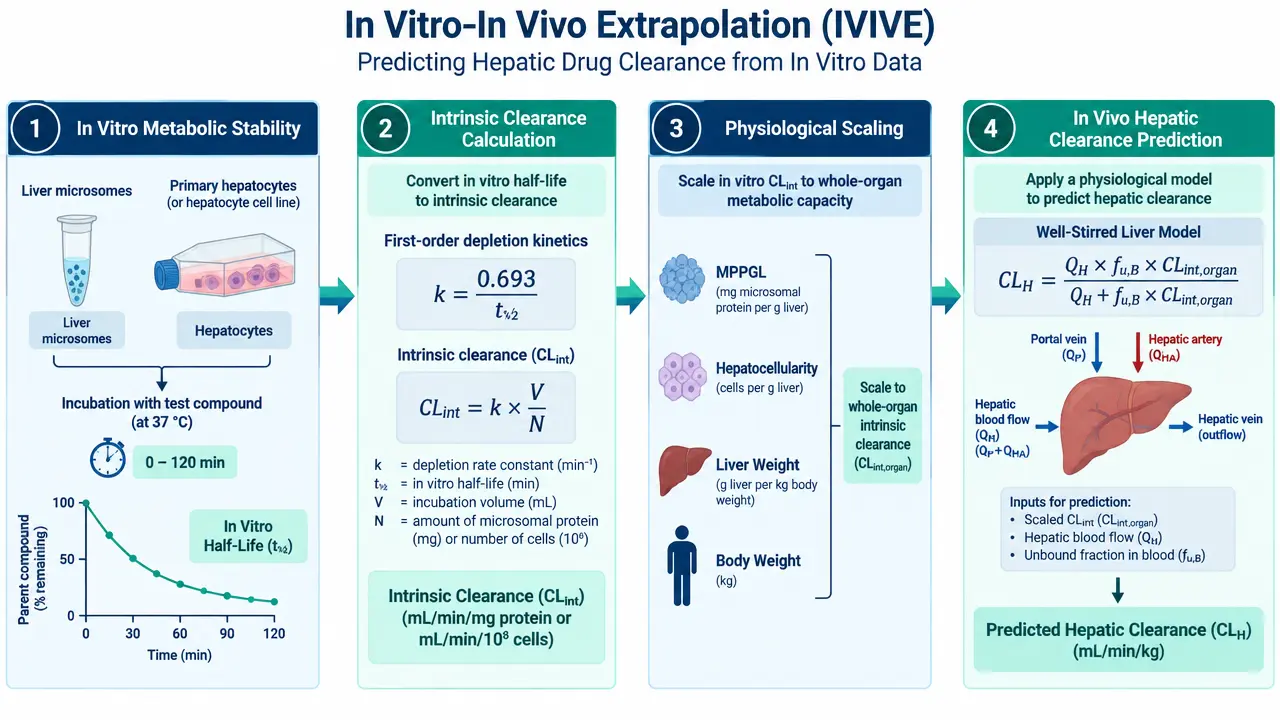
Intrinsic Clearance (CLint) describes the inherent capacity of a metabolic system to eliminate a compound. In microsomal stability studies, it can be estimated from the disappearance rate of the parent compound:
CLint = (0.693 / t1/2) • (Vinc / Pmic)
Where (t1/2) is the in vitro disappearance half-life, (Vinc) is the incubation volume, and (Pmic) is the total amount of microsomal protein. The resulting value is commonly expressed in mL/min/mg protein.
IVIVE translates in vitro CLint into estimates of in vivo hepatic clearance. First, physiological scaling factors, such as microsomal protein per gram of liver (MPPGL), liver weight, and body weight, are used to estimate whole-liver intrinsic clearance. For hepatocyte-based studies, hepatocellularity scaling can be applied.
The scaled intrinsic clearance can then be incorporated into the well-stirred liver model:
CLH=(QH × fu,B × CLint,scaled) / (QH + fu,B × CLint,scaled)
Where QH represents hepatic blood flow, fu,B is the unbound fraction of the drug in blood, and CLint,scaled is the scaled intrinsic clearance.
IVIVE provides a useful framework for predicting hepatic clearance, but its accuracy depends on factors such as protein binding, nonspecific incubation binding, enzyme and transporter expression, and species differences. Predicted values should therefore be interpreted alongside complementary experimental data.
In Vivo Pharmacokinetic Validation
In vivo pharmacokinetic studies help determine systemic clearance and evaluate whether in vitro predictions reflect actual drug disposition.
In a typical study, a compound is administered to an appropriate animal model, followed by blood sampling at predefined time points. Plasma drug concentrations are quantified using bioanalytical methods such as LC-MS/MS to establish a concentration-time profile.
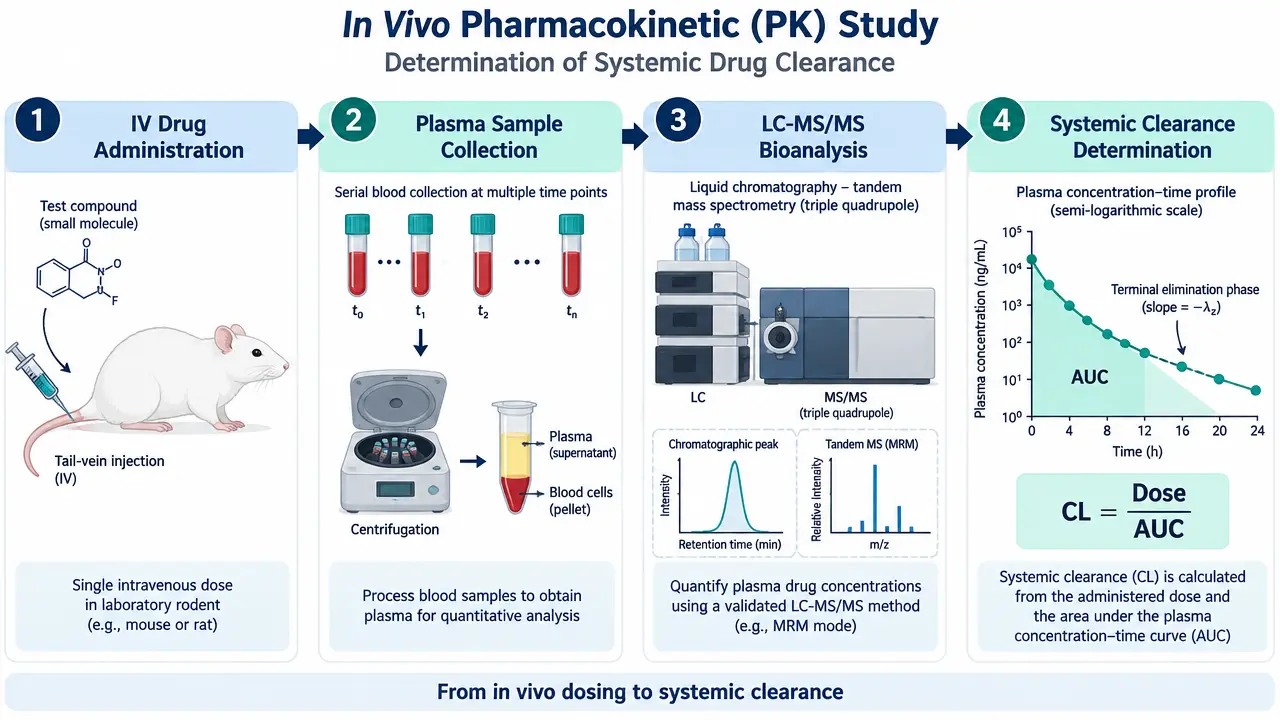
For intravenous administration under linear pharmacokinetic conditions, systemic clearance is calculated as:
CL = DoseIV / AUC0-∞
The resulting data can also provide information about AUC, terminal half-life, and volume of distribution.
Comparing predicted and observed clearance values helps identify limitations in in vitro models. For example, a compound with relatively high microsomal stability may still exhibit rapid in vivo clearance due to renal excretion, extrahepatic metabolism, or transporter-mediated processes. Integrating in vitro and in vivo findings provides a more comprehensive understanding of drug elimination.
Why Drug Clearance Matters in Drug Development
Clearance data supports several important decisions throughout drug discovery and development:
- Lead Optimization: Identifying rapid metabolic turnover can help guide structural modifications to improve compound stability.
- Drug Exposure Assessment: Clearance influences systemic exposure and helps explain differences in AUC between candidate compounds.
- Safety Evaluation: Reduced clearance may contribute to drug accumulation, while excessive clearance may result in insufficient exposure.
- Candidate Selection: Combining clearance data with potency, solubility, permeability, and other ADME properties helps prioritize compounds for further development.
For example, two compounds with similar target activity may show different microsomal CLint values. Further hepatocyte and in vivo PK studies can help determine whether these differences translate into meaningful changes in systemic exposure and development potential.
Frequently Asked Questions
1. What is the difference between CL and CLint?
CL represents the apparent volume of plasma or blood cleared of a drug per unit of time, while CLint describes the inherent metabolic capacity of an enzyme or metabolic system to eliminate a compound.
2. Can liver microsomal stability predict in vivo clearance?
Microsomal stability provides useful information about CYP-mediated metabolism and supports hepatic clearance prediction through IVIVE. However, it does not fully capture renal elimination, extrahepatic metabolism, or transporter-mediated processes.
3. Does low drug clearance always indicate better drug properties?
No. Low clearance may increase systemic exposure but can also raise the risk of drug accumulation. Its suitability depends on potency, therapeutic window, dosing requirements, and overall pharmacokinetic properties.
4. What factors can cause differences between in vitro and in vivo clearance?
Differences may arise from protein binding, enzyme and transporter expression, hepatic blood flow, extrahepatic metabolism, renal excretion, and species-specific physiological characteristics.
Conclusion
Drug clearance is an important determinant of drug exposure and pharmacokinetic behavior. Combining in vitro metabolic stability assays, CLint calculations, IVIVE modeling, and in vivo PK studies provides a more comprehensive evaluation of drug elimination. These approaches help identify metabolic liabilities and support more informed decisions during drug discovery and candidate selection.
Reference
- Benet LZ, Sodhi JK. Can In Vitro-In Vivo Extrapolation Be Successful? Recognizing the Incorrect Clearance Assumptions. Clin Pharmacol Ther. 2022 May;111(5):1022-1035. doi: 10.1002/cpt.2482. Epub 2021 Dec 8. Erratum in: Clin Pharmacol Ther. 2022 Aug;112(2):411