
Human Esophageal Epithelial Cells (HEEpiC)
Cat.No.: CSC-7783W
Species: Human
Source: Esophagus
Cell Type: Epithelial Cell
- Specification
- Background
- Scientific Data
- Q & A
- Customer Review
Human esophageal epithelial cells (HEEpiC) are primary epithelial cells isolated from human esophageal mucosa. They retain the native stratified squamous phenotype and donor genetic background. In culture, HEEpiC express basal markers p63 and cytokeratin 5/14, differentiation-associated cytokeratin 4/13, involucrin, and transglutaminase, together with junctional proteins such as E-cadherin, ZO-1, and occludin. Under optimized conditions, including calcium-induced differentiation or air-liquid interface culture, they form stratified layers and develop barrier properties measurable by TEER and permeability assays. They respond to acid, pepsin, bile acids, inflammatory cytokines, and Toll-like receptor ligands, secreting cytokines and chemokines relevant to mucosal immunity and injury.
Their key advantage is human, site-specific physiological relevance. Compared with immortalized esophageal lines, HEEpiC better preserve native receptor expression, signaling pathways, and donor-specific responses. They are widely used to model esophageal barrier dysfunction, gastroesophageal reflux disease (GERD), Barrett’s esophagus, eosinophilic esophagitis, and esophageal carcinogenesis. They also support drug transport, toxicity, and biocompatibility testing, and mechanistic studies of acid injury, oxidative stress, epithelial-mesenchymal transition, and host-microbiome interactions.
Overall, HEEpiC provide a robust, human-relevant, and physiologically characterized platform for esophageal biology, disease modeling, and translational research.
Robust pH Sensing Using a Graphene Oxide and Covalent Organic Frameworks Composite for Gastro-esophageal Reflux Disease Diagnosis
Gastro-esophageal reflux disease (GERD) affects 15–20% of the global population and is commonly diagnosed via 24-h ambulatory pH monitoring. However, current diagnostic tools, including catheter-based systems and ingestible capsules, suffer from poor patient compliance and unreliable pH readings due to sensor degradation in acidic environments. To address this challenge, a robust, composite pH sensor is reported in this work by combining graphene oxide (GO) with covalent organic frameworks (COFs) coatings.
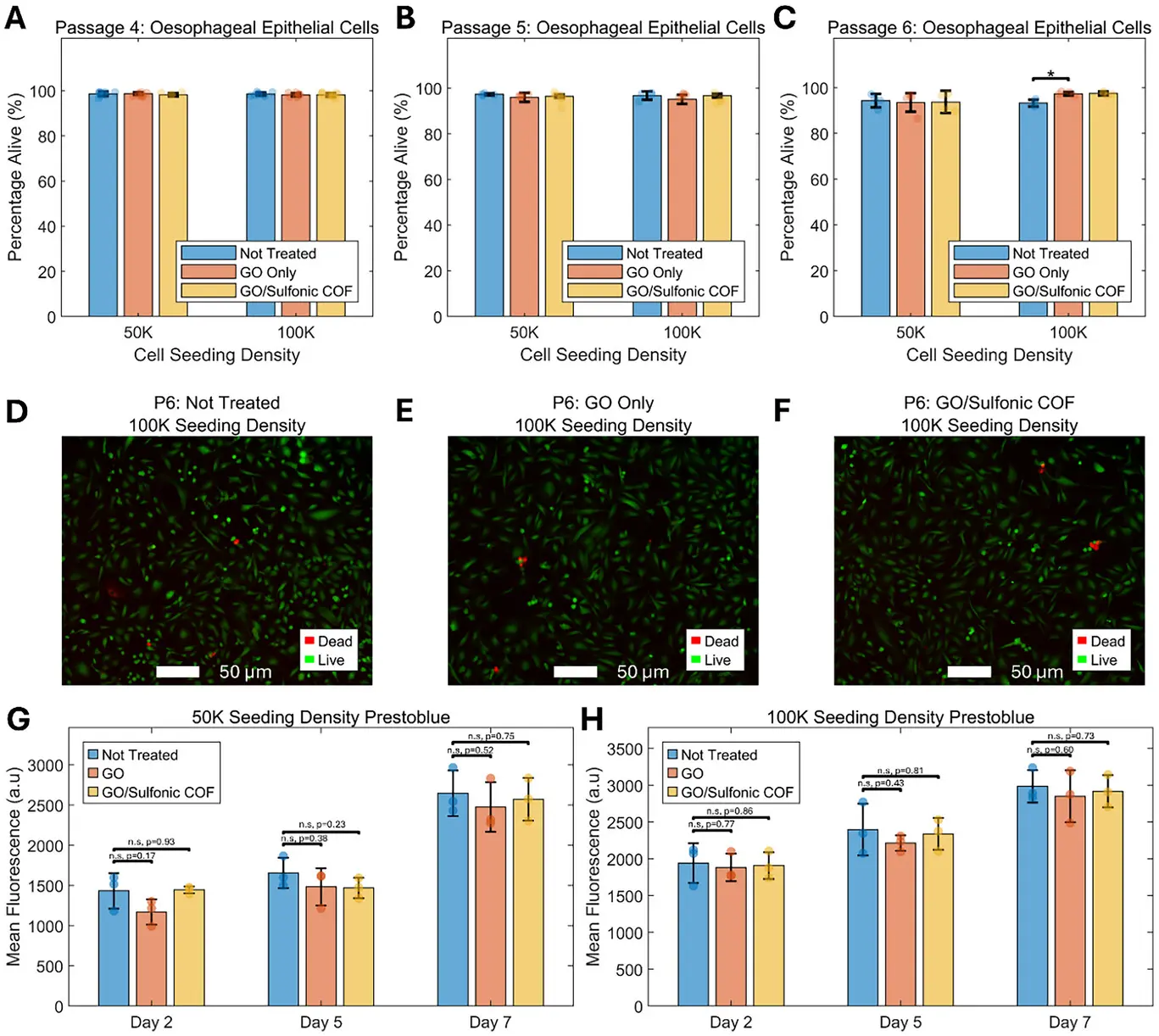
The sensor exhibits excellent linearity, stability, and high reproducibility in simulated gastric fluid. The cytotoxicity evaluation of the GO/COF composite demonstrated excellent biocompatibility with human esophageal epithelial cells (HEsEpiC), supporting its potential use in medical applications. Throughout the 7-day incubation period, epithelial cells adhered consistently to the coated slides, showing robust proliferation with no adverse effects observed. Cell viability remained consistently high, exceeding 93.5% under all tested conditions, independent of initial seeding densities (50,000 or 100,000 cells/well). These findings position the GO/COF composite as a promising material for use in biomedical devices, particularly in diagnosing GERD.
Ask a Question
Write your own review
Description: Smooth muscle is responsible for the contractility of hollow organs, such as blood vessels, the gastrointestinal tract, the bladder, and the uterus. Its structure differs greatly from that of ...
Description: HEMEC from Creative Bioarray are isolated from human esophageal tissue. HEMEC are cryopreserved at passage one and delivered frozen. Each vial contains >5 x 10^5 cells in 1 ml volume. HEMEC are ...
Description: The HEF cells from Creative Bioarray are isolated from human esophageal tissue. HEF are cryopreserved at passage one and delivered frozen. Each vial contains >5 x 10^5 cells in 1 ml volume. HEF are ...