
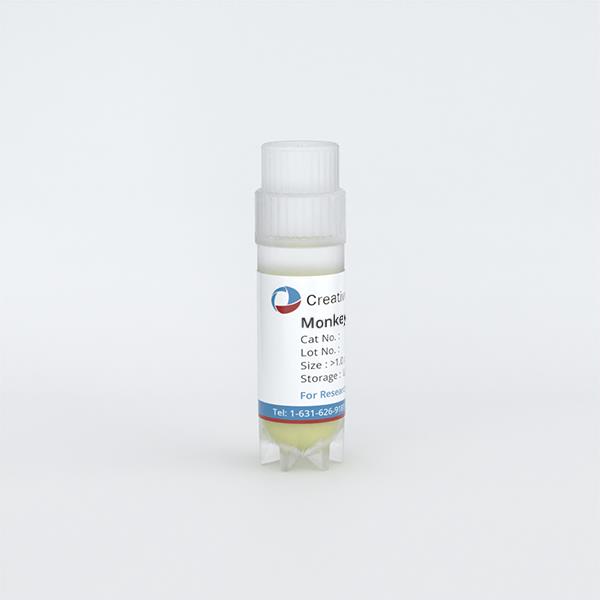
Monkey CD16+ NK Cells
Cat.No.: CSC-C4728Z
Species: Monkey
Source: Peripheral Blood; Blood
Culture Properties: Suspension
Cell Type: NK Cell; Lymphocyte
- Specification
- Background
- Scientific Data
- Q & A
- Customer Review
Monkey CD16+ Natural Killer (NK) cells are a supercytotoxic subset of innate lymphocytes, identified from nonhuman primates such as cynomolgus monkeys and rhesus macaques. Cells are similar to human CD56+ CD16+ NK cells, the most prevalent circulating NK cell subset involved in fast immune surveillance and target cell killing. Characterized by the expression of CD16 (FcγRIII), monkey CD16+ NK cells play a central role in antibody-dependent cellular cytotoxicity (ADCC), enabling the recognition and destruction of antibody-coated target cells.
Monkey CD16+ NK cells are commonly used in translational immunology studies, preclinical safety studies and therapeutic antibody development due to their functional and phenotypic similarity to human NK cells. They are important models for assessment of Fc-mediated immune responses, antiviral immunity, and the efficacy of monoclonal antibodies, bispecific antibodies and other immunotherapeutic drugs. Also, these cells are used more and more for vaccine research, adaptive NK cell investigations and immunological surveillance.
Activated monkey CD16+ NK cells produce strong cytotoxic chemicals including perforin and granzymes and emit immune-regulatory cytokines such as IFN-γ. Due to their connection to non-human primate illness models, they are a valuable experimental system for bridging pre-clinical discoveries to human clinical research, notably in the areas of immuno-oncology, infectious disease and the development of cell therapies.
Distinct Trafficking Kinetics of Natural Killer Cell Subsets in Non-Human Primates
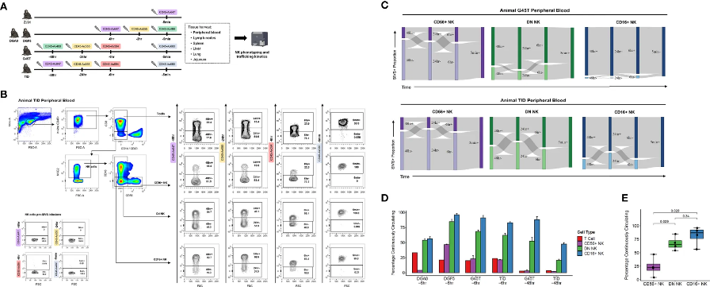
To characterize the in vivo tissue distribution and trafficking dynamics of Natural Killer (NK) cells, Mortlock et al. utilized serial intravascular staining (SIVS) in rhesus macaques. Five healthy animals received anti-CD45 SIVS antibody infusions at specific intervals prior to tissue harvest (Fig. 1A). By quantifying SIVS labeling in peripheral blood mononuclear cells (PBMCs), the vascular residence time of CD56⁺, DN (double-negative), and CD16⁺ NK cell subsets was determined (Fig. 1B).
Analysis revealed distinct subset-specific behaviors. In animals receiving a 48-hour SIVS time-course, the majority of CD56⁺ NK cells in the peripheral blood were negative for the 6-hour antibody, indicating recent emigration from tissues within the last 6 hours (Fig. 1C). Conversely, most CD16⁺ NK cells remained positive for all SIVS infusions, demonstrating sustained vascular residence. DN NK cells exhibited intermediate kinetics, with 25%-50% retained in the vasculature throughout the experiment. Short-term (6-hour) SIVS profiles confirmed this hierarchy: CD16⁺ NK cells had the longest blood retention, followed by DN, while CD56⁺ NK cells showed the highest rate of tissue-to-blood trafficking.
Quantification of "Continuously Circulating" (CC) cells showed that CD56⁺ NK cells consistently had the lowest proportion of CC cells, while CD16⁺ and DN subsets had significantly higher rates (Figs. 1D, E). These data indicate that while the dominant CD16⁺ and DN NK cell populations (constituting >95% of circulating NK cells) remain in continuous vascular circulation, the minor CD56⁺ subset exhibits frequent trafficking between blood and tissues.
Ask a Question
Write your own review

Description: Cynomolgus Monkey Primary Spleen Fibroblasts are isolated from Cynomolgus Cynomolgus Monkey spleen tissue.
Description: Cynomolgues Monkey Pancreatic Islets from Creative Bioarray are isolated from the Cynomolgus Monkey pancreas using Collagenase P and purified using Ficoll density gradient.
Description: Cynomolgus Monkey Pancreatic Epithelial Cells from Creative Bioarray are isolated from normal Cynomolgus Monkey pancreatic tissue. Cynomolgus Monkey Pancreatic Epithelial Cells are grown in T25 ...
Description: Cynomolgus Monkey Primary Bladder Epithelial Cells are isolated from normal Cynomolgus Monkey bladder tissue.
Description: Cynomolgus Monkey Dermal Lymphatic Endothelial Cells from Creative Bioarray are isolated from Cynomolgus monkey skin tissue. Monkey Dermal Lymphatic Endothelial Cells are grown in T25 tissue culture ...
Description: Cynomolgus Monkey Proximal Tubular Epithelial Cells from Creative Bioarray are isolated from normal Cynomolgus Monkey proximal tubular. Cynomolgus Monkey Proximal Tubular Epithelial Cells are grown ...