

- Specification
- Scientific Data
- Q & A
- Customer Review
Diet therapy abates mutant APC and KRas effects by reshaping plasma membrane cholesterol nanodomains
Background
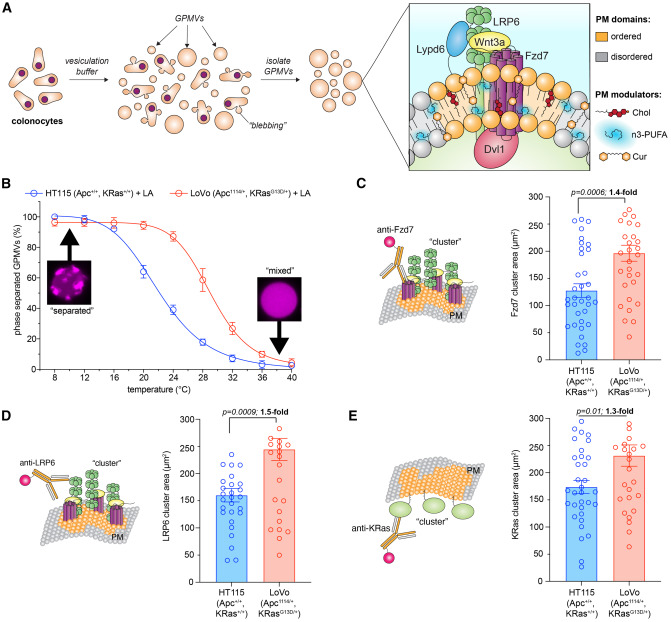
This study investigates how oncogenic APC and KRas mutations disrupt plasma membrane cholesterol homeostasis, increasing membrane order and receptor nanoclustering to promote colon tumorigenesis. Using human CRC cell lines and a mouse model, the authors show that mutant APC-KRas alters cholesterol metabolism genes, leading to elevated free cholesterol, membrane rigidity, and enlarged Wnt receptor and KRas nanoclusters. Notably, a chemoprotective diet combining n-3 PUFAs and curcumin reduces these effects, decreasing membrane cholesterol, order, receptor cluster size, cell proliferation, and dysplastic foci. The findings highlight membrane-targeted therapy as a potential strategy for colorectal cancer prevention.
Key Findings
The study reveals that oncogenic APC and KRas cooperatively dysregulate cholesterol homeostasis, increasing plasma membrane free cholesterol and order in colonocytes. This is associated with upregulated cholesterol uptake and synthesis genes and downregulated efflux genes. Super-resolution imaging shows enlarged Fzd7, LRP6, and KRas nanoclusters, enhancing Wnt and KRas signaling. Exogenous cholesterol alone increases membrane order and proliferation in organoids. Importantly, a diet rich in n-3 PUFAs and curcumin reverses these phenotypes, reducing membrane cholesterol, order, receptor cluster size, and cell proliferation in vitro and in vivo. In AKC mice, the diet decreases dysplastic foci, crypt length, and proliferative zone, demonstrating a chemoprotective effect.
Contribution
Creative Bioarray provided the HT115 human colorectal cancer cell line (CSC-C9449J), which served as a wild-type APC/KRas control in experiments comparing with mutant LoVo cells. This cell line was essential for investigating the effects of oncogenic APC and KRas on plasma membrane properties and signaling.
Ask a Question
Write your own review
Description: Established from an adenocarcinoma located in the ascending colon of a 68 year-old male patient. The adenocarcinoma was well differentiated and determined to be Dukes' stage B. Imperial College ...
Description: This is one cell line out of a series of colon carcinoma cell lines established by PD Dr. Michael Linnebacher.
Description: Rectal carcinoma from a Japanese patient. Cell growth is slow.
Description: The C80 cell line was established from a 69-year old male patient with a moderately well differentiated adenocarcinoma of the rectum classified as Dukes' stage D.
Description: RKO is a poorly differentiated colon carcinoma cell line developed by Michael Brattain.
- Adipose Tissue-Derived Stem Cells
- Human Neurons
- Mouse Probe
- Whole Chromosome Painting Probes
- Hepatic Cells
- Renal Cells
- In Vitro ADME Kits
- Tissue Microarray
- Tissue Blocks
- Tissue Sections
- FFPE Cell Pellet
- Probe
- Centromere Probes
- Telomere Probes
- Satellite Enumeration Probes
- Subtelomere Specific Probes
- Bacterial Probes
- ISH/FISH Probes
- Exosome Isolation Kit
- Human Adult Stem Cells
- Mouse Stem Cells
- iPSCs
- Mouse Embryonic Stem Cells
- iPSC Differentiation Kits
- Mesenchymal Stem Cells
- Immortalized Human Cells
- Immortalized Murine Cells
- Cell Immortalization Kit
- Adipose Cells
- Cardiac Cells
- Dermal Cells
- Epidermal Cells
- Peripheral Blood Mononuclear Cells
- Umbilical Cord Cells
- Monkey Primary Cells
- Mouse Primary Cells
- Breast Tumor Cells
- Colorectal Tumor Cells
- Esophageal Tumor Cells
- Lung Tumor Cells
- Leukemia/Lymphoma/Myeloma Cells
- Ovarian Tumor Cells
- Pancreatic Tumor Cells
- Mouse Tumor Cells