

WSU-FSCCL
Cat.No.: CSC-C0611
Species: Homo sapiens (Human)
Source: Blood; Peripheral Blood
Morphology: round to polymorph cells growing singly in suspension
Culture Properties: suspension
- Specification
- Background
- Scientific Data
- Q & A
- Customer Review
Immunology: CD3 -, CD10 +, CD13 -, CD19 +, CD34 -, CD37 +, CD38 +, CD80 +, CD138 -, HLA-DR +, sm/cyIgG -, sm/cyIgM +, sm/cykappa +, sm/cylambda -
Viruses: PCR: EBV -, HBV -, HCV -, HIV -, HTLV-I/
WSU-FSCCL is an established human B-cell lymphoma cell line, derived from a follicular small cleaved cell lymphoma, a prototypical germinal-center-origin non-Hodgkin lymphoma. As a representative of germinal-center B-cell lymphoma, WSU-FSCCL recapitulates the key biological attributes of follicular lymphoma, including t(14;18)(q32;q21) chromosomal translocation and resultant BCL2 overexpression and enhanced resistance to apoptosis. It is therefore a useful tool for mechanistic studies of lymphomagenesis and germinal-center B-cell survival.
The WSU-FSCCL cells grow densely clustered in suspension while showing typical small cleaved lymphoma cell features including irregular nuclear shapes and condensed chromatin with minimal cytoplasm. The immunophenotype of WSU-FSCCL is characterized by expression of CD19, CD20, CD22, HLA-DR, and surface immunoglobulin, along with germinal-center markers such as CD10. The phenotype is a close match to that of malignant B cells from follicular lymphoma, and the line's robust proliferation and growth make it suitable for use in functional immune and signaling studies.
In terms of functional behavior, WSU-FSCCL is strongly anti-apoptotic as a result of BCL2 dysregulation, has active B-cell receptor signaling, and has a number of downstream pathways, including NF-κB, PI3K/AKT, and JAK/STAT that are altered or hyperactive. The cell line is frequently used for preclinical evaluation of targeted agents (BCL2 inhibitors, CD20-directed antibodies, epigenetic modulators, etc.), as well as studies of drug resistance, microenvironmental dependence, and genetic perturbation.
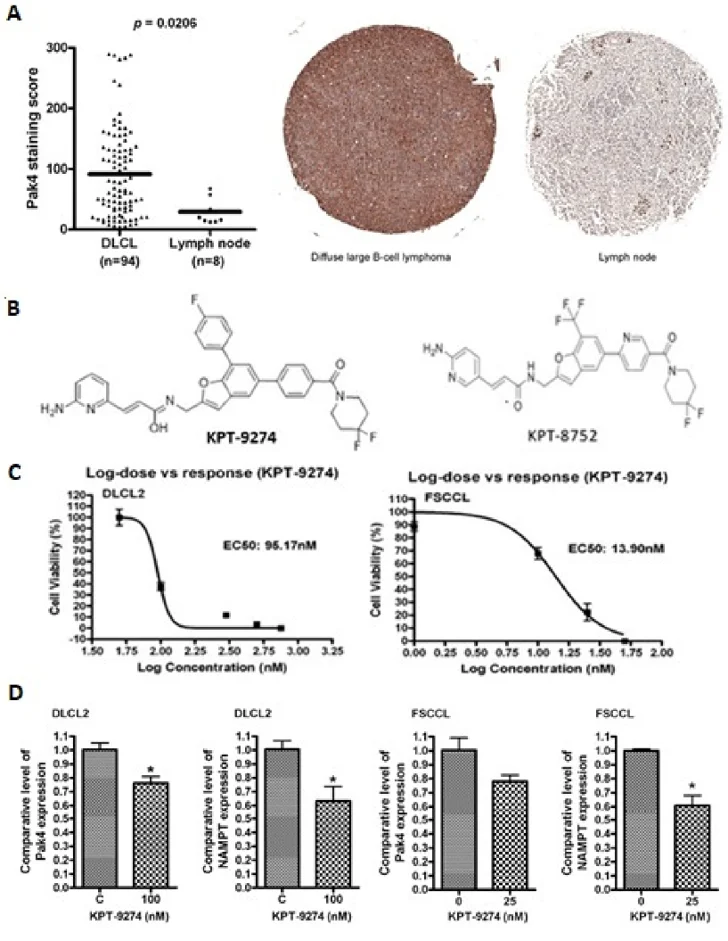
PAK4-NAMPT Is Essential for Lymphoma Cell Survival
Non-Hodgkin's lymphomas (NHL) are diverse, with aggressive subtypes like DLBCL and MCL, and indolent ones like FL. All NHL subtypes can metastasize if untreated. Khan et al. investigated the potential of a dual inhibitor, KPT-9274, targeting PAK4 and NAMPT, to induce energy depletion, inhibit cell proliferation, and trigger apoptosis in various NHL subtypes.
IHC on tissue microarrays showed higher PAK4 expression in NHL primary tumors vs. normal lymph nodes (Fig. 1A). PAK4 staining correlated with the proliferation index (Ki67) in high-grade lymphomas but was lower in low-grade NHLs. Exposure of lymphoma cells to low nanomolar concentrations of the dual PAK4-NAMPT inhibitor KPT-9274 (Fig. 1B) inhibited cell proliferation (Fig. 1C), with EC50 values of 95.17 nM in WSU-DLCL2 and 13.9 nM in WSU-FSCCL cells. To assess the effect on normal cells, PBMCs from a healthy, non-smoking donor were treated with KPT-9274 (0-750 nM) for 72 h. KPT-9274 did not significantly reduce cell viability even at 750 nM, with an EC50 of 1836 nM for PBMCs, much higher than for WSU-DLCL2 and WSU-FSCCL cells. KPT-9274 activity is not restricted to lymphoma models; they have shown cancer cell selectivity with high micromolar EC50s in normal peripheral lymphocytes and normal human pancreatic ductal epithelial cells (>500 nM). qRT-PCR results showed that KPT-9274 treatment reduced PAK4 and NAMPT expression in WSU-DLCL2 and WSU-FSCCL cells (Fig. 1D). These findings support their hypothesis that PAK4-NAMPT is critical for lymphoma cell survival and that targeting these proteins could be an effective strategy against these challenging diseases.
Ask a Question
Write your own review
- You May Also Need
Description: Established in 2007 from the bone marrow mononuclear cells of an 82-year-old Japanese man with diffuse large B-cell lymphoma in the leukemic phase

Description: Established from the bone marrow of a 28-year-old man who developed the terminal leukemic phase of lymphosarcoma in 1976
Description: This cell line was derived from the bone marrow aspirate of a 59 year old male with erythroleukemia that became acute myelogenous leukaemia.The cells form colonies in soft-agar in the presence of ...
Description: Established from the pleural effusion of a 24-year-old woman with recurrent anaplastic large cell lymphoma (ALCL); cells were described to clonally derive from T-lineage lymphoid cells and to be ...
Description: Established from a 37-year-old man at second (refractory/terminal) relapse of Hodgkin lymphoma (nodular sclerosing -> lymphocyte depleted/stage IIISA -> stage IV) after both combined chemo- and ...
Description: Established from the peripheral blood of a 10-year-old Caucasian boy with acute lymphoblastic leukemia (pre B-ALL) at diagnosis in 1993
- Adipose Tissue-Derived Stem Cells
- Human Neurons
- Mouse Probe
- Whole Chromosome Painting Probes
- Hepatic Cells
- Renal Cells
- In Vitro ADME Kits
- Tissue Microarray
- Tissue Blocks
- Tissue Sections
- FFPE Cell Pellet
- Probe
- Centromere Probes
- Telomere Probes
- Satellite Enumeration Probes
- Subtelomere Specific Probes
- Bacterial Probes
- ISH/FISH Probes
- Exosome Isolation Kit
- Human Adult Stem Cells
- Mouse Stem Cells
- iPSCs
- Mouse Embryonic Stem Cells
- iPSC Differentiation Kits
- Mesenchymal Stem Cells
- Immortalized Human Cells
- Immortalized Murine Cells
- Cell Immortalization Kit
- Adipose Cells
- Cardiac Cells
- Dermal Cells
- Epidermal Cells
- Peripheral Blood Mononuclear Cells
- Umbilical Cord Cells
- Monkey Primary Cells
- Mouse Primary Cells
- Breast Tumor Cells
- Colorectal Tumor Cells
- Esophageal Tumor Cells
- Lung Tumor Cells
- Leukemia/Lymphoma/Myeloma Cells
- Ovarian Tumor Cells
- Pancreatic Tumor Cells
- Mouse Tumor Cells