
JK-1
Cat.No.: CSC-C0403
Species: Homo sapiens (Human)
Morphology: round single cells growing in suspension (cell pellet shows reddish color hemoglobin)
Culture Properties: suspension
- Specification
- Background
- Scientific Data
- Q & A
- Customer Review
Immunology: CD3 -, CD13 (+), CD14 -, CD15 -, CD19 -, CD33 +, CD34 +, CD41 (+), CD42 (+), CD71 +, CD235a +
Viruses: ELISA: reverse transcriptase negative; PCR: EBV -, HBV
JK-1 is a human erythroleukemia cell line derived from a chronic myeloid leukemia patient in erythroid crisis. Its standout advantage lies in its exceptional permissiveness to Friend leukemia virus and other erythrotropic viruses, making it a superior model for viral entry, replication, and oncogenesis studies. Unlike many hematopoietic lines, JK-1 retains a robust capacity for hemoglobin synthesis upon chemical induction (e.g., hemin or DMSO), closely recapitulating terminal erythroid differentiation. This dual utility-viral susceptibility and inducible maturation-positions JK-1 as an indispensable tool for dissecting erythropoiesis, virus-host interactions, and leukemic transformation. Its stable growth kinetics and well-characterized erythroid genetic profile further enhance experimental reproducibility and translational relevance.
Invasion Ligand RBP1a of Plasmodium Vivax Targets Human TfR1, Prohibitin-2, and Basigin
Plasmodium vivax is the most widespread cause of malaria outside Africa. Developing effective controls is challenging because P. vivax exclusively invades reticulocytes, immature erythrocytes that are scarce and short-lived.
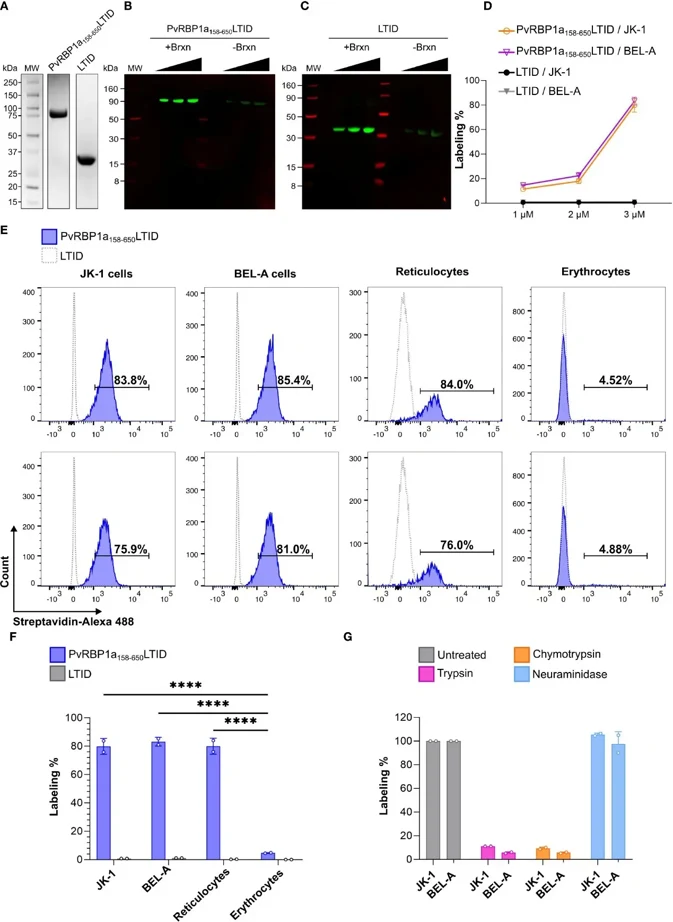
The erythroid cell lines JK-1 and BEL-A were evaluated in vitro as reticulocyte surrogates to assess their susceptibility to P. vivax invasion. Comparative membrane proteomics of these cell lines, reticulocytes, and mature erythrocytes were performed using quantitative liquid chromatography-mass spectrometry (LC-MS). Specific interactions between the parasite ligand PvRBP1a (residues 158-650) and candidate host receptors were identified by TurboID proximity labeling and validated through ELISA binding assays.
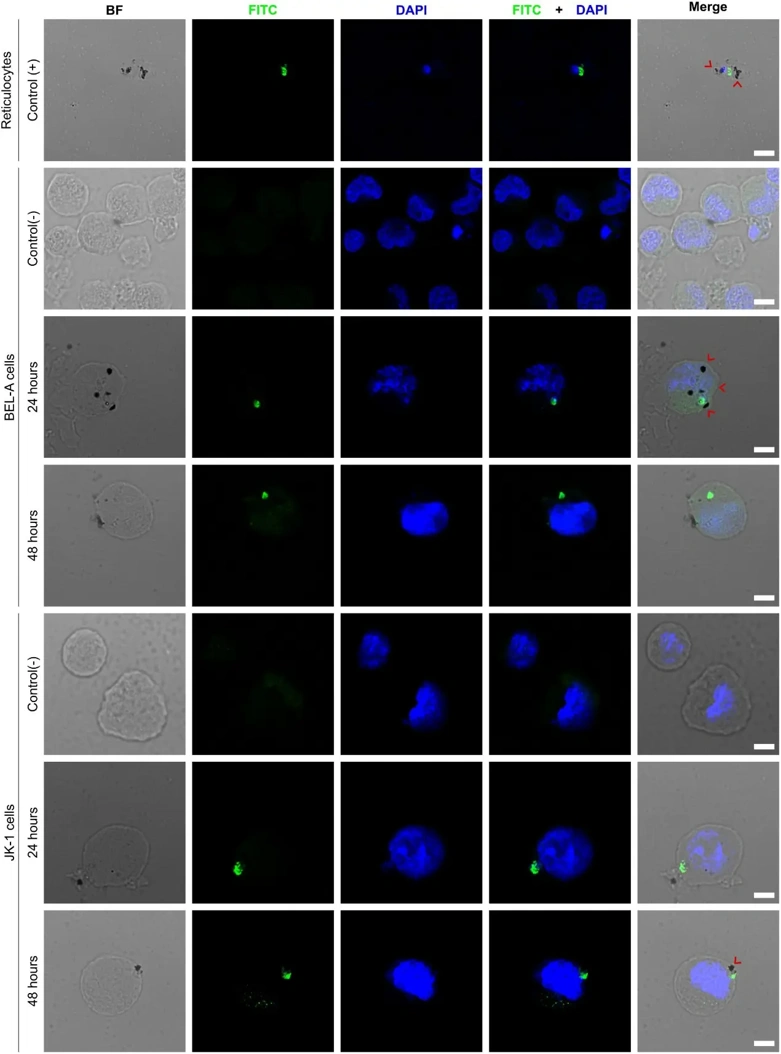
The results confirmed that the JK-1 cell line supports P. vivax invasion and demonstrated for the first time that BEL-A cells are similarly susceptible, establishing both as effective surrogate models. Membrane proteomics identified several receptor candidates potentially involved in selective host-cell entry. In addition to known receptors, including transferrin receptor protein 1 (TfR1/CD71), CD98hc, and basigin (BSG), novel receptor candidates such as prohibitin-2 (PHB2), CAT-1 (SLC7A1), ATB(0) (SLC1A5), CD36, integrin beta-1 (ITGB1), and metal transporter CNNM3 were discovered. Proximity labeling with a recombinant PvRBP1a (158-650)-TurboID fusion protein confirmed the known interactions with TfR1 and BSG, and additionally identified PHB2 as a novel interacting partner. Notably, this is the first report implicating PHB2 as a co-receptor for P. vivax invasion.
Ask a Question
Write your own review
- You May Also Need
Description: Established in 2007 from the bone marrow mononuclear cells of an 82-year-old Japanese man with diffuse large B-cell lymphoma in the leukemic phase
Description: Established from the bone marrow of a 28-year-old man who developed the terminal leukemic phase of lymphosarcoma in 1976
Description: This cell line was derived from the bone marrow aspirate of a 59 year old male with erythroleukemia that became acute myelogenous leukaemia.The cells form colonies in soft-agar in the presence of ...
Description: Established from the pleural effusion of a 24-year-old woman with recurrent anaplastic large cell lymphoma (ALCL); cells were described to clonally derive from T-lineage lymphoid cells and to be ...
Description: Established from a 37-year-old man at second (refractory/terminal) relapse of Hodgkin lymphoma (nodular sclerosing -> lymphocyte depleted/stage IIISA -> stage IV) after both combined chemo- and ...
Description: Established from the peripheral blood of a 10-year-old Caucasian boy with acute lymphoblastic leukemia (pre B-ALL) at diagnosis in 1993
- Adipose Tissue-Derived Stem Cells
- Human Neurons
- Mouse Probe
- Whole Chromosome Painting Probes
- Hepatic Cells
- Renal Cells
- In Vitro ADME Kits
- Tissue Microarray
- Tissue Blocks
- Tissue Sections
- FFPE Cell Pellet
- Probe
- Centromere Probes
- Telomere Probes
- Satellite Enumeration Probes
- Subtelomere Specific Probes
- Bacterial Probes
- ISH/FISH Probes
- Exosome Isolation Kit
- Human Adult Stem Cells
- Mouse Stem Cells
- iPSCs
- Mouse Embryonic Stem Cells
- iPSC Differentiation Kits
- Mesenchymal Stem Cells
- Immortalized Human Cells
- Immortalized Murine Cells
- Cell Immortalization Kit
- Adipose Cells
- Cardiac Cells
- Dermal Cells
- Epidermal Cells
- Peripheral Blood Mononuclear Cells
- Umbilical Cord Cells
- Monkey Primary Cells
- Mouse Primary Cells
- Breast Tumor Cells
- Colorectal Tumor Cells
- Esophageal Tumor Cells
- Lung Tumor Cells
- Leukemia/Lymphoma/Myeloma Cells
- Ovarian Tumor Cells
- Pancreatic Tumor Cells
- Mouse Tumor Cells