

Immortalized Human Bone Marrow-Derived Mesenchymal Stem Cells-SV40 (Tet-on)
Cat.No.: CSC-I1907Z
Species: homo sapiens
Morphology: Polygonal
Culture Properties: Adherent
- Specification
- Background
- Scientific Data
- Q & A
- Customer Review
CIK-HT004 HT? Lenti-SV40 (tsA58 temperature sensitive mutant) Lentivirus Immortalization Kit
Note: Never can cells be kept at -20 °C.
Immortalized human bone marrow-derived mesenchymal stem cells (BM-MSCs) were established via stable introduction of the Simian Virus 40 large T antigen (SV40T), which inactivates p53- and pRB-dependent cell cycle checkpoints, thereby bypassing replicative senescence and enabling continuous proliferation. The incorporation of the Tet-on inducible expression system (reverse tetracycline-controlled transactivator) provides an additional layer of experimental control. In this system, gene expression of interest is tightly regulated by doxycycline, allowing precise temporal induction or repression of transgenes. This feature is particularly valuable for studying dose-dependent or time-sensitive gene functions without the confounding effects of constitutive expression.
Key advantages of this cell line include: (1) unlimited proliferative capacity while maintaining typical MSC morphology (fibroblast-like, adherent); (2) preservation of surface marker profile (CD73+, CD90+, CD105+, CD14-, CD34-, CD45-); (3) retention of multilineage differentiation potential into osteocytes, chondrocytes, and adipocytes under appropriate inductive conditions; (4) genomic stability without tumorigenicity in immunodeficient hosts; (5) Tet-on inducibility enabling conditional gene expression studies; and (6) batch-to-batch consistency eliminating primary culture variability.
Collectively, Immortalized Human BM-MSCs-SV40 (Tet-on) provide a robust, reproducible, and versatile in vitro platform for mechanistic studies of MSC biology, bone and cartilage regeneration, gene function analysis, and high-throughput drug screening, circumventing the inherent limitations of primary MSCs.
Context-Dependent Modulation of Breast Cancer Cell by Immortalized Human Mesenchymal Stem Cells In Vitro
The major event that leads to death from breast cancer (BrCa) is the emergence of micrometastases into lethal growing metastases. While it is still uncertain what regulates the cell fate decision between remaining in dormancy and aggressive proliferative progression, accumulating evidence demonstrates a major role for the metastatic microenvironment. One area of interest is that of tissue and circulating mesenchymal stem cells (MSCs), which have been shown to alter the proliferative and metastatic potential of BrCa. Herein, Dai, Bei investigated how these cells impact the phenotype of metastatic BrCa. As the disseminated BrCa cells initially adopt an epithelial phenotype in ectopic organs, one that is dormant in having limited proliferation and being immune-silent, interactions that revert the disseminated metastatic BrCa to aggressive mesenchymal phenotypes, would be a driver of metastatic progression.
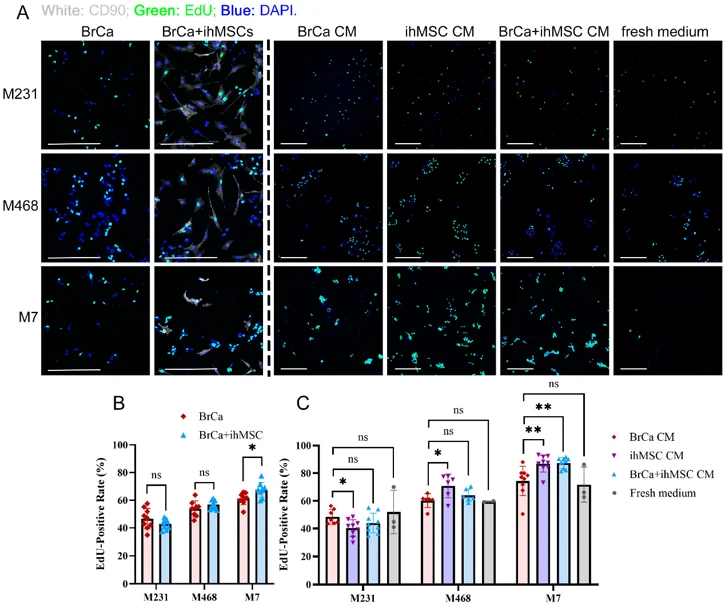
BrCa cells exhibited phenotypic changes including increased E-cadherin expression, altered proliferation, and differential sensitivity to TRAIL-induced apoptosis when directly co-cultured with immortalized human MSCs, compared to the BrCa cells not co-cultured. These regulatory effects were dependent upon the BrCa cell's epithelial-mesenchymal status and involved distinct juxtacrine and paracrine signaling mechanisms, as evidenced by differing responses in direct co-culture, conditioned medium, and Transwell systems. These findings highlight the complex and context-dependent roles of MSCs in BrCa progression.
Ask a Question
Write your own review

Description: Nasal epithelial cells form the outermost protective layer against environmental factors. They clean, humidify, and warm inhaled air. They produces mucus, which binds particles that are subsequently ...
Description: Immortalized Human Splenic Endothelial Cells-SV40 have been obtained immortalizing Human Splenic Endothelial Cells with SV40LT expressing lentiviral particles. Immortalized cells were controlled ...
Description: Immortalized Human Corneal Epithelial Cells-SV40 have been obtained immortalizing Human Corneal Epithelial Cells with Lenti-SV40 Lentivirus. Immortalized cells were controlled passaging side by side ...
Description: Immortalized Human Lymphatic Endothelial Cells-SV40 were developed from human tissues transduced with a lentiviral expression vector containing the SV40T gene. The cell line was continuously cultured ...
- Adipose Tissue-Derived Stem Cells
- Human Neurons
- Mouse Probe
- Whole Chromosome Painting Probes
- Hepatic Cells
- Renal Cells
- In Vitro ADME Kits
- Tissue Microarray
- Tissue Blocks
- Tissue Sections
- FFPE Cell Pellet
- Probe
- Centromere Probes
- Telomere Probes
- Satellite Enumeration Probes
- Subtelomere Specific Probes
- Bacterial Probes
- ISH/FISH Probes
- Exosome Isolation Kit
- Human Adult Stem Cells
- Mouse Stem Cells
- iPSCs
- Mouse Embryonic Stem Cells
- iPSC Differentiation Kits
- Mesenchymal Stem Cells
- Immortalized Human Cells
- Immortalized Murine Cells
- Cell Immortalization Kit
- Adipose Cells
- Cardiac Cells
- Dermal Cells
- Epidermal Cells
- Peripheral Blood Mononuclear Cells
- Umbilical Cord Cells
- Monkey Primary Cells
- Mouse Primary Cells
- Breast Tumor Cells
- Colorectal Tumor Cells
- Esophageal Tumor Cells
- Lung Tumor Cells
- Leukemia/Lymphoma/Myeloma Cells
- Ovarian Tumor Cells
- Pancreatic Tumor Cells
- Mouse Tumor Cells