
Immortalized Equine Lung Cells (extEqFL)
Cat.No.: CSC-I9288L
Species: Equine
Source: Lung
Morphology: Polygonal
Culture Properties: Adherent
- Specification
- Background
- Scientific Data
- Q & A
- Customer Review
Note: Never can cells be kept at -20 °C.
2) PCR analysis for HPV16 E6/E7 presence
extEqFL refers to Immortalized Equine Lung cell line. These cells are used extensively as an in vitro model and originated from fetal lung cells of horses. Created by transduction with LXSN116E6E7 retroviral vector containing human papillomavirus type 16 E6/E7 oncogenes, they have been passaged for over 40 times with retention of epithelial like morphology and normal growth properties. They allow for an unlimited source of equine cells in a laboratory setting due to their immortality, bypassing the usual senescence seen in primary cultures. extEqFL cells are used to research viruses that target the respiratory system of horses. The cells support replication of equine gammaherpesviruses EHV-2 and EHV-5 extremely well, allowing for analysis of replication and other viral property studies. They have also been used in studies with other viruses such as Henipaviruses (family Paramyxoviridae), specifically Hendra virus (HeV) as a model for
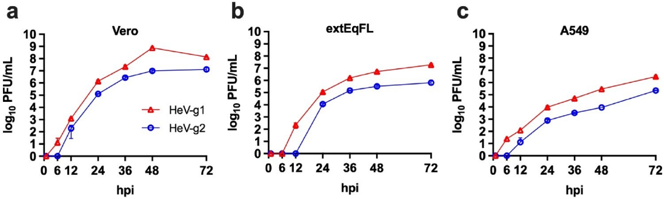
In Vitro Characterization of Viral Growth Kinetics of Hev-G1 and Hev-G2
Hendra virus is a lethal zoonotic pathogen with no approved human countermeasures, requiring nonhuman primate models for therapeutic evaluation. Pigeaud et al. compared the pathogenesis of the classic genotype 1 and the emerging genotype 2 Hendra virus in African green monkeys to assess their relative virulence and human health risk.
Replication kinetics of HeV-g1 and HeV-g2 were compared by infecting African green monkey, human, and equine-derived cell lines, with viral titers in supernatants measured by plaque assay (Fig. 1). In all cell types, HeV-g2 replication was slower and peak titers were lower than HeV-g1. Specifically, in Vero cells, HeV-g2 peaked at 7.1 log₁₀ PFU/mL versus 8.9 for HeV-g1; in human A549 cells at 5.4 versus 6.5 log₁₀ PFU/mL; and in equine extEqFL cells at 5.8 versus 7.3 log₁₀ PFU/mL.
Ask a Question
Write your own review
Description: Immortalized Cynomolgus Monkey Pulmonary Artery Smooth Muscle Cells-GFP provided by Creative Bioarray have been developed by immortalizing cynomolgus monkey pulmonary artery smooth muscle cells with ...

Description: Immortalized Monkey Spleen Fibroblasts-SV40T were developed from monkey tissues transduced with a lentiviral expression vector containing the SV40T gene. The cell line was continuously cultured for ...
Description: Immortalized Monkey Bronchial Fibroblasts-GFP provided by Creative Bioarray have been developed by immortalizing monkey bronchial fibroblasts with SV40 Large T antigen and transfecting with tGFP. The ...
Description: Immortalized Canine Kidney Fibroblasts-SV40 have been obtained immortalizing Canine Kidney Fibroblasts with Lenti-SV40 Lentivirus. Immortalized cells were controlled passaging side by side with the ...
Description: Immortalized Monkey Primary Aortic Endothelial Cells-GFP provided by Creative Bioarray have been developed by immortalizing primary monkey aortic endothelial cells with SV40 Large T antigen and ...
Description: Immortalized Monkey Pancreatic Epithelial Cells-SV40T were developed from monkey tissues transduced with a lentiviral expression vector containing the SV40T gene. The cell line was continuously ...
- Adipose Tissue-Derived Stem Cells
- Human Neurons
- Mouse Probe
- Whole Chromosome Painting Probes
- Hepatic Cells
- Renal Cells
- In Vitro ADME Kits
- Tissue Microarray
- Tissue Blocks
- Tissue Sections
- FFPE Cell Pellet
- Probe
- Centromere Probes
- Telomere Probes
- Satellite Enumeration Probes
- Subtelomere Specific Probes
- Bacterial Probes
- ISH/FISH Probes
- Exosome Isolation Kit
- Human Adult Stem Cells
- Mouse Stem Cells
- iPSCs
- Mouse Embryonic Stem Cells
- iPSC Differentiation Kits
- Mesenchymal Stem Cells
- Immortalized Human Cells
- Immortalized Murine Cells
- Cell Immortalization Kit
- Adipose Cells
- Cardiac Cells
- Dermal Cells
- Epidermal Cells
- Peripheral Blood Mononuclear Cells
- Umbilical Cord Cells
- Monkey Primary Cells
- Mouse Primary Cells
- Breast Tumor Cells
- Colorectal Tumor Cells
- Esophageal Tumor Cells
- Lung Tumor Cells
- Leukemia/Lymphoma/Myeloma Cells
- Ovarian Tumor Cells
- Pancreatic Tumor Cells
- Mouse Tumor Cells