In Vitro Permeability and Transporters
Creative Bioarray provides a number of in vitro permeability and transporter assays to evaluate drug permeability and predict drug absorption and distribution, including Caco-2 permeability assay, MDCK permeability assay, Parallel artificial membrane permeability assay (PAMPA), and a panel of transporter assays on several of the most relevant transporters such as canine P-glycoprotein (P-gp), BCRP, BSEP, OAT1, OAT3, OATP1B1, OATP1B3, OCT1, and OCT2.
Prediction of drug absorption is an important goal in the design, optimization, and selection of drugs. Drug permeability across biological membranes is a key factor in the absorption of drugs across gastrointestinal mucosa and the distribution of drugs to tissues through blood circulation. Poor permeability can lead to poor absorption (for orally administered drugs) or poor distribution throughout the body. The permeability of a drug across a membrane depends on both the passive diffusion and the active transport of the drug.
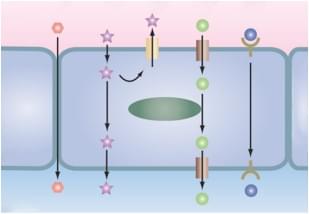
There are a number of in vitro cell-based or cell-free methods to study drug permeability and transporter interactions:
Caco-2 permeability assay is the gold standard method to evaluate both the passive and active transport and the absorption of orally taken drugs. The method can be used to assess the bidirectional permeability of a test compound (from the apical to the basolateral side or vice versa).
MDCK permeability assay is a useful tool for the identification of substrates and inhibitors of efflux transporters P-gp, and for the calculation of net flux ratio.
PAMPA, a cell-free method that uses a lipid-infused artificial membrane to determine the passive permeability of substances from a donor compartment to an acceptor compartment, is a widely used assay to predict oral absorption that exhibit a high degree of correlation with Caco-2 assay. Mechanism of drug absorption can be better estimated combining the results of PAMPA and of Caco-2 assay.
Other related assays and transporter assays are also available. We provide assays on a variety of transporters, including but not limited to P-gp, BCRP, BSEP, OAT1, OAT3, OATP1B1, OATP1B3, OCT1, and OCT2. Contact us for more information.
Study Example
Discovery of novel brain permeable human ACSS2 inhibitors for blocking breast cancer brain metastatic growth
Background
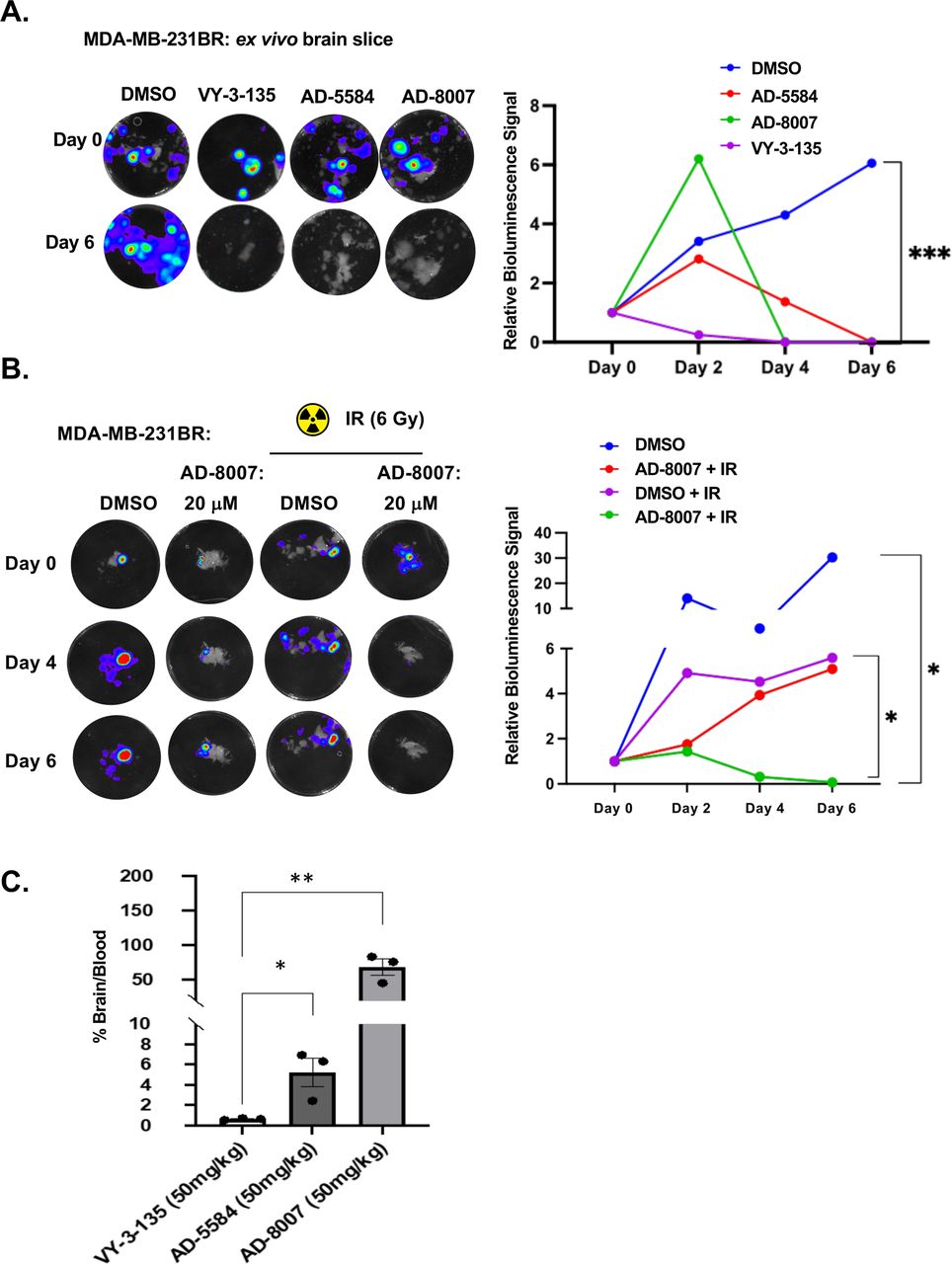
This preprint reports the discovery of novel blood-brain barrier-permeable inhibitors of acetyl-CoA synthetase 2 (ACSS2) to treat breast cancer brain metastasis (BCBM). Using computational pharmacophore screening and ADME predictions, the authors identified AD-5584 and AD-8007, which bind ACSS2, show metabolic stability, and cross the BBB. In MDA-MB-231BR BCBM cells, these compounds reduce lipid storage, colony formation, and increase cell death. In ex vivo brain-slice tumor models, they reduce tumor growth and synergize with radiation. In vivo, both compounds reach the brain, supporting further development.
Key Findings
The study identified 30 potential ACSS2 binders via a computational pipeline combining pharmacophore-based shape screening with ADME/CNS predictions. Two leads, AD-5584 and AD-8007, bound human ACSS2 with low-micromolar affinity, inhibited ATPase activity, and showed improved predicted metabolic stability. In MDA-MB-231BR BCBM cells, both compounds reduced lipid droplet content and clonogenic survival and increased propidium iodide-positive cell death. In an ex vivo orthotopic brain-slice tumor model, AD-5584 and AD-8007 significantly reduced tumor size, did not harm normal brain tissue, and AD-8007 synergized with 6 Gy radiation to block BCBM growth. Following intraperitoneal injection, LC-MS detected both compounds in brain at significantly higher levels than control VY-3-135, confirming BBB permeability. AD-8007 showed high metabolic stability (T1/2 >145 min), AD-5584 moderate stability (T1/2 20 min), and AD-8007 had a low efflux ratio in MDR1-MDCK assays. These first-in-class brain-permeable ACSS2 inhibitors are promising candidates for breast cancer brain metastasis.
Contribution
Creative Bioarray performed the in vitro permeability assessment of AD-8007 and AD-5584 using MDR1-MDCK1 cells, providing Papp, efflux ratio, and recovery data. This service supported the BBB penetration evaluation and helped validate these compounds as brain-permeable ACSS2 inhibitors.
Creative Bioarray is staffed with experienced experts in the field of drug development. We are dedicated to serving our customers with well-developed assays and high quality data, helping our customers achieve a trouble-free drug screening and optimizing experience. We are capable of tailoring the assays in order to meet your needs. If you have any questions, please feel free to contact us. We look forward to working with you in the future.
Explore Other Options