
Human Pancreatic Epithelial Cells
Cat.No.: CSC-C9227J
Species: Human
Source: Pancreas
Cell Type: Epithelial Cell
- Specification
- Scientific Data
- Q & A
- Customer Review
Ubiquitination of Oncogenic Mutant p53 via Attenuation of Ribosome Biogenesis Machinery Effectively Inhibits Pancreatic Tumor Growth
Background
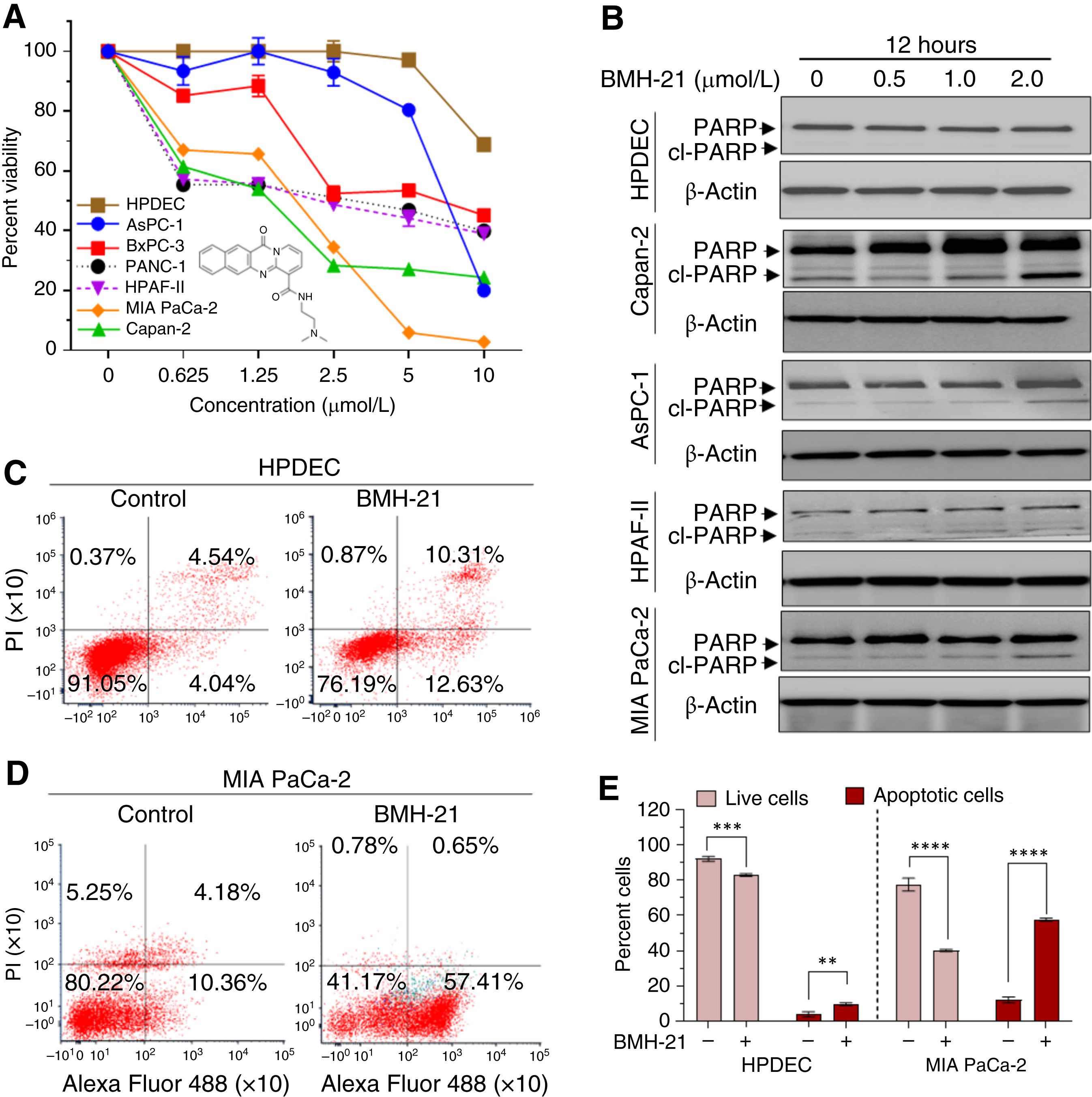
Pancreatic cancer features dysregulated ribosome biogenesis and frequent p53 mutations. This study demonstrates that BMH-21, an RNA polymerase I inhibitor, selectively induces apoptosis and inhibits growth of pancreatic cancer cells while sparing normal pancreatic epithelial cells. BMH-21 degrades RPA194, suppresses pre-rRNA synthesis, and triggers nucleolar stress. Importantly, RPA194 interacts with p53, and BMH-21-induced RPA194 degradation selectively promotes ubiquitination of mutant/truncated p53 without affecting wild-type p53. In orthotopic xenografts, BMH-21 significantly inhibits pancreatic tumor growth with no observed toxicity.
Key Findings
Key findings: (1) BMH-21 selectively induces apoptosis and inhibits proliferation of pancreatic cancer cells but not normal human pancreatic ductal epithelial cells. (2) BMH-21 triggers proteasomal degradation of RPA194, the catalytic subunit of RNA polymerase I, and inhibits recruitment of RPA194 and RPA135 to rDNA, suppressing pre-rRNA synthesis. (3) BMH-21 induces nucleolar stress, marked by dispersal of nucleolar proteins FBL and NCL. (4) RPA194 physically interacts with p53; BMH-21-mediated RPA194 degradation selectively exposes truncated and mutant p53 (Δp53 in AsPC-1; R248W in MIA PaCa-2) to ubiquitination, while wild-type p53 in Capan-2 cells remains non-ubiquitinated. (5) In orthotopic xenograft mouse models, BMH-21 significantly reduces pancreatic tumor growth, tumor weight, and volume, and decreases RPA194, Ki-67, PCNA, and mutant p53 expression by IHC, with no apparent systemic toxicity.
Contribution
Creative Bioarray provided the normal human pancreatic ductal epithelial (HPDE) cells used as a non-cancerous control. These cells enabled assessment of BMH-21 selectivity, showing no cytotoxicity up to 5 μmol/L and a high IC50, establishing a therapeutic window over pancreatic cancer cells.
Ask a Question
Write your own review
Description: Human Pancreatic Microvascular Endothelial Cells from Creative Bioarray are isolated from human pancreatic tissue. Human Pancreatic Microvascular Endothelial Cells are grown in T25 tissue culture ...
Description: Pancreatic Stellate Cells (HPaSteC) are the main fibroblastic cells of the pancreas. HPaSteC are responsible for the synthesis and the degradation of the extracellular matrix proteins that promote ...
Description: Recent research indicates cancer associated fibroblasts (CAFs) significant involvement in crucial aspects of epithelial solid tumor biology, specifically neoplastic progression, tumor growth, ...
Description: Primary Human Pancreatic Stromal Cells were initiated by elutriation from normal human pancreatic tissue.These cells were originated using Complete Serum-Free Medium Kit With SuperFuel™, are ...

Description: Human Pancreatic Islets are isolated from the pancreas of human using Collagenase P and purified using Ficoll density gradient.
Description: Human Primary Pancreatic Fibroblasts are isolated from normal human pancreatic tissue. Human Primary Pancreatic Fibroblasts are grown in T75 tissue culture flasks pre-coated with gelatin-based ...