
Primary Human Pancreatic Stromal Cells
Cat.No.: CSC-C4365X
Species: Human
Source: Pancreas
Cell Type: Stromal Cell
- Specification
- Background
- Scientific Data
- Q & A
- Customer Review
These cells were originated using Complete Serum-Free Medium Kit With SuperFuel™, are available at <12 Cumulative Population Doublings (CPD) in vitro [Passage 3] and were cryopreserved in aliquots of ~1.5 X 10^6 cells. This vial will initiate a Passage 4 cell culture in a 75cm2 flask.
Primary Human Pancreatic Stromal Cells are primary stromal cells derived from human pancreatic tissue. Most of these cells belong to the population of fibroblast-like and mesenchymal stromal cells involved in the formation of the structural framework and microenvironment of the pancreas. Stromal cells are essential elements of pancreatic tissue, contributing to extracellular matrix (ECM) architecture, cell-cell communication and regulation of local tissue homeostasis.
Primary Human Pancreatic Stromal Cells are employed for studies of pancreatic stromal biology, fibroblast activation, extracellular matrix remodeling, and stromal-epithelial cell interactions. These cells can be used to study pancreatic development, tissue healing, fibrosis and disease-associated alterations in the microenvironment. In pancreatic cancer research, pancreatic stromal cells and cancer-associated fibroblast (CAF)-like populations are often researched to understand the role of stromal components in tumor cell behavior, signaling pathways, and therapeutic responses.
Recent research has used human pancreatic stromal cells in co-culture systems and organoid models to explore the impact of stromal factors to pancreatic epithelial proliferation and tissue structure. These cells have also been examined for their responses to signaling pathways involved in fibrosis and matrix modulation including TGF-β related pathways.
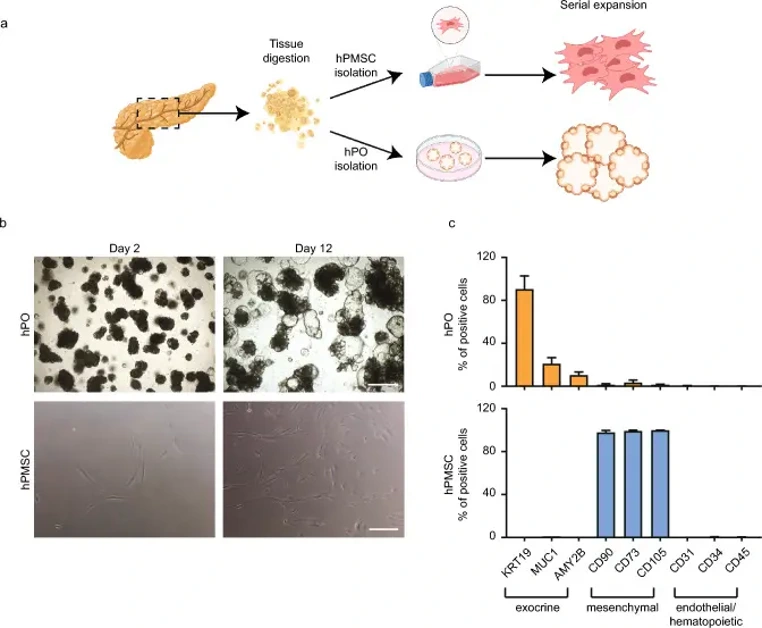
Phenotypic and Functional Characterization of Human Pancreatic Mesenchymal Stromal Cells (hPMSC) and Pancreatic Organoids (hPO)
Human pancreatic organoids (hPO) exhibited a phenotypically heterogeneous epithelial population expressing KRT19, MUC1, and AMY2B, with no detectable mesenchymal or endothelial components (Fig. 1c, upper panel). In contrast, human pancreatic mesenchymal stromal cells (hPMSC) fulfilled the International Society for Cell Therapy criteria, expressing canonical mesenchymal surface antigens (CD73, CD90, CD105) and lacking epithelial and hematopoietic markers (Fig. 1c, lower panel). Molecular analysis of lineage-specific markers corroborated these immunophenotyping results.
Functional assays confirmed the mesenchymal identity of hPMSC, as they differentiated into osteoblast-like and adipocyte-like cells under standard in vitro conditions. Alizarin Red and Oil Red O staining, alongside molecular confirmation, demonstrated successful osteogenic and adipogenic differentiation. DNA profiling verified that syngeneic hPMSC and hPO were consistently derived from the same pancreatic donor samples, eliminating biases associated with unrelated donors. These findings establish the distinct phenotypic identities of hPO and hPMSC and provide a validated experimental system for studying their interactions in a physiologically relevant, donor-matched context.
Ask a Question
Write your own review
Description: Human Pancreatic Microvascular Endothelial Cells from Creative Bioarray are isolated from human pancreatic tissue. Human Pancreatic Microvascular Endothelial Cells are grown in T25 tissue culture ...

Description: Pancreatic Stellate Cells (HPaSteC) are the main fibroblastic cells of the pancreas. HPaSteC are responsible for the synthesis and the degradation of the extracellular matrix proteins that promote ...
Description: Recent research indicates cancer associated fibroblasts (CAFs) significant involvement in crucial aspects of epithelial solid tumor biology, specifically neoplastic progression, tumor growth, ...
Description: Human Pancreatic Islets are isolated from the pancreas of human using Collagenase P and purified using Ficoll density gradient.
Description: Human Primary Pancreatic Fibroblasts are isolated from normal human pancreatic tissue. Human Primary Pancreatic Fibroblasts are grown in T75 tissue culture flasks pre-coated with gelatin-based ...
Description: Human Pancreatic Epithelial Cells from Creative Bioarray are isolated from normal human pancreatic tissue. Human Pancreatic Epithelial Cells are grown in T25 tissue culture flasks pre-coated with ...