
Canine Bladder Epithelial Cells
Cat.No.: CSC-C9111J
Species: Dog
Source: Bladder
Cell Type: Epithelial Cell
- Specification
- Scientific Data
- Q & A
- Customer Review
Urothelial genotoxicity of environmental chemicals detected in the urine of healthy dogs and their owners
Background
This study tested whether urinary acrolein and inorganic arsenic exposures, previously detected in healthy pet dogs and their owners, reach genotoxic concentrations in urothelial cells. Using γ-H2AX and CometChip assays in immortal and primary human and canine urothelial cells, researchers identified species-specific DNA-damage thresholds. Acrolein was genotoxic at lower concentrations in human cells than canine cells, and urinary levels in many healthy humans and some dogs exceeded these thresholds. Inorganic arsenic thresholds were ≥10 μM, not reached in single-time-point urine samples. The findings suggest non-tobacco household acrolein exposure may contribute to early urothelial DNA damage.
Key Findings
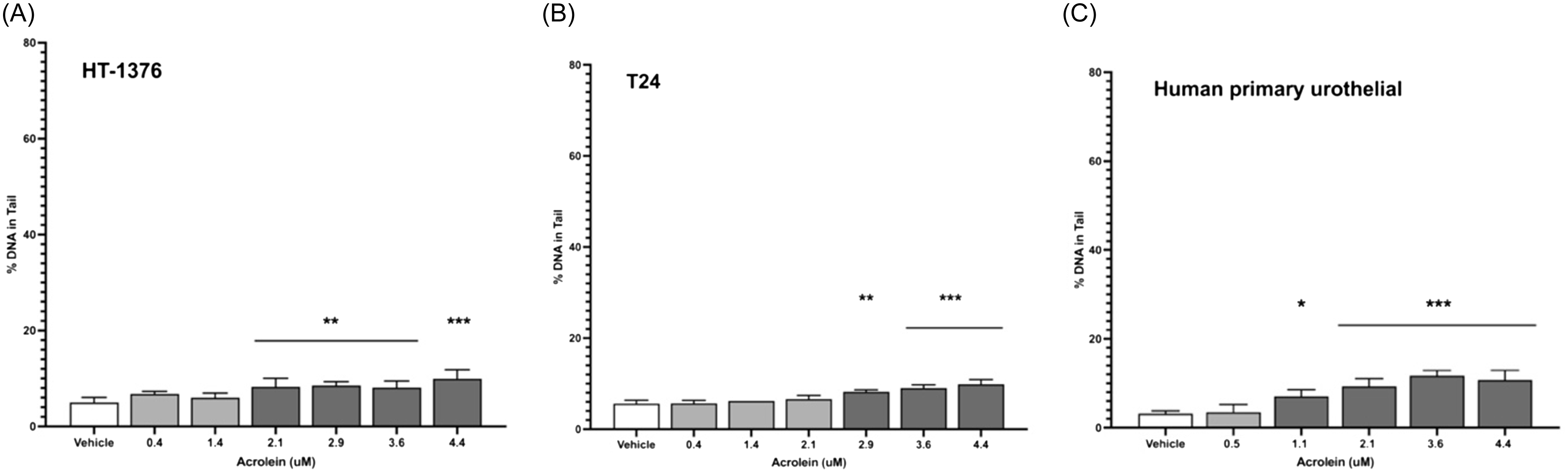
Acrolein produced concentration-dependent DNA damage in human and canine urothelial cells. Genotoxic thresholds were 1.1–4.4 μM in human cells (immortal HT-1376/T24 and primary) and 20.0–55.6 μM in canine cells (K9TCC-AxC/K9TCC-SH and primary). Based on these thresholds, 51% of previously surveyed healthy human subjects and 17% of pet dogs had potentially genotoxic urinary acrolein exposures at a single time point. Inorganic arsenic showed genotoxic thresholds of ≥10 μM in primary human and canine urothelial cells and in K9TCC-SH cells, but only at 75 μM in some immortal lines. No healthy human or canine subject reached the ≥10 μM urinary inorganic arsenic threshold when assayed at a single time point. The γ-H2AX assay was insensitive to arsenic because arsenic inhibits ATM-mediated H2AX phosphorylation; therefore, the alkaline CometChip assay was used for arsenic and parallel acrolein experiments. The results suggest non-tobacco, non-occupational acrolein exposure may cause early urothelial DNA damage in both species.
Contribution
Creative Bioarray provided primary canine urothelial cells (Cat No. CSC-C9111J, Donor ID 363633) and SuperCult® bladder epithelial cell medium (Cat No. CM-C9111J). These reagents enabled the study’s species-comparative in vitro experiments, allowing researchers to determine acrolein and inorganic arsenic genotoxic thresholds in primary canine urothelial cells.
Ask a Question
Write your own review
Description: Canine Vein Smooth Muscle Cells are isolated from vena cava tissue of beagle dog.
Description: Dog Liver Endothelial Cells from Creative Bioarray are isolated from tissue of dog liver. Dog Liver Endothelial Cells are grown in T25 tissue culture flasks pre-coated with gelatin-based coating ...
Description: Canine Astrocytes from Creative Bioarray are isolated from canine brain tissue. The method we use to isolate canine astrocytes were developed based on a combination of established and our proprietary ...
Description: Canine Mammary Microvascular Endothelial Cells from Creative Bioarray are isolated from breast of pathogen-free laboratory Canine. Canine Mammary Microvascular Endothelial Cells are grown in T25 ...
Description: Canine Chondrocytes (CnC) provided by Creative Bioarray are isolated from normal canine articular cartilage tissue. The cells are frozen at passage 1 and each vial contains at least 0.5*10^6 cells. ...
Description: Canine Pancreatic Microvascular Endothelial Cells from Creative Bioarray are isolated from Pancreatic Microvascular of pathogen-free laboratory Canine. Canine Pancreatic Microvascular Endothelial ...