
SuperCult® Mouse Smooth Muscle Cell Medium
- Specification
- Scientific Data
- Q & A
- Customer Review
The medium consists of 500 ml of basal medium (containing essential and non-essential amino acids, vitamins, organic and inorganic compounds, hormones, growth factors, trace minerals), supplemented with cell culture supplement, antibiotics, and fetal bovine serum.
Protect from light.
To assure sterility, the prepared medium should be filtered with a 0.2 um filter after 2 weeks or if there is concern that sterility was compromised during the supplementation process.
DDR1 Regulates Femoral Arterial Calcification in Lower-Extremity Artery Disease Through NF-Kappa B Activation
Background
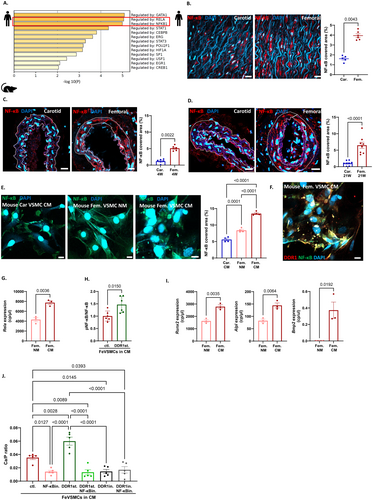
Lower-extremity artery disease (LEAD) is marked by medial arterial calcification (MAC), but its molecular drivers remain unclear. Comparing femoral and carotid arteries from patients and Apoe−/− mice, this study found greater calcification and pro-calcifying gene/protein expression (BMP2, RUNX2, TNAP) in femoral vessels. DDR1 was elevated in femoral arteries and vascular smooth muscle cells, correlating with calcification. DDR1 activation promoted calcification via NF-κB p65, while DDR1 or NF-κB inhibition reduced it. DDR1 may be a therapeutic target for femoral MAC in LEAD.
Key Findings
Femoral arteries and femoral vascular smooth muscle cells (VSMCs) showed significantly greater calcification and higher expression of pro-calcifying markers BMP2, RUNX2 and TNAP than carotid arteries/VSMCs in human atherosclerotic samples and hyperlipidemic Apoe−/− mice. DDR1 was upregulated in femoral arteries and VSMCs and positively correlated with calcification in human femoral specimens. In vitro, DDR1 inhibition reduced, while DDR1 stimulation increased, calcium deposition specifically in femoral VSMCs, with no effect in carotid VSMCs. Transcriptomic and immunofluorescence analyses revealed elevated NF-κB p65 in femoral arteries. DDR1 stimulation activated NF-κB, and NF-κB inhibition blocked DDR1-induced calcification, linking DDR1 to NF-κB-dependent BMP2/RUNX2 expression. These findings identify DDR1 as a key driver of medial arterial calcification in LEAD and a potential therapeutic target.
Contribution
Creative Bioarray provided murine carotid and femoral artery smooth muscle cells (Cat. Nos. CSC-C5356S and CSC-C5361S) and SuperCult Mouse Smooth Muscle Cell Medium (Cat. No. CM-2008S). These reagents enabled the in vitro comparison of vascular bed-specific calcification responses and DDR1/NF-κB mechanistic experiments.
Ask a Question
Write your own review