
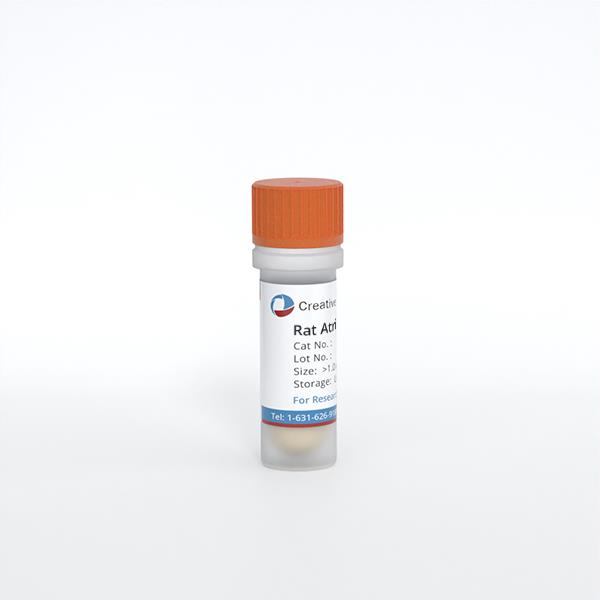
Rat Atrial Cardiomyocytes
Cat.No.: CSC-C5094S
Species: Rat
Source: Heart
Cell Type: Cardiomyocyte
- Specification
- Background
- Scientific Data
- Q & A
- Customer Review
Rat Atrial Cardiomyocytes from Creative Bioarray are isolated from the rat heart tissue. The method we use to isolate Rat Atrial Cardiomyocytes was developed based on a combination of established and our proprietary methods. The Rat Atrial Cardiomyocytes are characterized by immunofluorescence with antibodies specific to myosin heavy chain. Each vial contains 0.5x10^6 cells per ml and is delivered frozen.
Rat Atrial Cardiomyocytes are primary cardiac muscle cells isolated from the atrial tissue of rats and are commonly used as an in vitro model for studying atrial-specific cardiac physiology and pathophysiology. As the main contractile cells of the atria, these cardiomyocytes play a crucial role in atrial contraction, heart rhythm regulation, and cardiac output. Rat Atrial Cardiomyocytes possess unique structural, electrophysiological, and molecular features that distinguish them from ventricular cardiomyocytes, making them a valuable model for research specifically focused on atrial function and disease.
Rat atrial cardiomyocytes are characterized by well-developed sarcomeric organization, spontaneous or inducible contractile activity, and the expression of atrial-specific ion channels and proteins involved in excitation-contraction coupling and calcium handling. These cells serve as a model to study excitation-contraction coupling, calcium signaling dynamics, and atrial electrophysiology. They also express atrial-enriched genes and peptides, such as atrial natriuretic peptide (ANP), which are involved in cardiovascular homeostasis and stress responses.
Rat Atrial Cardiomyocytes are used extensively in research areas related to atrial arrhythmias, especially atrial fibrillation, cardiac hypertrophy, ischemia-reperfusion injury, oxidative stress, and drug-induced cardiotoxicity. The accessibility of well-characterized rat disease models has made these cardiomyocytes a popular choice for studies in these areas.
Succinate and Atrial Arrhythmia Susceptibility in a Rodent Model
Atrial fibrillation (AF) often progresses from paroxysmal to stable forms, but the underlying mechanisms are unclear. The results of this study indicate that in the ovine model, AF stabilization is associated with TCA cycle remodeling, mitochondrial succinate accumulation, and mitochondrial oxidation. The succinate accumulation may contribute to the metabolic disturbances that stabilize AF in AF-S sheep.
To evaluate the role of succinate accumulation in AF, Caluori et al. assessed whether acute exposure of atrial cardiomyocytes to exogenous succinate could alter atrial metabolism, ROS emission, and NAD(P)H fluorescence in beating rat hearts and isolated rat atrial cardiomyocytes (RACMs). Succinate, a dicarboxylate, is transported across the membrane only in acidic conditions (e.g., ischemia or intense exercise). RACMs were incubated with a high concentration of succinate (5 mmol/L), and its impact on TCA cycle metabolites was assessed by mass spectrometry. Following succinate incubation, intracellular metabolite levels were analyzed using deuterium-labeled succinate and internal oxalate for signal correction and normalization. This showed increased intracellular concentrations of succinate, fumarate, and L-malate, with trends towards increased citrate and alpha-ketoglutarate (Fig. 1B-D and Fig. 2A-B). Glycolytic intermediates (glucose-6-phosphate, fructose-1,6-bisphosphate, and pyruvate) remained unchanged (Fig. 2C-E). Succinate incubation significantly increased intracellular succinate concentration by 3.8-fold (Fig. 2F). Functionally, succinate incubation of RACMs significantly increased ROS emission (Fig. 1E-F and Fig. 2G). Succinate perfusion of Langendorff-perfused beating rat hearts significantly increased NAD(P)H and MitoPY1 LAA fluorescence (Fig. 1G-J). H2O2 perfusion had no impact on NAD(P)H fluorescence but increased MitoPY1 fluorescence (Fig. 2H-K).


Ask a Question
Write your own review
Description: The thoracic aorta is located in the chest cavity and gives off arteries that branch to the esophagus, pericardium, lungs, and trachea. The thoracic aorta can be subdivided into the ascending aorta, ...
Description: Rat Podocytes are isolated from normal rat kidney. The cells are characterized by immunofluorescence with antibodies specific to podocin, Ang1, Nephrin, ACTN4, NPHS2. T25 flasks is required for cell ...
Description: Rat Bronchial Smooth Muscle Cells are isolated from normal rat bronchi tissue. Rat Bronchial Smooth Muscle Cells are characterized by immunofluorescence with antibodies specific to alpha-actin. T25 ...
Description: Guinea Pig Endothelial Cells from Creative Bioarray are isolated from guinea pig tissue. Prior to shipping, cells at passage 2 are detached from flasks and immediately cryopreserved in vials. Each ...
Description: Rat Lung Epithelial Cells are isolated from normal rat lung tissue. The cells are characterized by immunofluorescence with antibodies specific to CK-18, CK-19. T25 flasks is required for cell ...
Description: Rat Vein Endothelial Cells from Creative Bioarray are isolated from inferior vena cava tissue of 6-8 week old laboratory Sprague-Dawley rat. Rat Vein Endothelial Cells are grown in T75 tissue culture ...