
Hamster Embryonic Fibroblasts
Cat.No.: CSC-C4782L
Species: Hamster
Source: Embryo
Cell Type: Fibroblast
- Specification
- Background
- Scientific Data
- Q & A
- Customer Review
Never can cryopreserved cells be kept at -36 °C.
Hamster Embryonic Fibroblasts (HEFs) are primary fibroblast cells cultured from embryonic tissue of hamsters. HEFs are one of the most common non-human mammalian models used in vitro for cell biology and molecular biology research. As cells derived from embryonic tissue, HEFs have high proliferative ability, metabolic activity, and genetic and environmental responsiveness.
Histologically normal appearing fibroblasts, HEFs are spindle-shaped cells that form adherent cell cultures. HEFs typically synthesize components of the extracellular matrix and remodel the cytoskeleton. Embryonic fibroblasts tend to have higher growth ability and more cellular plasticity than adult fibroblasts. For this reason, they are preferred in labs that perform techniques such as transfection, viral infection and cellular reprogramming. These cells have been used in many studies for viruses-host interactions and replication as well as toxicology and carcinogenesis research. HEFs have also been used often as feeder layers for stem cells and to study the cell cycle, senescence and stress responses.
GPX4 Activity is Broadly Required for Cold Tolerance in Primary Cells Across Evolutionarily Distant Mammalian Species
Hibernators survive core-temperature drops to 4 °C, yet the genetic basis of mammalian cold tolerance is unknown. Unbiased genome-wide screens in hamster (hibernator) and human (non-hibernator) cells at 4 °C converged on glutathione peroxidase 4 (GPX4) and its selenoprotein network.
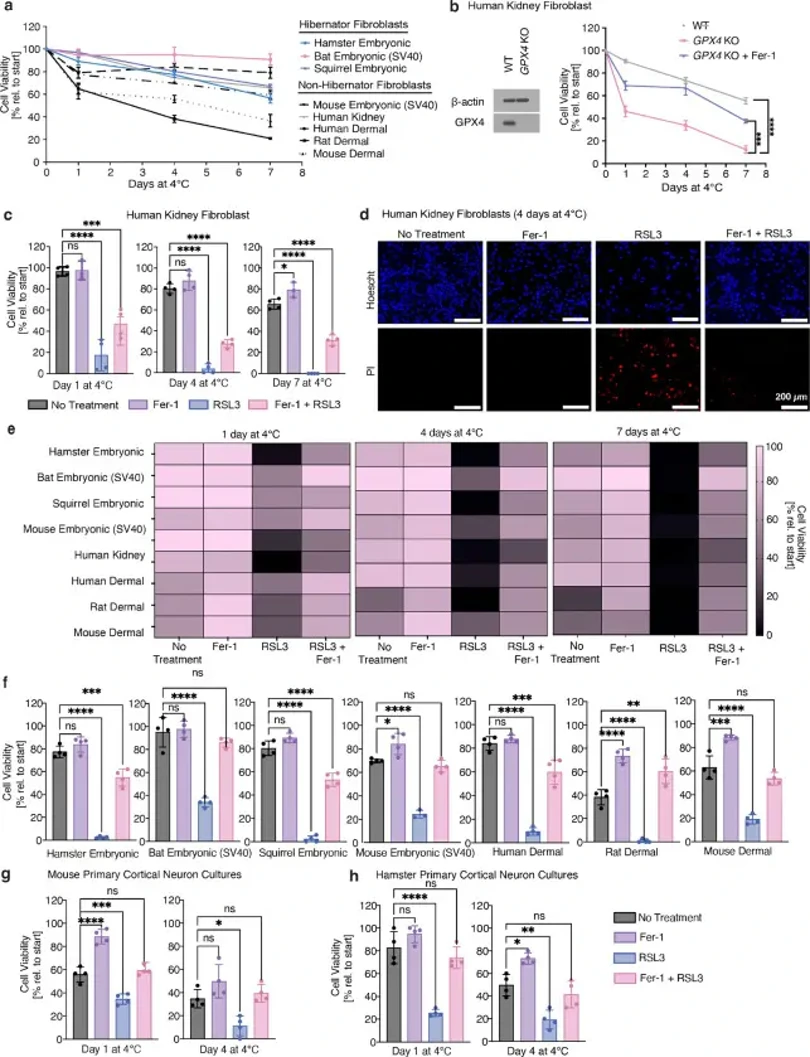
Given that the studies had largely employed transformed cell lines, Lam et al. extended their investigation to primary cells and additional hibernating species. They obtained embryonic fibroblasts from human, mouse, rat, and three distantly related hibernators (Syrian hamster, 13-lined ground squirrel, and horseshoe bat). While hibernator-derived fibroblasts showed robust, uniform cold tolerance, non-hibernator primary cells exhibited surprising variability (Fig. 1a), with human dermal fibroblasts achieving 79 ± 4.93% viability after 7 days at 4°C-comparable to hamster BHK-21 cells. To examine GPX4's role in primary cell cold resistance, they generated GPX4 knockout human kidney fibroblasts (Fig. 1b). Consistent with cell line findings, GPX4 loss significantly reduced cold viability, which was largely rescued by ferrostatin-1. RSL3 treatment similarly decreased wild-type human kidney fibroblast viability in the cold (Fig. 1c, d), with effects dependent on GPX4 inhibition-GPX4 knockout cells were unaffected by RSL3. Testing fibroblasts from six mammalian species revealed that GPX4 activity broadly contributes to cold tolerance across both hibernators and non-hibernators, as RSL3-induced cell death was rescued by ferrostatin-1 (Fig. 1e, f). These findings extended to non-fibroblast cell types, with primary cortical neurons from neonatal mice and hamsters showing similar patterns (Fig. 1g, h). Together, their data indicate that primary cells are strongly sensitive to GPX4 loss in the cold, with differential cold sensitivities reflecting varying levels of GPX4-mediated protection.
Ask a Question
Write your own review
Description: Hamster Ovarian Smooth Muscle Cells are isolated from ovarian tissue of pathogen-free laboratory mice.
Description: Hamster Esophageal Epithelial Cells from Creative Bioarray are isolated from esophageal tissue of pathogen-free laboratory mice. Hamster Esophageal Epithelial Cells are grown in a T25 tissue culture ...
Description: Hamster Spleen Epithelial Cells from Creative Bioarray are isolated from spleen tissue of pathogen-free laboratory mice. Hamster Spleen Epithelial Cells are grown in a T25 tissue culture flask ...
Description: Hamster Corneal Epithelial Cells from Creative Bioarray are isolated from corneal tissue of pathogen-free laboratory mice. Hamster Corneal Epithelial Cells are grown in a T25 tissue culture flask ...
Description: Hamster Aortic Smooth Muscle Cells are isolated from aorta of hamster.
Description: Hamster Primary Pancreatic Fibroblasts are isolated from pancreas tissue of hamster.