
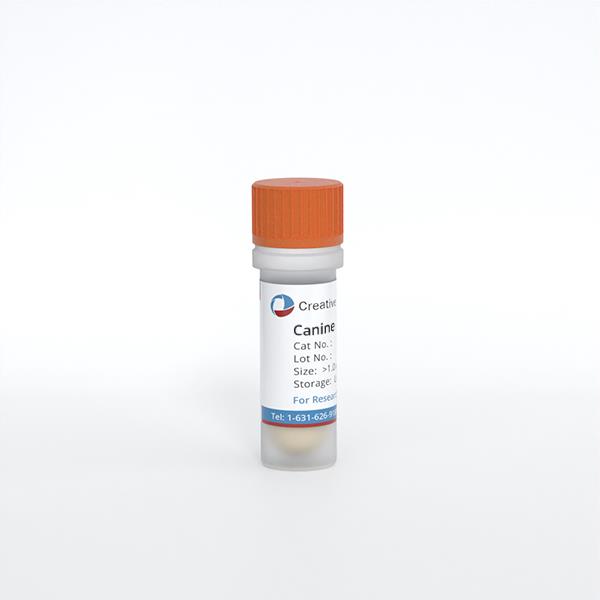
Canine Bone Marrow Neutrophils
Cat.No.: CSC-C4843L
Species: Dog
Source: Bone Marrow
Cell Type: Neutrophil; Granulocyte
- Specification
- Background
- Scientific Data
- Q & A
- Customer Review
Never can cryopreserved cells be kept at -20 °C.
Bone Marrow, Canine Neutrophils are the primary granulocytes, newly separated from the bone marrow (often femur or tibia) of healthy dogs (most commonly Beagle). They are mature or late-stage polymorphonuclear leukocytes with segmented nuclei and neutral-staining cytoplasmic granules and can be positively identified by surface markers such as CD11b/CD18 (integrin αMβ2) and CD45. These are terminally differentiated primary cells (not cell lines) grown in suspension with a short ex vivo lifespan (usually employed within 4-24 hours after isolation) and maintained in a specific neutrophil medium at 37°C with 5% CO₂.
In the literature, bone marrow neutrophils are preferred over peripheral blood neutrophils in the dog because the bone marrow has a bigger reserve pool of the immature and mature forms and thus allows a higher yield and research of granulopoiesis. They are an important model to study canine innate immunity including chemotaxis, phagocytosis, generation of reactive oxygen species (ROS/superoxide), degranulation, and NETosis (Neutrophil extracellular trap creation). Moreover, they are widely employed in veterinary translational research, including in the assessment of chemotherapeutic myelosuppressive effects, breed-specific neutrophil dysfunction (e.g. canine cyclic neutropenia), and as a large-animal preclinical platform for the testing of anti-inflammatory or immunomodulatory drugs before human trials.
Sand Fly Saliva Recruits Neutrophils
Beyond bacterial formyl peptides or viral mimics, non-vertebrate proteins directly attracting mammalian neutrophils remain uncharacterized. Here, Guimaraes-Costa et al. show that sand fly yellow salivary proteins induce chemotaxis of mouse, canine, and human neutrophils.
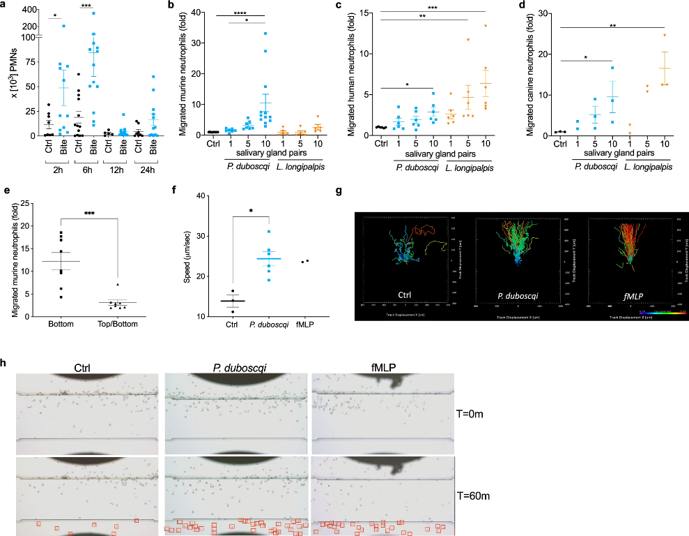
A single Phlebotomus duboscqi bite recruited significant numbers of CD11b+Ly6G+Ly6 Cint neutrophils to mouse ear skin, peaking at 6 hours and returning to baseline by 24 hours (Fig. 1a). Using transwell assays, they confirmed that salivary gland homogenate (SGH) directly induced dose-dependent neutrophil migration across species. Murine neutrophils responded preferentially to P. duboscqi SGH, requiring higher concentrations of Lutzomyia longipalpis SGH (10 gland pairs, ~10 µg) for migration (Fig. 1b). Conversely, human (Fig. 1c) and canine (Fig. 1d) neutrophils responded efficiently to both species, with stronger responses to L. longipalpis. Uniform SGH distribution (top/bottom chambers) disrupted directional migration (Fig. 1e).
EZ-TAXI Scan assays visualized human neutrophil migration toward P. duboscqi SGH (10 µg) on fibronectin-coated surfaces (Fig. 1f-h). Neutrophils polarized and migrated toward SGH at speeds comparable to the fMLP positive control, though with a delayed initiation phase, likely due to the complex protein mixture (~35 proteins). In contrast, neutrophils exhibited only random migration in RPMI/BSA alone. These results demonstrate that sand fly saliva contains potent, evolutionarily conserved neutrophil chemoattractants.
Ask a Question
Write your own review
- You May Also Need
Description: Dog Liver Endothelial Cells from Creative Bioarray are isolated from tissue of dog liver. Dog Liver Endothelial Cells are grown in T25 tissue culture flasks pre-coated with gelatin-based coating ...
Description: Canine Astrocytes from Creative Bioarray are isolated from canine brain tissue. The method we use to isolate canine astrocytes were developed based on a combination of established and our proprietary ...
Description: Canine Mammary Microvascular Endothelial Cells from Creative Bioarray are isolated from breast of pathogen-free laboratory Canine. Canine Mammary Microvascular Endothelial Cells are grown in T25 ...
Description: Canine Chondrocytes (CnC) provided by Creative Bioarray are isolated from normal canine articular cartilage tissue. The cells are frozen at passage 1 and each vial contains at least 0.5*10^6 cells. ...
Description: Canine Pancreatic Microvascular Endothelial Cells from Creative Bioarray are isolated from Pancreatic Microvascular of pathogen-free laboratory Canine. Canine Pancreatic Microvascular Endothelial ...
Description: Canine Prostate Microvascular Endothelial Cells from Creative Bioarray are isolated from prostate of pathogen-free laboratory Canine. Canine Prostate Microvascular Endothelial Cells are grown in T25 ...