SuperCult® Skeletal Muscle Cell Growth Medium Kit

  • Specification
  • Scientific Data
  • Q & A
  • Customer Review
Cat.No.
CM-1140X
Description
Creative Bioarray Skeletal Muscle Cell Growth Medium is a low-serum medium developed for the expansion of human skeletal muscle cell cultures. The Skeletal Muscle Cell Differentiation Medium is a serum-free medium developed to induce the fusion of skeletal muscle cells to myotubes with typical multinucleated syncytia. The media are optimized for primary human cells, but can also be used for murine, rat, canine, and rabbit skeletal muscle cells. Creative Bioarray Skeletal Muscle Cell Media are available as Medium kit. The Medium Kit consists of a 500 ml bottle of Basal Medium and the SupplementPack (a set of individual vials with pre-measured supplements) allowing the user full control over the media formulation. Adding the Supplements to the Basal Medium results in the complete Growth or Differentiation Medium, respectively. Basal Medium (with or without phenol red) as well as SupplementMix (Growth and Differentiation Medium) and SupplementPack (Growth Medium) can also be purchased separately.
Components
Creative Bioarray Skeletal Muscle Cell Growth Medium contains all the growth factors and supplements necessary for the optimal growth of human skeletal muscle cells, e.g. Epidermal Growth Factor, basic Fibroblast Growth Factor, and Insulin.
Storage and Shipping
Store the Basal Medium at 4 to 8 °C in the dark and the SupplementMix or SupplementPack at -20 °C immediately after arrival. Do not freeze the Basal Medium. If stored properly, the products are stable until the expiry date stated on the label. After adding the supplements to the Basal Medium, the shelf life of the complete medium is 6 weeks at 4 to 8 °C. Do not freeze the complete medium. For use, pre-warm only an aliquot of the complete medium and keep the remaining medium refrigerated at 4 to 8 °C.
Note: The SupplementMix and SupplementPack are delivered thawed and can be frozen after arrival without losing any activity.
Citation Guidance
If you use this products in your scientific publication, it should be cited in the publication as: Creative Bioarray cat no. If your paper has been published, please click here to submit the PubMed ID of your paper to get a coupon.

AAV Gene Transfer with Tandem Promoter Design Prevents Anti-transgene Immunity and Provides Persistent Efficacy in Neonate Pompe Mice

Molecular Therapy Methods & Clinical Development | DOI | Paper |

Background

This study describes tandem promoter monocistronic expression cassettes packaged in a single AAV vector that combine hepatic and extra-hepatic tissue-specific transgene expression to prevent anti-transgene immunity. Validated in infantile Pompe disease, the tandem liver-muscle promoter (LiMP) and liver-neuron promoter (LiNeuP) drove specific transgene expression in target tissues of immunocompetent Gaa−/− mice without eliciting anti-GAA antibodies. Neonatal AAV8 or AAV9 gene therapy with LiMP provided persistent therapeutic GAA expression and corrected glycogen accumulation, cardiomegaly and muscle strength at low vector doses.

Key Findings

Tandem promoters combining the liver ApoE-hAAT enhancer-promoter with the muscle spC5.12 promoter (LiMP) or the neuronal hSYN promoter (LiNeuP) were engineered within the <5 kb AAV packaging limit and verified in hepatocyte, myoblast and neuronal cell lines. Systemically delivered AAV vectors using LiMP or LiNeuP drove specific hGAA mRNA expression in liver plus muscle or CNS, respectively, and, unlike the ubiquitous CAG or muscle-only C5.12 promoters, prevented anti-hGAA IgG formation in adult immunocompetent Gaa−/− mice; LiMP also reduced pre-existing anti-GAA antibodies. In neonate Gaa−/− mice, AAV8- or AAV9-LiMP-sec-hGAA at doses 10–50-fold lower than previously reported produced persistent hepatic and muscle enzyme expression, supra-physiological muscle GAA activity, glycogen clearance in heart, diaphragm, triceps, quadriceps, spinal cord and brain, corrected cardiomegaly and rescued muscle strength without anti-GAA immunity, whereas single tissue-specific promoters or LiNeuP failed.

Contribution

Creative Bioarray provided the human skeletal muscle myoblasts (CSC-C3196) and the SuperCult Skeletal Muscle Cell Growth Medium Kit used to confirm in vitro that the tandem LiMP promoter retains transcriptional activity in human muscle cells, supporting translation of the tandem promoter design to human muscle.
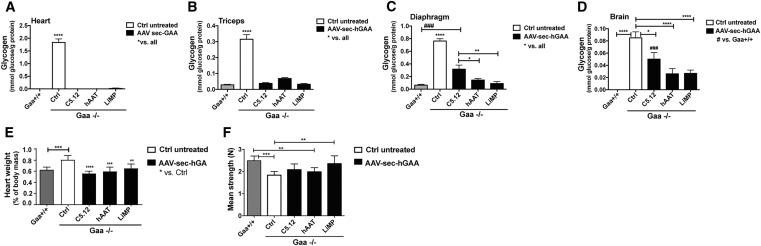
Efficacy in Gaa−/− Mice Treated as Neonates with Systemic AAV Gene Therapy Using the Tandem LiMP Promoter
Fig. 1. Efficacy in Gaa−/− Mice Treated as Neonates with Systemic AAV Gene Therapy Using the Tandem LiMP Promoter

Ask a Question

Write your own review

For research use only. Not for any other purpose.

Hot Products