
Rat Bone Marrow Progenitor Cells
Cat.No.: CSC-C4189X
Species: Rat
Source: Bone Marrow
Cell Type: Progenitor Cell
- Specification
- Background
- Scientific Data
- Q & A
- Customer Review
Standard biochemical procedures performed with progenitor cell cultures include cell adhesion, migration, RT-PCR, Western blotting, immunoprecipitation, immunofluorescent staining or immunofluorescent flow cytometry or generating cell derivatives for desired research applications.
Rat Bone Marrow Progenitor Cells are stem cells derived from the bone marrow of rats that can self-renew and further differentiate into different types of blood and stromal cells. Bone marrow contains a diverse array of stem cells and progenitor cells that differentiate into hematopoietic, immune and repair cells. Rat bone marrow progenitor cells are an early-stage bone marrow cell between stem cells and mature blood cells. They are partially committed to becoming a certain cell lineage but have robust expansion potential.
Bone marrow progenitor cells are responsible for maintaining the population of blood cells such as red blood cells, white blood cells, and platelets which are vital for immune function and hematopoiesis. Rat bone marrow progenitor cells can be expanded and differentiated into specific blood cell types in vitro when provided with the appropriate cocktail of cytokines and growth factors. Rat bone marrow progenitor cells often express markers associated with progenitor cells and have the ability to form colonies in vitro, which is a common assay to determine hematopoietic differentiation potential. Bone marrow progenitor cells from rats are used broadly to study hematopoiesis, stem cell differentiation, and regulation of the bone marrow niche. Rat bone marrow progenitor cells can also be used as a tool to study immune regulation.
Alginate-HEMA Hydrogels as Promising Biomaterials for Bone Regeneration: In Vitro and In Vivo Studies
Torres et al. studied the osteogenic and angiogenic potential of semi-interpenetrated HEMA-EGDMA polymeric networks (sIPN) with and without incorporation of alginate for bone tissue engineering. Rat bone marrow progenitor cells (BMPCs) as well as EA.hy926 endothelial cells and rat vascular smooth muscle cells (VSMCs) were used to characterize these scaffolds in vitro.
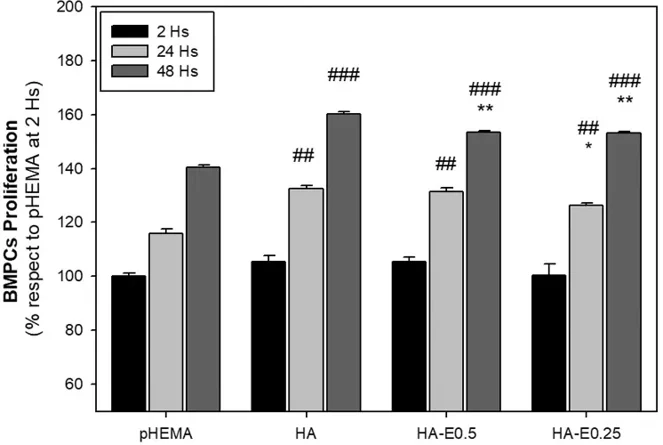
BMPCs proliferation and adhesion are shown in Figure 1. Observations concluded that while all hydrogels allowed cells to adhere well, the addition of alginate caused an increase in proliferation at 24 and 48 h compared to pHEMA. Cells within hydrogels with lower EGDMA content proliferated less when compared to HA hydrogels alone. Cell proliferation was likely increased by alginate incorporation because it creates a viscoelastic environment conducive to extracellular matrix production. This does not negatively impact cell adhesion initially which has also been observed in chondrocyte cultures. These findings are consistent with previous results that showed alginate containing sIPN hydrogels promoted cell proliferation.
Ask a Question
Write your own review
Description: The thoracic aorta is located in the chest cavity and gives off arteries that branch to the esophagus, pericardium, lungs, and trachea. The thoracic aorta can be subdivided into the ascending aorta, ...
Description: Rat Podocytes are isolated from normal rat kidney. The cells are characterized by immunofluorescence with antibodies specific to podocin, Ang1, Nephrin, ACTN4, NPHS2. T25 flasks is required for cell ...
Description: Rat Bronchial Smooth Muscle Cells are isolated from normal rat bronchi tissue. Rat Bronchial Smooth Muscle Cells are characterized by immunofluorescence with antibodies specific to alpha-actin. T25 ...
Description: Guinea Pig Endothelial Cells from Creative Bioarray are isolated from guinea pig tissue. Prior to shipping, cells at passage 2 are detached from flasks and immediately cryopreserved in vials. Each ...
Description: Rat Lung Epithelial Cells are isolated from normal rat lung tissue. The cells are characterized by immunofluorescence with antibodies specific to CK-18, CK-19. T25 flasks is required for cell ...
Description: Rat Vein Endothelial Cells from Creative Bioarray are isolated from inferior vena cava tissue of 6-8 week old laboratory Sprague-Dawley rat. Rat Vein Endothelial Cells are grown in T75 tissue culture ...