
Human Villous Mesenchymal Fibroblasts (HVMF)
Cat.No.: CSC-7694W
Species: Human
Source: Placenta
Cell Type: Fibroblast
- Specification
- Background
- Scientific Data
- Q & A
- Customer Review
Human villous mesenchymal fibroblasts (HVMF) are primary fibroblast-like cells derived from the mesenchymal core of human placental villi. HVMF are unique in that they are located at the maternal-fetal interface and simultaneously contribute to both structural support, immune tolerance and placental development. As such, these cells in the villous stroma are exposed to rapidly changing mechanical, metabolic, and immunological cues throughout pregnancy.
HVMF have an elongated spindle-shaped morphology, and they are active producers of extracellular matrix components that help maintain villous structure and elasticity. These cells produce numerous growth factors, cytokines and signaling molecules which direct trophoblast behavior along with vascular and immune cell functioning. The overall phenotype of HVMF is a balance between regenerative and immune-modulatory functions, which is a key difference from non-placental tissue-derived fibroblasts. HVMF are often used as a model to investigate placental biology, fetal-maternal communication, and diseases such as preeclampsia, intrauterine growth restriction, and placental fibrosis. The unique developmental and immunological environment that HVMF are derived from makes them an ideal in vitro model for studying pregnancy-related mechanisms and testing potential therapeutic interventions targeting placental dysfunction.
In Vitro Competitive Fitness Assays Using Viral Isolates Confirm Replicative Fitness Differences of Recombinant Zika Viruses
RNA viruses evolve rapidly due to their short generation times and high mutation rates. This study investigates the phenotypic evolution of Zika virus during the 2015-2016 epidemic in the Americas, focusing on lineage-specific fitness differences in human cells and mosquitoes.
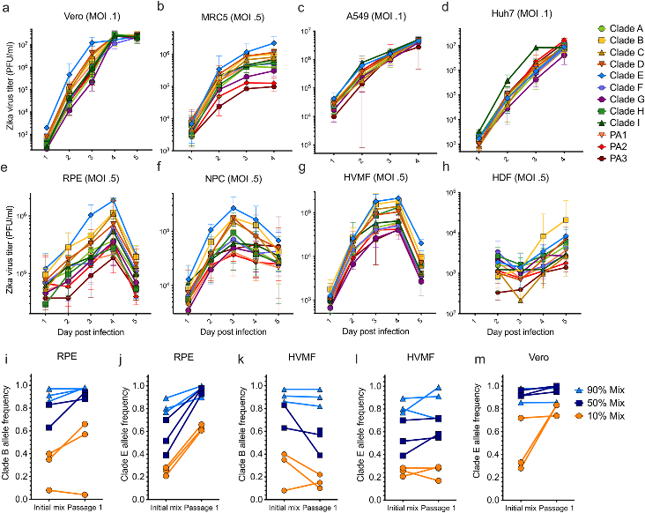
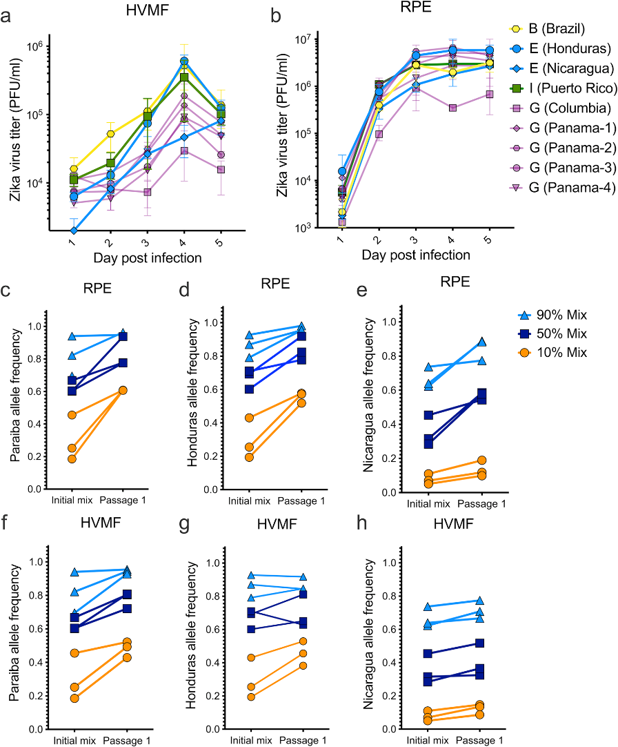
They obtained Zika virus isolates from Nicaragua (Nica-6547) and Honduras (R103451), which share lineage-defining mutations with clade E, known for high replicative fitness in human primary cells (Fig. 1A-H). They also got isolates from Colombia (FLR) and Panama (PA259359, PA259634, PAN259249, PAN259364), which have mutations specific to clade G, our lowest-performing clade (Fig 1A-H). Additionally, they included isolates from Brazil (Paraiba_01, clade B) and Puerto Rico (PRVABC59, clade I), which has moderate fitness (Fig.1A-H). They used these isolates to infect human villous mesenchymal fibroblasts (HVMF) and retinal pigment epithelial (RPE) to generate in vitro replicative fitness curves. In HVMFs, isolates from Brazil (clade B), Honduras (clade E), and Puerto Rico (clade I) had the highest fitness (Fig 3A). In RPE cells, high-fitness clades did not outperform clade G isolates (Fig. 2B). They conducted competitive fitness assays in HVMFs and RPE cells, competing clade B (Paraiba_01) and two clade E isolates (Nica-6547 and R103451) against three clade G isolates (PA259359, PA259634, PAN259249). Each competition was done at 90%, 50%, and 10% lineage percentages, totaling 27 competitions per cell type. We used deep sequencing to assess lineage frequencies five days post-infection. In RPE cells, Paraiba (clade B), Nicaragua (clade E), and Honduras (clade E) isolates outcompeted clade G isolates (Fig. 2C-E), with average frequency increases of 21% for Paraiba, 18% for Honduras, and 15% for Nicaragua. In HVMF cells, 24/27 competitions showed Paraiba, Nicaragua, and Honduras isolates increasing in frequency (Fig. 2F-H), with average increases of 10% for Paraiba, 7% for Honduras, and 5% for Nicaragua.
Ask a Question
Write your own review
Description: Human Metastatic Ovarian Tumor -Associated Endothelial Cells are isolated from human ovarian metastases tissue developed from colon cancer. Human Metastatic Ovarian Tumor -Associated Endothelial ...
Description: HAEpiC from Creative Bioarray are isolated from human amniotic membranes. HAEpiC are cryopreserved at passage one and delivered frozen. Each vial contains >5 x 10^5 cells in 1 ml volume. HAEpiC are ...
Description: Human Ovarian Tumor-Associated Endothelial Cells from Creative Bioarray are isolated from human ovarian tumor tissue. Human Ovarian Tumor-Associated Endothelial Cells are grown in T25 tissue culture ...
Description: Human endometrial epithelial cells from Creative Bioarray are isolated from human endometrium tissue. Human endometrial epithelial cells are grown in T25 tissue culture flasks and incubated in ...
Description: Smooth muscle tissue is found in the tunica media layer of large and small blood vessels and in the walls of hollow organs like the bladder and the uterus. Smooth Muscle Cells (SMC) possess all the ...
Description: Human gonadal stromal cells are derived from testes that have been dissociated into a single cell suspension. Human gonadal stromal cells are from a single donor. These cells enable researchers to ...