
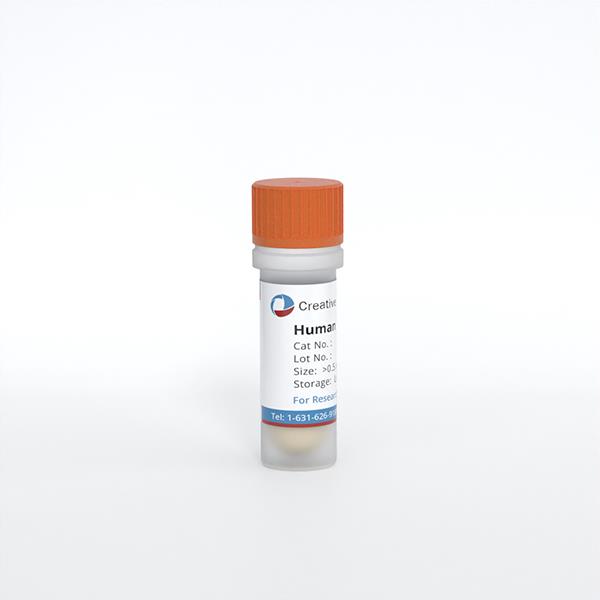
Human Lens Epithelial Cells (HLEpiC)
Cat.No.: CSC-7764W
Species: Human
Source: Lens; Eye
Cell Type: Epithelial Cell
- Specification
- Background
- Scientific Data
- Q & A
- Customer Review
Human Lens Epithelial Cells (HLECs) constitute a critical monolayer of cells located on the anterior surface of the crystalline lens, beneath the lens capsule. This single layer of cuboidal cells serves as the sole actively metabolic and proliferative zone of the entire lens, playing a definitive role in maintaining lifelong lens homeostasis and transparency. Their primary functions encompass the regulation of ion and nutrient transport into the avascular lens, synthesis of key crystalline proteins and antioxidants (notably glutathione), and the terminal differentiation into elongated, organelle-free lens fiber cells at the equatorial region-a process essential for optical clarity. Any dysfunction in HLECs, such as abnormal proliferation, migration, or epithelial-mesenchymal transition (EMT), is directly linked to the pathogenesis of the world's leading cause of blindness: cataracts, particularly posterior capsule opacification (PCO, or "secondary cataract") after surgery.
Primary or immortalized HLEC lines are the gold-standard in vitro system for studying the molecular mechanisms of both age-related and secondary cataracts. HLECs are crucial for high-throughput screening of novel anti-cataract agents, including antioxidant compounds (e.g., N-acetylcarnosine, plant polyphenols), pharmacological inhibitors of EMT, and innovative formulations aimed at preventing or delaying lens opacification. They are equally vital for evaluating the cytotoxicity and biocompatibility of intraocular lens (IOL) materials and viscoelastic surgical agents.
Hyaluronic Acid-Mediated Epithelial-Mesenchymal Transition of Human Lens Epithelial Cells
Posterior capsule opacification (PCO) is a crucial complication of cataract surgery. PCO is caused by the proliferation and migration of lens epithelial cells (LECs) left on the anterior capsule and the capsular bag after cataract surgery. The factors triggering the proliferation of residual LECs remains unclear, which makes targeting the EMT process therapeutically difficult.
The hyaluronic acid (HA) receptor CD44 has a putative role in mediating PCO pathogenesis. It is expressed in numerous cell types and LECs of human eyes, with known roles in modulating LEC proliferation in vitro. HA binds to and activates CD44, thereby inducing signaling pathways that trigger cell proliferation and migration. Among these pathways, transforming growth factor-β2 (TGF-β2) plays a crucial role in LEC modulation.
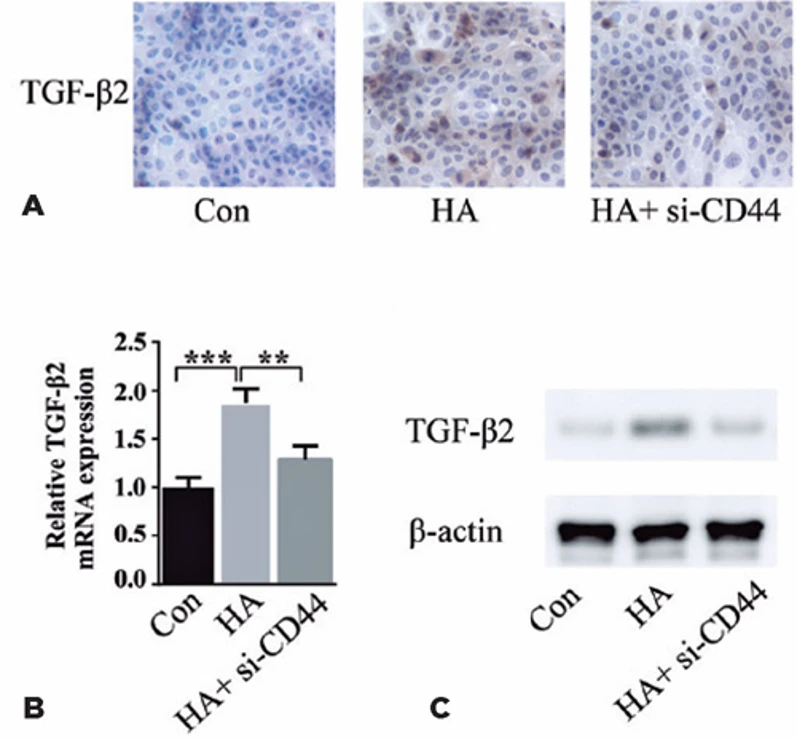
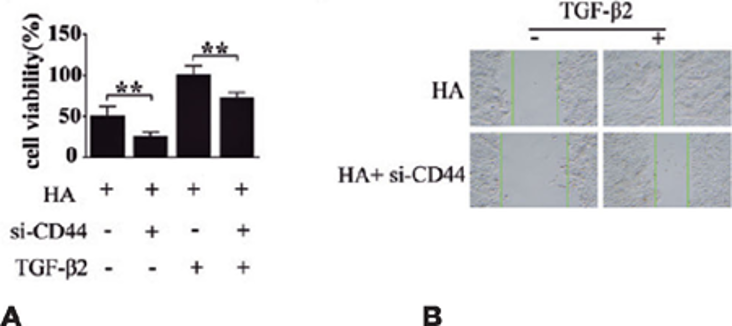
To investigate whether HA and CD44 work through TGF-β2 in the pathogenic development of PCO, an in vitro model HLEB3 was used to examined the role of TGF-β2 in the HA-mediated EMT. The results showed that both CD44 and TGF-β2 are critical contributors to the HA-mediated EMT of lens epithelial cells, and that TGF-β2 is regulated by CD44. These results suggest that CD44 could be used as a target for preventing hyaluronic acid-induced posterior capsule opacification.
Ask a Question
Write your own review
Description: Human choroidal endothelial cells are isolated from normal human choroidal tissue. The cells are provided at passage 1 and shipped in frozen vials. These cells have a minimum average population ...

Description: Human Non-Pigment Ciliary Epithelial Cells (HNPCEpiC) from Creative Bioarray are isolated from human ciliary bodies. HNPCEC are cryopreserved at primary culture and delivered frozen. Each vial ...
Description: Human Keratocytes (HK) from Creative Bioarray are isolated from human cornea. HK are cryopreserved at primary culture. Each vial contains >5 x 10^5 cells in 1 ml volume. HK are characterized by their ...
Description: RFP Expressing Human Retinal Microvascular Pericytes (RFP-HRMPs) provided by Creative Bioarray are zeocin-selected from Human Retinal Microvascular Pericytes infected with lentivirus expressing RFP. ...
Description: Primary Human Retinal Pericyte Cells (HRPEpiC) are isolated from human retina. HRPEpiC are cryopreserved at passage one and delivered frozen. Each vial contains >5 x 10^5 cells in 1 ml volume. ...
Description: Human Retinal Pigment Epithelial Cells (HRPEpiC) are isolated from human retina. HRPEpiC are cryopreserved at passage one and delivered frozen. Each vial contains >5 x 10^5 cells in 1 ml volume. ...