
Porcine Skeletal Muscle Satellite cells
Cat.No.: CSC-C0521Z
Species: Pig
Source: Skeletal Muscle
Morphology: Polygonal
Culture Properties: Adherent
Cell Type: Satellite Cell; Myosatellite Cell
- Specification
- Background
- Scientific Data
- Q & A
- Customer Review
Note: Never can cells be kept at -20°C.
Satellite cells are a heterogeneous population of adult stem cells found in skeletal muscles. These cells reside between the muscle sarcolemma and the basal lamina of muscle fibers and remain quiescent under normal conditions. Upon injury, quiescent satellite cells are activated to repair muscle injury, while a subset of the activated satellite cells return to a quiescent status after self-renewal. Satellite cells are essential for muscle regeneration. Satellite cells dysfunction is common in muscular diseases such as Duchenne muscular dystrophy (DMD) and in aged muscles.
Pigs have many advantages in modeling human diseases due to their similar anatomic and physiological features to human beings. For example, pig DMD models recapitulate human symptoms better than mouse models. The severe progressive dystrophic changes of skeletal muscles, impaired mobility, muscle weakness, and a much shorter life span are common symptoms in human DMD patients. These symptoms can only be recapitulated in pig DMD model, but not mouse DMD model, supporting the notion that pigs can model human diseases better than rodents. Characterization of pig satellite cells will be a valuable addition to our understanding of the porcine model system.
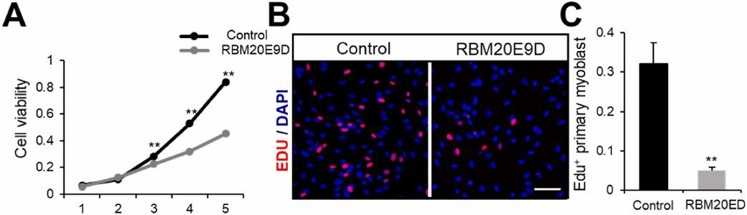
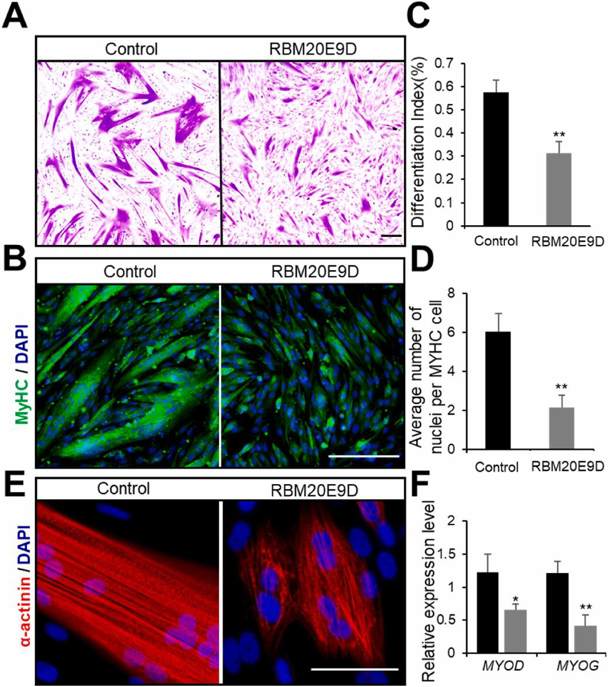
Deletion of RBM20 Exon 9 Impairs Pig Skeletal Muscle Satellite Cells Proliferation and Differentiation
Skeletal muscle dysfunction is a common clinical issue, often arising from injury, disease, or aging. Effectively treating skeletal muscle injuries, enhancing healing quality, and expediting the repair process have emerged as urgent goals in clinical research. Although recent studies have linked RNA-binding motif protein 20 (RBM20) to human dilated cardiomyopathy (DCM), its functions, regulation, and substrates remain unclear, particularly in skeletal muscle, despite its expression in cardiac and skeletal muscle.
In this study, the CRISPR/Cas9 system was used to generate RBM20E9D (RBM20 exon 9 deletion) pigs to explore the role of RBM20 in porcine skeletal muscle growth and development. By isolating and characterizing porcine skeletal muscle satellite cells (PSCs), we investigated RBM20's function in satellite cell proliferation and differentiation.
The deletion of exon 9 resulted in loosely arranged muscle fibers, large inter-fiber gaps, and irregular organization, leading to impaired muscle growth and development. Analysis of skeletal muscle satellite cells revealed significantly reduced proliferation, diminished myotube formation in vitro, and disrupted sarcomere structure due to exon 9 deletion. Given the critical role of satellite cell proliferation and differentiation in muscle repair, RBM20E9D pigs offer a novel model for studying the mechanisms underlying skeletal muscle injury, repair, and growth.
It is recommended that after removing the serum from the freezer, it should be placed in a refrigerator at 2 to 8 °C to thaw, and then at room temperature to thaw all the way through. However, it is important to note that it must be shaken regularly and evenly during the thawing process.
Ask a Question
Average Rating: 5.0 | 1 Scientist has reviewed this product
Excellent
The quality of the products is excellent, and the customer service is friendly and helpful.
02 Aug 2023
Ease of use
After sales services
Value for money
Write your own review

Description: Porcine Corneal Epithelial Cells from Creative Bioarray are isolated from corneal tissue of porcine. Porcine Corneal Epithelial Cells are grown in a T25 tissue culture flask pre-coated with ...
Description: Porcine Brain Vascular Fibroblasts from Creative Bioarray are isolated from brain tissue of porcine. Porcine Brain Vascular Fibroblasts are grown in T75 tissue culture flasks pre-coated with ...
Description: Porcine Thymus Endothelial Cells from Creative Bioarray are isolated from thymus tissue of porcine. Porcine Thymus Endothelial Cells are grown in T25 tissue culture flasks pre-coated with ...
Description: Porcine Kidney Endothelial Cells from Creative Bioarray are isolated from kidney tissue of porcine. Porcine Kidney Endothelial Cells are grown in T25 tissue culture flasks pre-coated with ...
Description: Pig bone marrow from Creative Bioarray is procured from the fresh femurs. Bone Marrow-CD34+ stem/progenitor cells are positively isolated using a direct immunomagnetic CD34 MicroBead labeling system.
Description: Porcine Primary Thymus Fibroblasts from Creative Bioarray are isolated from thymus tissue of porcine. Porcine Primary Thymus Fibroblasts are grown in T75 tissue culture flasks pre-coated with ...