

Rabbit Kidney Epithelial Cells
Cat.No.: CSC-C9267J
Species: Rabbit
Source: Kidney
Cell Type: Epithelial Cell
- Specification
- Background
- Scientific Data
- Q & A
- Customer Review
"Rabbit Kidney Epithelial Cells" most commonly refers to primary or low-passage renal epithelial cells originally isolated from kidney tissue obtained from rabbits. These cells are epithelial-like with a typical cobblestone morphology and express classic markers of kidney epithelium including cytokeratins and renal transporter proteins. Rabbit kidney epithelial cells form confluent monolayers that polarize well to form tight junctions. Because of this characteristic, they are used as models of the renal tubular barrier that reabsorbs or secretes solutes. The rabbit is also considered to be a relevant animal model for renal physiology and pharmacology due to its historic use in studying renal handling of drugs and diuretic drug action.
Rabbit kidney epithelial cells are most commonly used for studies related to renal transport physiology and pharmacology. Researchers use rabbit kidney epithelial cells as part of a "functional in vitro" model to study activity and regulation of channels, transporters (e.g., sodium glucose co-transporters, organic anion transporters, organic cation transporters), and receptors localized to the nephron. This model is used to study mechanisms behind drug induced nephrotoxicity, renal handling of pharmaceuticals and endogenous compounds, and mechanisms of diuretics. Being a primary cell, they can only be passaged a limited number of times.
Minor Prion Strains Convert in Cell-Based Assay, where Dominant Strain does not Convert
Mammalian prion diseases are infectious neurodegenerative disorders caused by the self-templating prion protein PrPSc, with evidence suggesting that prions exist as mixtures of dominant and minor strains.
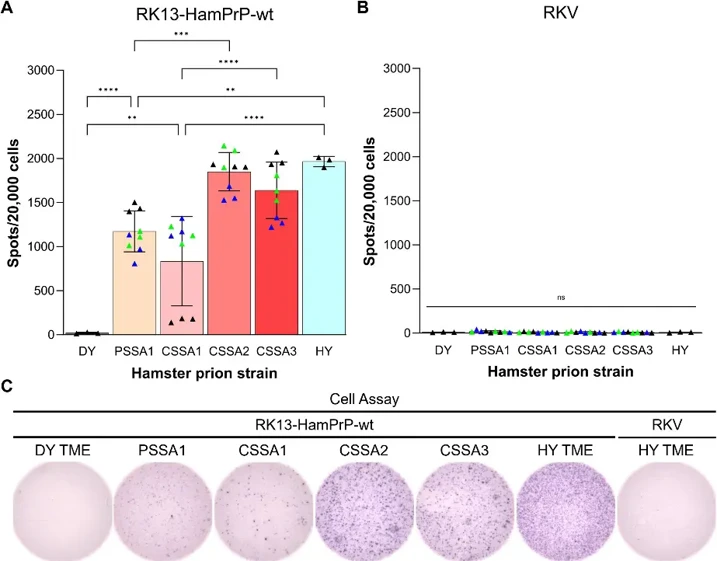
Steadman et al. investigated whether minor prion strains from a cloned DY TME isolate contribute to crossing species barriers more efficiently than the dominant strain, revealing their enhanced ability to convert heterologous PrP and implications for zoonotic risk assessment. In rabbit kidney epithelial (RK13)-HamPrP-wt cells, minor prion strains were compared to the dominant strain DY TME (Fig. 1). DY TME failed to infect these cells, whereas HY TME, PSSA1, CSSA1, CSSA2, and CSSA3 all succeeded (Fig. 1, panel A), with significant differences from DY TME. HY TME showed higher infection efficiency than CSSA1, as did CSSA2 and CSSA3 compared to CSSA1, suggesting CSSA strains increased in efficiency upon serial hamster passage (Fig. 1, panel A). Overall, minor strains from CSSA and PSSA differed in cell infection efficiency from each other and from DY TME.
Ask a Question
Write your own review
Description: Rabbit Hepatocytes are derived from the liver of New Zealand White Rabbit.
Description: The aortic arch is the top part of the main artery carrying blood away from the heart. It is the connection between the ascending and descending aorta, and its central part is formed by the left 4th ...
Description: The synovium secretes synovial fluid, which plays an important role in joint movement. The normal synovium has two layers, a thin cellular layer (luminal layer) and a vascular layer (subintima). ...
Description: The pituitary gland is an important endocrine gland in the body that secretes growth hormone and adrenocorticotropic hormone. It plays an important role in the growth and development of the body, ...
Description: The oral epthelial cells are responsible for important functions, like the primary protection of oral mucosa against external aggressions building a mechanical barrier against microorganisms, ...
Description: The carotid arteries are major blood vessels in the neck that supply blood to the brain, neck, and face. There are two carotid arteries, one on the right and one on the left. In the neck, each ...