

Rabbit Hepatocytes, Suspension
Cat.No.: CSC-C9355W
Species: Rabbit
Source: Liver
Morphology: Polygonal
Cell Type: Hepatocyte
- Specification
- Background
- Scientific Data
- Q & A
- Customer Review
'Rabbit Hepatocytes, Suspension' are cryopreserved, ready-to-thaw primary hepatocytes (parenchymal cells from the liver) freshly isolated and supplied as a ready-to-use, non-adherent suspension. Hepatocytes can be supplied in suspension format for assays where cells require high metabolic function and intact membrane receptors but where attachment to tissue culture plates is not necessary or desirable for assessment of acute cellular responses. A key factor in using rabbits is that their hepatic cytochrome P450 (CYP) enzyme makeup, specifically for some isoforms, is closer to human, offering better predictions of human liver function and drug safety.
The main applications of this format are used throughout nonclinical drug discovery and toxicology. Uses include: hepatic metabolic stability screening (intrinsic clearance determination), CYP induction/inhibition, metabolite identification, acute hepatotoxicity evaluation, etc. Cells are exposed directly to test compounds and maintained in a precisely defined medium, allowing for rapid and reproducible pharmacokinetic and mechanistic data. Cells can only be maintained for a few hours.
Species specificity of BA-CoA conjugate formation
Para-substituted benzoic acids (p-BA) and their metabolites are known to impair sperm quality in male rats, potentially linked to p-BA metabolism into toxic intermediates. To further investigate the role of p-alkyl-benzoyl-CoA accumulation in male reproductive toxicity in rats and rabbits, and to examine its species specificity.
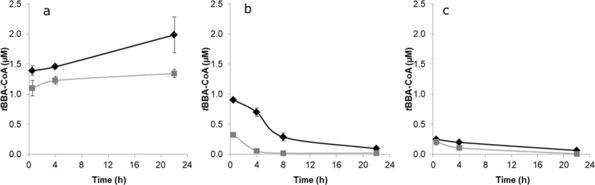
In rabbit hepatocytes, initial formation of p-tBBA-CoA and p-iPBA-CoA was observed for BMHCA and PMHCA, respectively. However, unlike in rat hepatocytes, these conjugates decreased over 22 hours, with levels becoming nearly undetectable at lower doses (Fig. 1). For example, after 22 h exposure to 50 µM BMHCA, p-tBBA-CoA in rabbit hepatocytes was 0.09 µM-about 20-fold lower than in rat hepatocytes (1.99 µM). The kinetic profile in rabbits resembled that of non-reprotoxic aldehydes in rats (Fig. 2). Higher initial CoA levels occurred with direct benzoic acid exposure versus parent aldehydes, as aldehydes require prior metabolism. A similar declining kinetic profile was seen for benzoic acids in rabbits, distinct from rats.
In human hepatocytes exposed to BMHCA, initial p-tBBA-CoA levels were much lower than in rats and decreased rapidly to near the detection limit by 22 h (Fig. 1). For PMHCA, p-iPBA-CoA levels in human hepatocytes were lower than in rat hepatocytes, and they declined over time similarly to rabbit hepatocytes. As in rabbits, direct benzoic acid exposure led to higher initial conjugate levels than aldehyde exposure, but conjugates still decreased rapidly. Overall, the CoA conjugation kinetics in human hepatocytes resembled the profile of non-reprotoxic compounds in rats.
Ask a Question
Write your own review
Description: Rabbit Hepatocytes are derived from the liver of New Zealand White Rabbit.
Description: The aortic arch is the top part of the main artery carrying blood away from the heart. It is the connection between the ascending and descending aorta, and its central part is formed by the left 4th ...
Description: The synovium secretes synovial fluid, which plays an important role in joint movement. The normal synovium has two layers, a thin cellular layer (luminal layer) and a vascular layer (subintima). ...
Description: The pituitary gland is an important endocrine gland in the body that secretes growth hormone and adrenocorticotropic hormone. It plays an important role in the growth and development of the body, ...
Description: The oral epthelial cells are responsible for important functions, like the primary protection of oral mucosa against external aggressions building a mechanical barrier against microorganisms, ...

Description: The carotid arteries are major blood vessels in the neck that supply blood to the brain, neck, and face. There are two carotid arteries, one on the right and one on the left. In the neck, each ...