
Human Peripheral Blood Mononuclear Cells-CLL
Cat.No.: CSC-C8134L
Species: Human
Source: Peripheral Blood; Blood
Cell Type: Mononuclear Cell
- Specification
- Background
- Scientific Data
- Q & A
- Customer Review
Desease: Chronic Lymphocytic Leukemia (CLL)
Application: These cells can be used to investigate stem cell properties in tissue engineering, regenerative medicine, and developmental studies.
Human Peripheral Blood Mononuclear Cells-CLL (PBMC-CLL) are mononuclear cells obtained from the peripheral blood of CLL patients. CLL is a type of leukemia that affects mature CD5⁺ B cells. CLL is marked by the accumulation of these B cells in the periphery. Thus, Human PBMC-CLL cells will be enriched for leukemic B cells. The sample may also be comprised of T cells, NK cells, and monocytes depending on the method of isolation and disease burden. The leukemic B cells will generally test positive for CD19, CD5, CD23, and will be IgM/IgD dim.
Researchers use PBMC-CLL cells to understand leukemogenesis, BCR signaling, apoptotic regulation, immune evasion, and drug resistance. This cell population can also be used to test novel therapeutics like BTK inhibitors, BCL-2 inhibitors, or PI3K inhibitors in a setting that more closely mimics a patient. Disease derived cells such as PBMC- CLL allow for translational research to be done. Scientists can test how sensitive these cells are to certain drugs based on TP53 alteration status, unmutated vs mutated IGHV, or different cytogenetic abnormalities. Since PBMC-CLL cells are primary cell they can only undergo a finite number of divisions in cell culture. There can also be heterogeneity between donors. Human PBMC-CLL are commonly used to understand the mechanism of disease and test new drugs in CLL.
IL-27 Effects on Lymphocyte Population Distribution
Chronic lymphocytic leukemia (CLL) is characterized by the accumulation of malignant B cells and the gradual loss of immune function. T-cell exhaustion marker TIM-3 and its ligand galectin-9 (Gal-9) are negative regulators of antitumor immunity. Interleukin-27 (IL-27) is pleiotropic cytokine with immunomodulatory properties; however, its effects on TIM-3/Gal-9 expression in CLL have not been well characterized.
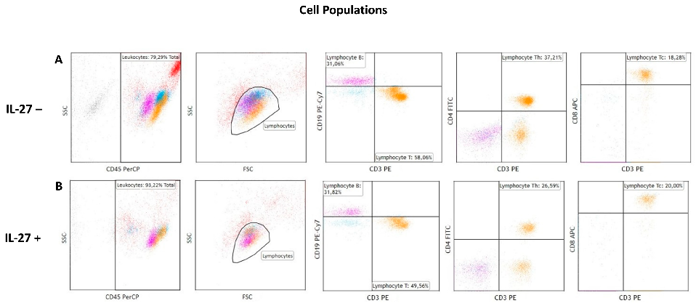
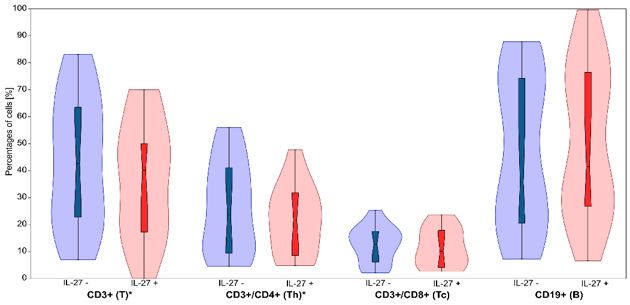
PBMCs from 20 treatment-naïve CLL patients were cultured with or without IL-27 (100 ng/mL, 72 h), and expression of multiple checkpoints was measured by flow cytometry. IL-27 induced significant changes in the proportion of circulating lymphocyte subsets. CD4⁺ T helper cells were the most significantly affected cell population with proportions decreasing from 26.71 ± 4.19% (median 23.59%) to 22.01 ± 3.23% (median 21.77%) following IL-27 stimulation. Although this difference was numerically small (~4.7 percentage points), this could still have biological significance as it affects the balance of T-cell subsets in CLL. Total CD3⁺ T cells also trended towards decreased proportions after IL-27 treatment with percentages going from 43.26 ± 5.94% (median 42.57%) to 36.85 ± 5.48% (median 40.18%). No other statistically significant differences were detected with CD8⁺ T cells or CD19⁺ B cells. Although further studies are needed to understand the functional consequences of IL-27 treatment in CLL, the data presented here suggest IL-27 preferentially affects the CD4⁺ T-cell compartment. Figure 1 depicts an example gating strategy used for flow cytometry. Figure 2 displays the results of flow cytometry after IL-27 treatment.
Ask a Question
Write your own review
- You May Also Need
Description: Chronic Myeloid Leukemia-PB Plasma is obtained by centrifuging Chronic Myeloid Leukemia peripheral blood. Plasma has a diminished number of cells and platelets. Chronic Myeloid Leukemia plasma is ...
Description: Acute Myeloid Leukemia-PB-Plasma is obtained by centrifugation of Acute Myeloid Leukemia peripheral blood. Acute Myeloid Leukemia-PB-plasma has a diminished number of cells and platelets. Acute ...
Description: These mononuclear cells (Mononuclear Cells) are collected using the COBE Spectra apheresis machine (>90% of the cells are Mononuclear Cells). These MPB-Mononuclear Cells products have been depleted ...
Description: NPB-Macrophages are derived from negatively-selected peripheral blood monocytes and stimulated with M-CSF and IL-4 growth factors and cultured for 6-7 day.
Description: PV-PB-Mononuclear Cells are enriched by separation using Ficoll-Paque density gradient from the peripheral blood. PV-PB-Mononuclear Cells are available in untreated and relapsed/refractory stages.
Description: Positively Selected NPB-CD56+ NK cells are directly isolated from mononuclear cells using direct immunomagnetic CD56 MicroBeads.