
- Specification
- Background
- Scientific Data
- Q & A
- Customer Review
Mouse Splenocytes refer to the heterogeneous mixture of primary immune cells derived from the spleen of mice. Splenocytes are not immortalized cell lines but instead represent a mixed population of lymphoid and myeloid cells that can be cultured ex vivo for experimentation and controlled study of immune function. Secondary lymphoid organs, such as the spleen, have roles in antigen presentation, lymphocyte activation, and systemic immune surveillance.
Mouse splenocytes typically include T lymphocytes (CD4⁺ and CD8⁺), B lymphocytes, NK cells, dendritic cells, macrophages, as well as other APCs. However, the ratio of each cell type may vary based on the strain and age of mice as well as the conditions of splenocyte isolation. Upon isolation splenocytes can then be cultured for a limited amount of time with stimulation by mitogens (such as concanavalin A, anti-CD3/CD28 antibodies, or lipopolysaccharide) to analyze cell proliferation, cytokine production, cytotoxic activity, or measure antibody secretion.
Mouse splenocytes are used in research areas studying adaptive immunity, innate immunity, vaccines, autoimmunity, transplantation, tumor immunity, infectious diseases, and many others. They are used in many applications including T-cell activation, ELISpot, cytokine production analysis, flow cytometry-based cell phenotyping, and mixed lymphocyte reactions.
Effect of BSFE on the Innate Immune Response in Splenocytes
Bioconversion using microorganisms or enzymes can generate novel functional compounds. Park et al. explores whether bioconverted Sophorae fructus (BSFE) exhibits immune-stimulatory and anti-inflammatory effects through bioconversion-mediated metabolite transformation.
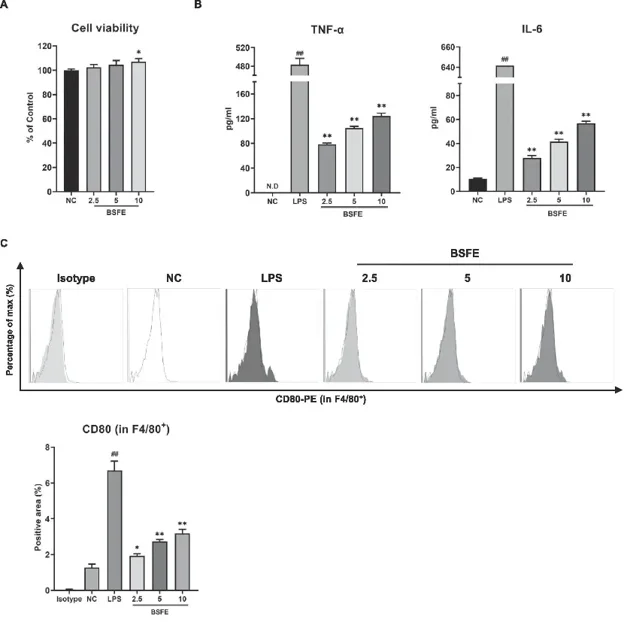
They previously presented the macrophage activation effect and mechanism of BSFE. In a further study, they isolated mouse splenocytes to confirm that BSFE may also regulate the innate immune response within the splenocytes. As shown in Fig. 1A-C, BSFE increased the secretion of TNF-α and IL-6, with a slight increase in splenocyte proliferation. Moreover, they gated the macrophages within splenocytes using the mouse macrophage marker F4/80, and identified the activated macrophages using CD80. They further confirmed that BSFE increased the proportion of CD80 cells within the F4/80 splenocytes, which suggests that BSFE induced the activation of splenic macrophages (Fig. 1D). In summary, they suggest that the macrophage activation effect of BSFE that was confirmed in vitro was reproduced ex vivo, including in splenocytes.
Ask a Question
Write your own review
Description: C57BL/6-GFP Mouse Skeletal Muscle Microvascular Endothelial Cells from Creative Bioarray are isolated from C57BL/6-Tg (CAG-EGFP) 1Osb/J mouse skeletal muscle tissue of pathogen-free laboratory mice. ...
Description: eNOS KO Mouse Stomach Epithelial Cells from Creative Bioarray are isolated from stomach tissue of pathogen-free laboratory mice. eNOS KO Mouse Stomach Epithelial Cells are grown in a T25 tissue ...
Description: eNOS KO Mouse Liver Fibroblasts from Creative Bioarray are isolated from liver tissue of pathogen-free laboratory mice. eNOS KO Mouse Liver Fibroblasts are grown in T75 tissue culture flasks ...
Description: C57BL/6-GFP Mouse Corneal Epithelial Cells from Creative Bioarray are isolated from C57BL/6-GFP-Tg(CAG-EGFP)1Osb/J mouse corneal tissue of pathogen-free laboratory mice. C57BL/6-GFP Mouse Corneal ...
Description: BALB/c Mouse Retinal Microvascular Endothelial Cells from Creative Bioarray are isolated from retinal tissue of pathogen-free laboratory mice. BALB/c Mouse Retinal Microvascular Endothelial Cells are ...