
BALB/c Mouse Primary Lung Fibroblasts
Cat.No.: CSC-C1950
Species: Mouse
Source: Lung
Cell Type: Fibroblast
- Specification
- Background
- Scientific Data
- Q & A
- Customer Review
Mouse Primary Lung Fibroblasts are negative for bacteria, yeast, fungi, and mycoplasma. Cells are tested for expression of marker using the antibody of anti-FSP1/S100A4 by immunofluorescence staining. Cells can be expanded for 2-4 passages at a split ratio of 1:2 under the cell culture conditions specified by Creative Bioarray. Repeated freezing and thawing of cells is not recommended.
Standard biochemical procedures performed with cell cultures include the assay of cell to cell interaction, RT-PCR, Western blotting, immunoprecipitation, immunofluorescent staining, flow cytometry or generating cell derivatives for desired research applications.
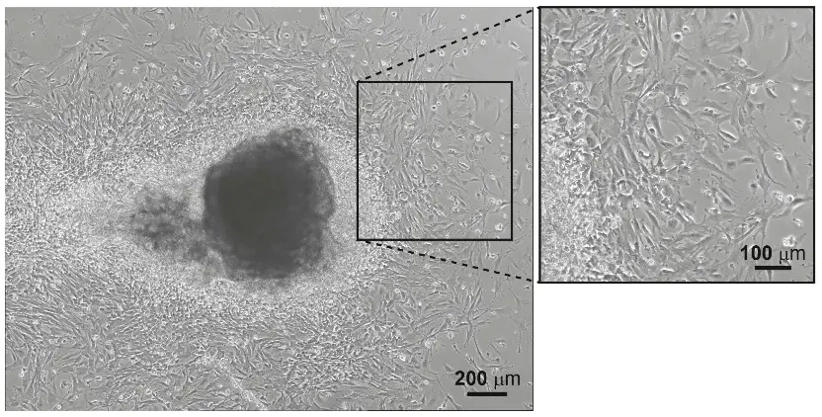
BALB/c Mouse Primary Lung Fibroblasts are primary mesenchymal cells isolated from lung tissue of BALB/c mice. They are commonly used to study fibroblast physiology in a pulmonary microenvironment. As primary cells, they maintain most of the biological properties of in vivo lung fibroblasts compared to immortalized lines, providing greater physiological relevance for mechanistic and translational research. In culture, BALB/c lung fibroblasts display a spindle-like morphology and are highly adherent, reflecting their active involvement in tissue structure maintenance and matrix organization in the lung.
These cells function as primary regulators of extracellular matrix deposition and intercellular communication while also maintaining tissue repair mechanisms. They are active synthesizers of collagen and matrix components and can be activated in the right microenvironment. They also phenotypically activate in response to profibrotic stimulation, including transforming growth factor-β (TGF-β) and readily contribute to contractility and matrix remodeling. They are often used for studies of pulmonary fibrosis, lung injury, inflammatory lung diseases, and tissue regeneration.
ZNF451 Acts as a Repressor of Lung Fibroblast Activation
To date, no effective therapeutic approaches are available for the treatment of PF due to the incomplete understanding of the molecular pathogenesis of PF and lack of therapeutic targets. Peng's team sought to explore the functions and underlying mechanisms of the zinc finger protein 451 (ZNF451), a type of transcriptional regulator, in lung fibrosis.
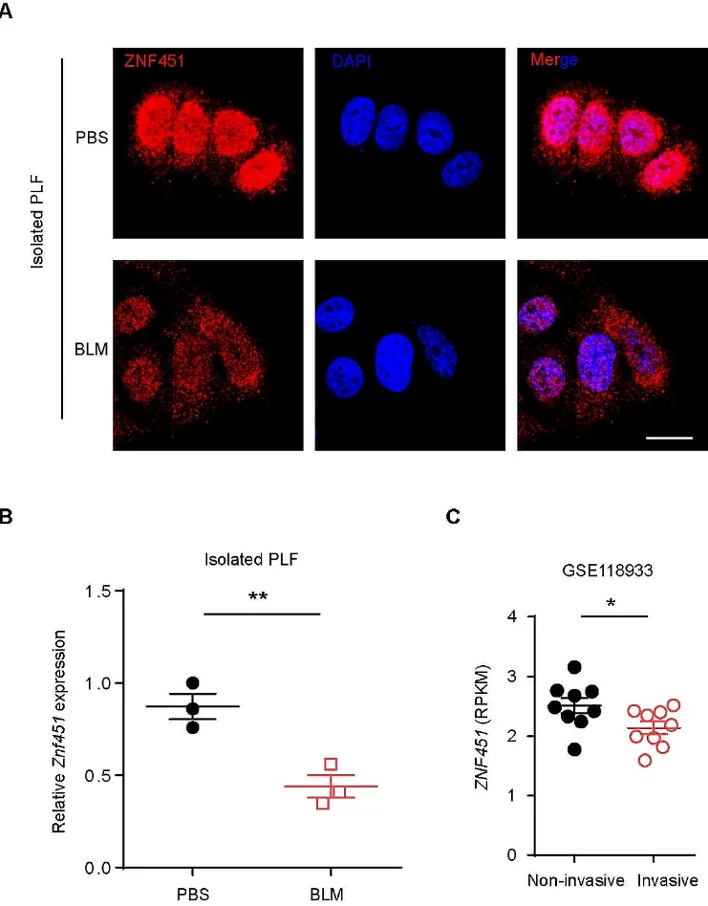
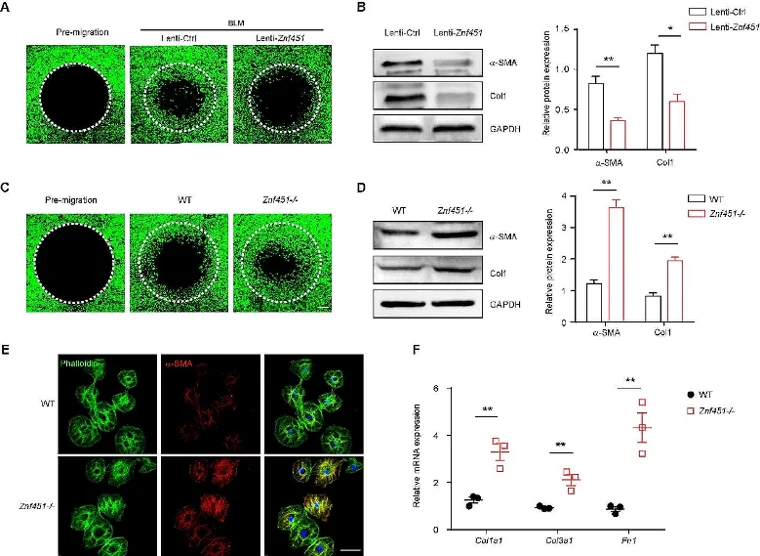
ZNF451 expression was examined in lung fibroblasts from mice with BLM-induced fibrosis. Immunofluorescence and qPCR showed that ZNF451 was downregulated in fibroblasts from BLM-treated mice compared to controls (Fig. 1A, B). Public dataset GSE118933 also showed low ZNF451 expression in invasive IPF fibroblasts (Fig. 1C). The primary lung fibroblasts from mice challenged with BLM with or without ZNF451 overexpression were then isolated and analyzed. Using in vitro scratch cell migration assays and western blot analysis, they found that ZNF451 overexpression in primary lung fibroblasts was sufficient to suppress fibroblast migration and downregulate the myofibroblast markers of α-SMA and Col1 (Fig. 2A, B). Furthermore, primary lung fibroblasts from WT mice and Znf451-/- mice were isolated and analyzed. Znf451-silenced lung fibroblasts showed increased migratory capability and expression of myofibroblast markers with an increased percentage of α-SMA-positive cells (Fig. 2C-E). RT‒PCR analysis also demonstrated that silencing of ZNF451 in fibroblasts led to upregulation of fibrotic genes (Fig. 2F). Taken together, these findings suggest that loss of ZNF451 promotes fibroblast activation in PF.
Ask a Question
Write your own review
Description: C57BL/6-GFP Mouse Skeletal Muscle Microvascular Endothelial Cells from Creative Bioarray are isolated from C57BL/6-Tg (CAG-EGFP) 1Osb/J mouse skeletal muscle tissue of pathogen-free laboratory mice. ...
Description: eNOS KO Mouse Stomach Epithelial Cells from Creative Bioarray are isolated from stomach tissue of pathogen-free laboratory mice. eNOS KO Mouse Stomach Epithelial Cells are grown in a T25 tissue ...
Description: eNOS KO Mouse Liver Fibroblasts from Creative Bioarray are isolated from liver tissue of pathogen-free laboratory mice. eNOS KO Mouse Liver Fibroblasts are grown in T75 tissue culture flasks ...
Description: C57BL/6-GFP Mouse Corneal Epithelial Cells from Creative Bioarray are isolated from C57BL/6-GFP-Tg(CAG-EGFP)1Osb/J mouse corneal tissue of pathogen-free laboratory mice. C57BL/6-GFP Mouse Corneal ...
Description: BALB/c Mouse Retinal Microvascular Endothelial Cells from Creative Bioarray are isolated from retinal tissue of pathogen-free laboratory mice. BALB/c Mouse Retinal Microvascular Endothelial Cells are ...