

Immortalized Human Lung Epithelial Cells
Cat.No.: CSC-I9123L
Species: Homo sapiens
Source: Lung
Morphology: Polygonal
Culture Properties: Adherent
- Specification
- Background
- Scientific Data
- Q & A
- Customer Review
Note: Never can cells be kept at -20 °C.
CIK-HT003 HT® Lenti-SV40T Immortalization Kit
Immortalized human lung epithelial cells are derived from normal human lung epithelial cells and are genetically engineered to obtain stable proliferation and long-term growth while retaining important epithelial properties. As opposed to lung cancer-derived cell lines, immortalized lung epithelial cells represent the non-malignant airway or alveolar epithelium in a more physiologically relevant manner while retaining the advantages of robust and indefinite culture.
One of the main advantages of this cell line is that it retains its epithelial identity. Cells generally grow as a single population of uniform cobblestone-like morphology and retain expression of epithelial markers and tight junction proteins that promote barrier function. The cells are also sensitive to environmental challenges, including hypoxia, oxidative stress, particulates, and inflammatory cytokines, in a manner similar to normal lung epithelium after injury or irritation. These cells are frequently used to model lung barrier function, epithelial repair, or early pathogenic events associated with lung diseases. In particular, these cells have been employed to study host-pathogen interactions, environmental and drug-induced toxicity, and the role of epithelial cells in chronic lung diseases. Their combination of biological relevance and experimental tractability makes these cells a popular choice for pulmonary research, drug screening, and safety testing.
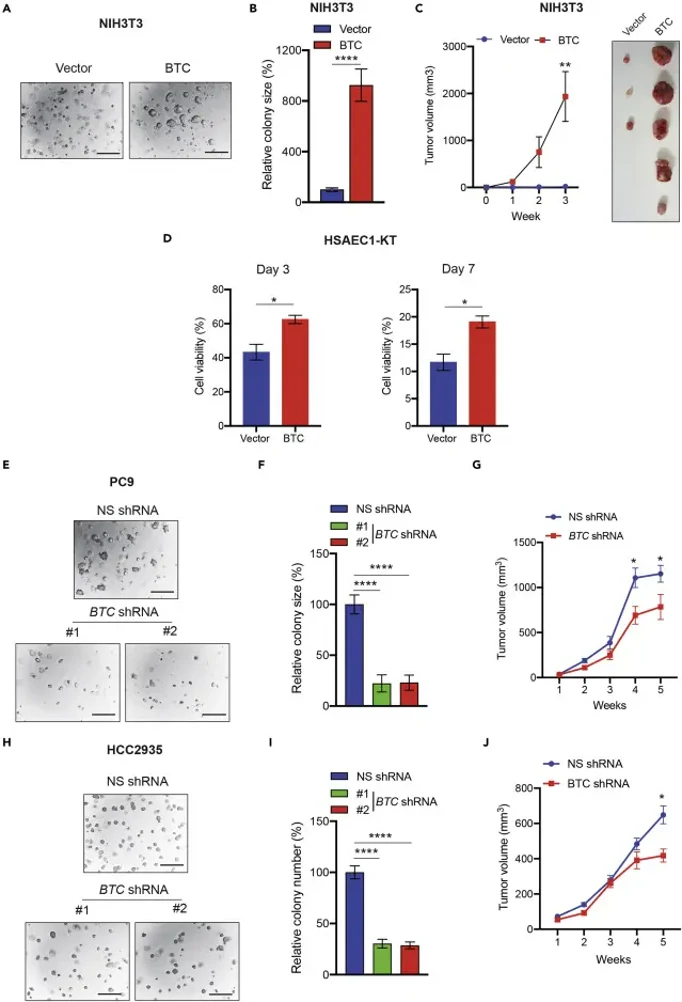
BTC is Sufficient to Cause Cellular Transformation of NIH3T3 Cells and Promote Anchorage-Independent Growth of Immortalized Human Lung Epithelial Cells
Oncogenic EGFR mutations are found in 15-20% of lung adenocarcinoma (LUAD) cases, but the mechanisms driving tumor development are not fully understood. Chava et al. identifies betacellulin (BTC) as a gene upregulated by oncogenic EGFR and investigates its role in LUAD.
Given that BTC expression relies on EGFR-MAPK-ERK signaling, they explored if overexpressing BTC could transform NIH3T3 cells. They introduced either an empty vector or BTC into these cells and tested their ability to grow without anchorage in soft agar and form tumors in mice. Overexpressing BTC led to larger colonies in soft agar (Fig. 1A and B), showing it promotes anchorage-independent growth. When injected into mice, NIH3T3 cells with BTC formed tumors, while those with the empty vector mostly did not (Fig. 1C). This confirms that overexpressing BTC transforms NIH3T3 cells. We also tested BTC overexpression in human airway epithelial cells (HSAEC1-KT). These cells, modified with hTERT and Cdk4, gained a growth advantage with BTC under anchorage-independent conditions (Fig. 1D). However, they didn't form tumors in mice, highlighting that human cells need multiple genetic changes for full transformation. Overall, overexpressing BTC can transform mouse cells and boost the growth of immortalized human lung epithelial cells without anchorage.
Ask a Question
Write your own review

Description: Nasal epithelial cells form the outermost protective layer against environmental factors. They clean, humidify, and warm inhaled air. They produces mucus, which binds particles that are subsequently ...
Description: Immortalized Human Corneal Epithelial Cells-SV40 have been obtained immortalizing Human Corneal Epithelial Cells with Lenti-SV40 Lentivirus. Immortalized cells were controlled passaging side by side ...

Description: Immortalized Human Lymphatic Endothelial Cells-SV40 were developed from human tissues transduced with a lentiviral expression vector containing the SV40T gene. The cell line was continuously cultured ...
Description: Immortalized Human Retinal Pigment Epithelial Cells were isolated from neonatal human globes and spontaneously immortalized in culture bypassing crisis. They retained typical morphology of the ...
- Adipose Tissue-Derived Stem Cells
- Human Neurons
- Mouse Probe
- Whole Chromosome Painting Probes
- Hepatic Cells
- Renal Cells
- In Vitro ADME Kits
- Tissue Microarray
- Tissue Blocks
- Tissue Sections
- FFPE Cell Pellet
- Probe
- Centromere Probes
- Telomere Probes
- Satellite Enumeration Probes
- Subtelomere Specific Probes
- Bacterial Probes
- ISH/FISH Probes
- Exosome Isolation Kit
- Human Adult Stem Cells
- Mouse Stem Cells
- iPSCs
- Mouse Embryonic Stem Cells
- iPSC Differentiation Kits
- Mesenchymal Stem Cells
- Immortalized Human Cells
- Immortalized Murine Cells
- Cell Immortalization Kit
- Adipose Cells
- Cardiac Cells
- Dermal Cells
- Epidermal Cells
- Peripheral Blood Mononuclear Cells
- Umbilical Cord Cells
- Monkey Primary Cells
- Mouse Primary Cells
- Breast Tumor Cells
- Colorectal Tumor Cells
- Esophageal Tumor Cells
- Lung Tumor Cells
- Leukemia/Lymphoma/Myeloma Cells
- Ovarian Tumor Cells
- Pancreatic Tumor Cells
- Mouse Tumor Cells