
Immortalized Human Gallbladder Epithelial Cells-SV40
Cat.No.: CSC-I2075Z
Species: homo sapiens
Morphology: Polygonal
Culture Properties: Adherent
- Specification
- Background
- Scientific Data
- Q & A
- Customer Review
- Documents
Note: Never can cells be kept at -20°C.
Immortalized Human Gallbladder Epithelial Cells-SV40 are epithelial cells derived from human gallbladder that have been immortalized with stable expression of SV40 large T antigen to allow them to bypass replicative senescence and be cultured indefinitely.
Immortalized Human Gallbladder Epithelial Cells-SV40 Cells exhibit an epithelial, cobblestone-like morphology and are adherent, growing as monolayers under conventional culture conditions. These cells express epithelial markers including E-cadherin, cytokeratins (CK7, CK19) and tight junction proteins ZO-1 and occludin demonstrating their intact epithelial barrier characteristics. These cells have been shown to respond to bile acids, cytokines and growth factors allowing them to be used to study gallbladder epithelial transport and secretion functions as well as inflammatory signaling pathways.
Immortalized Human Gallbladder Epithelial Cells-SV40 has been used to study gallbladder and biliary tract physiology, regulation of epithelial barrier function, mechanisms involved in cholelithiasis (gallstone) formation and biliary inflammation. These cells have also been used to study host-pathogen interactions associated with biliary tract infections as well as the effects of pharmaceuticals or toxic compounds on gallbladder epithelium.
PltC Typhoid Toxin Promotes S. Typhi Pathogenicity In Vivo
Salmonella Typhi secretes two typhoid toxin forms using PltB and PltC subunits. While PltB tropism is established, PltC's cellular targets and functional consequences remain unknown. Kim et al. investigated PltC typhoid toxin tropism and its role in S. Typhi pathogenicity.
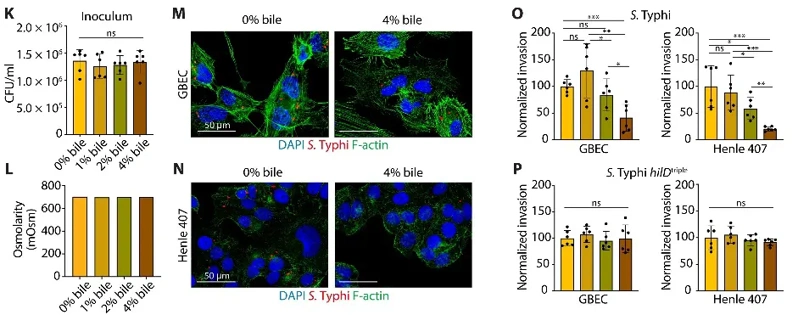
They identified PltC's hepatobiliary tropism through binding to sulfated glycans on liver sinusoidal endothelial and gallbladder epithelial cells, mediated by PltC R109 and carbohydrate sulfotransferases CHST2/4. PltC typhoid toxin reduced bile acids, promoting S. Typhi pathogenicity in infected mice. Then, they assessed whether bile acid levels affect S. Typhi infectivity into immortalized human gallbladder epithelial cells. WT Vi capsule S. Typhi strains were cultured in high-salt LB (0.3 M NaCl, SPI-1 inducing condition), showing equivalent growth with or without bile extract (Fig. 1K). For invasion assays, they osmolarity-balanced culture media to isolate bile acid effects (Fig. 1L), noting that unadjusted bile extract addition increases osmolarity and artificially enhances infectivity. Under these controlled conditions, bile acids inhibited S. Typhi invasion of human gallbladder epithelial cells (Fig. 1M), Henle 407 cells (Fig. 1N), and primary hepatocytes, with microscopy and CFU assays yielding consistent results (Fig. 1O). However, this inhibition was abolished in S. Typhi with hilD triple mutations (Fig. 1P), indicating that three residues in HilD's jellyroll motif are critical for bile acid-mediated suppression of cellular invasion.
Our Immortalized Human Gallbladder Epithelial Cells-SV40 are ideal for:
Gallbladder cancer research.
Cholesterol metabolism studies.
Bile acid transport and secretion investigations.
Drug screening and toxicity testing.
Inflammation and infection studies in the biliary system.
Tissue engineering of the biliary tract.
Cells are shipped in specialized cryopreservation media using temperature-controlled packaging. Upon receipt, they should be stored in liquid nitrogen or used immediately following our thawing protocol.
Ask a Question
Write your own review
 Immortalized Human Gallbladder Epithelial Cells-SV40
Description: Nasal epithelial cells form the outermost protective layer against environmental factors. They clean, humidify, and warm inhaled air. They produces mucus, which binds particles that are subsequently ...
Description: Immortalized Human Corneal Epithelial Cells-SV40 have been obtained immortalizing Human Corneal Epithelial Cells with Lenti-SV40 Lentivirus. Immortalized cells were controlled passaging side by side ...
Description: Immortalized Human Lymphatic Endothelial Cells-SV40 were developed from human tissues transduced with a lentiviral expression vector containing the SV40T gene. The cell line was continuously cultured ...
Description: Immortalized Human Retinal Pigment Epithelial Cells were isolated from neonatal human globes and spontaneously immortalized in culture bypassing crisis. They retained typical morphology of the ...
- Adipose Tissue-Derived Stem Cells
- Human Neurons
- Mouse Probe
- Whole Chromosome Painting Probes
- Hepatic Cells
- Renal Cells
- In Vitro ADME Kits
- Tissue Microarray
- Tissue Blocks
- Tissue Sections
- FFPE Cell Pellet
- Probe
- Centromere Probes
- Telomere Probes
- Satellite Enumeration Probes
- Subtelomere Specific Probes
- Bacterial Probes
- ISH/FISH Probes
- Exosome Isolation Kit
- Human Adult Stem Cells
- Mouse Stem Cells
- iPSCs
- Mouse Embryonic Stem Cells
- iPSC Differentiation Kits
- Mesenchymal Stem Cells
- Immortalized Human Cells
- Immortalized Murine Cells
- Cell Immortalization Kit
- Adipose Cells
- Cardiac Cells
- Dermal Cells
- Epidermal Cells
- Peripheral Blood Mononuclear Cells
- Umbilical Cord Cells
- Monkey Primary Cells
- Mouse Primary Cells
- Breast Tumor Cells
- Colorectal Tumor Cells
- Esophageal Tumor Cells
- Lung Tumor Cells
- Leukemia/Lymphoma/Myeloma Cells
- Ovarian Tumor Cells
- Pancreatic Tumor Cells
- Mouse Tumor Cells