
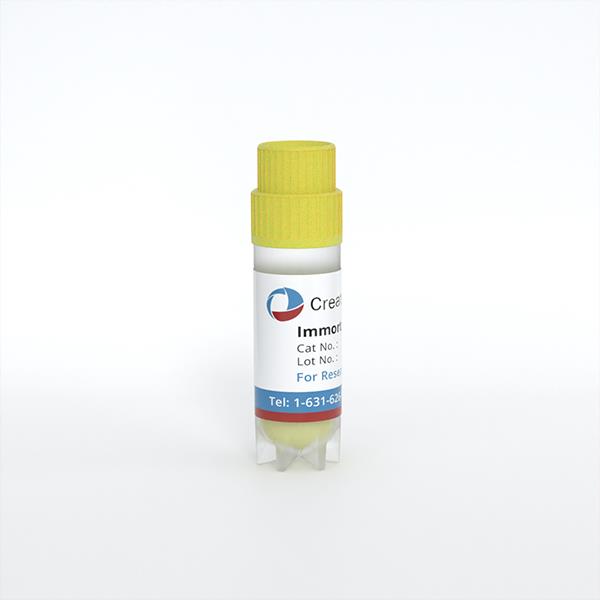
Immortalized Human Bone Marrow Mesenchymal Stem Cells-SV40
Cat.No.: CSC-I9164L
Species: Homo sapiens
Source: Bone Marrow
Morphology: Bipolar
Culture Properties: Adherent
- Specification
- Background
- Scientific Data
- Q & A
- Customer Review
Note: Never can cells be kept at -20 °C.
Immortalized Human Bone Marrow Mesenchymal Stem Cells-SV40 (SV40-hBMMSCs) are immortalized MSC cell line from primary human bone marrow derived mesenchymal stem cells, created using stable expression of the SV40 large T antigen. By doing this, the cells lifespan was prolonged without affecting mesenchymal stem cell phenotype and function allowing for reproducible long-term in vitro experimentation.
SV40-hBMMSCs are adherent, monolayer, spindle-shaped cells, similar in appearance to fibroblasts. The cells show positive results for MSC markers CD73+, CD90+, CD105+ but negative outcomes for hematopoietic markers CD34- and CD45-. They also maintain multipotent differentiation capability towards osteogenic, adipogenic and chondrogenic lineages when exposed to proper conditions.
Researchers apply immortalized hBMMSCs-SV40 to study MSC functions like renewal processes, differentiation mechanisms and senescence behavior. Because of the extended life of these cells, they allow for controlled study of gene regulation, cell signaling and cell-cell/matrix interaction. Since these cells are immortalized, there is no variability due to donors or early replicative senescence. They are used in drug screening, biomaterial assessment as well tissue regeneration and disease modeling.
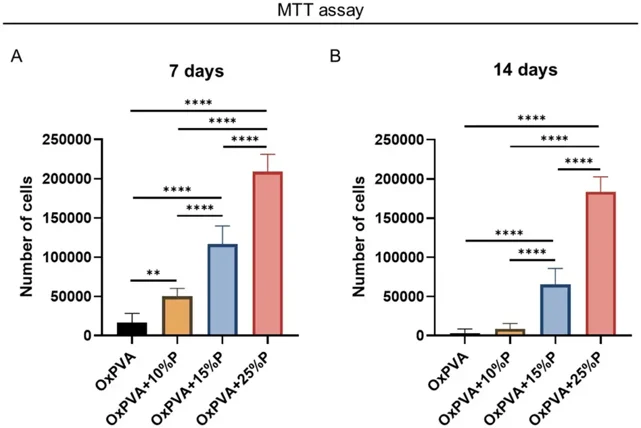
The impact of microstructure and extracellular matrix suspension on the proliferation of bone marrow-derived mesenchymal stem cells for osteochondral defect repair
Osteochondral defects remain challenging due to cartilage's limited healing capacity. Stocco et al. developed oxidized polyvinyl alcohol (OxPVA) scaffolds with/without human cartilage-derived decellularized ECM (dECM) to support immortalized human bone marrow mesenchymal stem cells (HM1-SV40) adhesion and proliferation for cartilage regeneration.
HM1-SV40 cell proliferation was analyzed at 7 and 14 days post-seeding. At Day 7, cell adhesion and proliferation on smooth OxPVA (control) was negligible compared to all porous scaffolds (P < 0.01 vs OxPVA+10%P; P < 0.0001 vs OxPVA+15%P and +25%P). Among porous groups, OxPVA+25%P showed significantly higher proliferation than OxPVA+10%P and +15%P (P < 0.0001), and OxPVA+15%P outperformed OxPVA+10%P (P < 0.0001; Fig. 1A). By Day 14, proliferation decreased across all groups. While OxPVA+25%P and +15%P remained significantly higher than control (P < 0.0001), the difference between control and OxPVA+10%P was no longer significant. OxPVA+25%P maintained the highest cell number, significantly exceeding both OxPVA+15%P and +10%P (P < 0.0001), with OxPVA+15%P also outperforming +10%P (P < 0.0001; Fig. 1B).
Ask a Question
Write your own review
Description: Nasal epithelial cells form the outermost protective layer against environmental factors. They clean, humidify, and warm inhaled air. They produces mucus, which binds particles that are subsequently ...
Description: Immortalized Human Corneal Epithelial Cells-SV40 have been obtained immortalizing Human Corneal Epithelial Cells with Lenti-SV40 Lentivirus. Immortalized cells were controlled passaging side by side ...
Description: Immortalized Human Lymphatic Endothelial Cells-SV40 were developed from human tissues transduced with a lentiviral expression vector containing the SV40T gene. The cell line was continuously cultured ...
Description: Immortalized Human Retinal Pigment Epithelial Cells were isolated from neonatal human globes and spontaneously immortalized in culture bypassing crisis. They retained typical morphology of the ...
- Adipose Tissue-Derived Stem Cells
- Human Neurons
- Mouse Probe
- Whole Chromosome Painting Probes
- Hepatic Cells
- Renal Cells
- In Vitro ADME Kits
- Tissue Microarray
- Tissue Blocks
- Tissue Sections
- FFPE Cell Pellet
- Probe
- Centromere Probes
- Telomere Probes
- Satellite Enumeration Probes
- Subtelomere Specific Probes
- Bacterial Probes
- ISH/FISH Probes
- Exosome Isolation Kit
- Human Adult Stem Cells
- Mouse Stem Cells
- iPSCs
- Mouse Embryonic Stem Cells
- iPSC Differentiation Kits
- Mesenchymal Stem Cells
- Immortalized Human Cells
- Immortalized Murine Cells
- Cell Immortalization Kit
- Adipose Cells
- Cardiac Cells
- Dermal Cells
- Epidermal Cells
- Peripheral Blood Mononuclear Cells
- Umbilical Cord Cells
- Monkey Primary Cells
- Mouse Primary Cells
- Breast Tumor Cells
- Colorectal Tumor Cells
- Esophageal Tumor Cells
- Lung Tumor Cells
- Leukemia/Lymphoma/Myeloma Cells
- Ovarian Tumor Cells
- Pancreatic Tumor Cells
- Mouse Tumor Cells