

Immortalized Human Osteoprecursor Cells (OPC1)
Cat.No.: CSC-I9257L
Species: Homo sapiens
Source: Bone
Morphology: Polygonal
Culture Properties: Adherent
- Specification
- Background
- Scientific Data
- Q & A
- Customer Review
Note: Never can cells be kept at -20 °C.
CIK-HT003 HT® Lenti-SV40T Immortalization Kit
2) ALP staining was utilized to determine presence of ALP.
Immortalized human osteoprecursor cells (OPC1) are a conditionally immortalized human osteogenic precursor cell line generated from fetal bone tissue by means of SV40 large T-antigen-mediated immortalization. The OPC1 cell line was established as a robust and reproducible model of human osteoprogenitor cells, with long-term proliferative capacity, while maintaining the essential osteoblastic properties and the ability to differentiate.
OPC1 cells are adherent growing cells expressing several osteogenic markers such as alkaline phosphatase (ALP), osteocalcin (OCN), osteonectin (ON), osteopontin (OPN), type I collagen and parathyroid hormone receptor (PTHR). Under osteogenic induction conditions, which mimics the processes of bone formation and maturation, OPC1 cells can be induced to undergo programmed osteogenic differentiation, produce mineralized extracellular matrix and form calcified nodules in the presence of recombinant human bone morphogenetic protein-2 (rhBMP-2).
Because of their stable phenotype and strong osteogenic responsiveness, OPC1 cells are often employed for research of bone biology, skeletal development, osteogenic signaling pathways and biomaterial-cell interactions. They are a great in vitro platform for assessing bone graft alternatives, orthopedic implants, tissue engineered scaffolds, growth factors and regenerative medicines. OPC1 cells are also commonly used in studies on BMP signaling, mineralization, bone regeneration and the creation of new osteoinductive biomaterials. OPC1, a well-characterized human osteoprecursor model, continues to be an essential tool for bone tissue engineering, regenerative medicine, and translational orthopedic research.
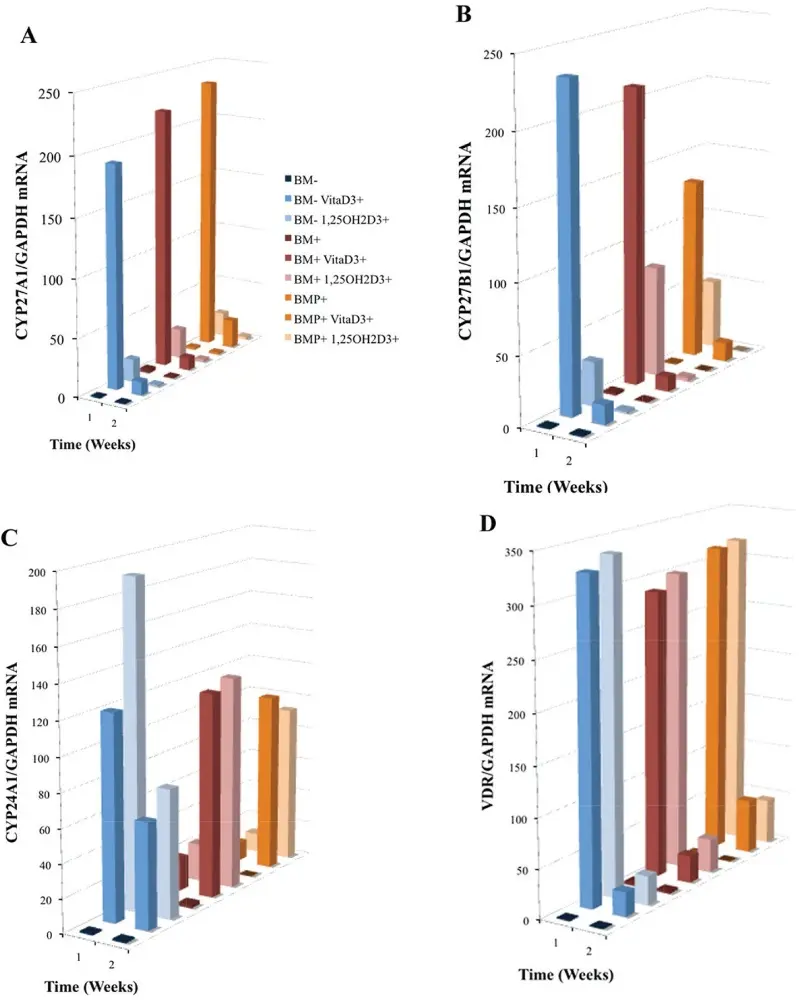
Vitamin D Metabolism and Target Gene Expression During Osteoblastic Differentiation of Human Engineered Osteoblast Precursor Cells (OPC1)
Human bone marrow–derived multipotential precursor cell lines can model osteoblast proliferation, differentiation, and extracellular matrix (ECM) mineralization. The engineered osteoblast precursor cell line OPC1 metabolizes vitamin D₃ (vitaD₃) to active 1α,25‑dihydroxyvitamin D₃ [1,25(OH)₂D₃] and undergoes osteogenic responses. Mason et al. characterized vitamin D–metabolizing enzyme and receptor gene expression during early bone development in vitro.
OPC1 expressed CYP27A1and CYP27B1 in response to vitaD₃ relative to ethanol‑treated control (BM−) (Fig. 1A, B). Both hydroxylases were induced within the first 72 h (week 1) but declined markedly by week 2 under continuous vitaD₃ exposure. Osteogenic conditions (BM+ and BMP+) enhanced CYP27A1 vs. BM− + vitaD₃, whereas BMP+ suppressed CYP27B1 relative to BM− and BM+ + vitaD₃. CYP24A1and vitamin D receptor (VDR) mRNA were also induced by vitaD₃ and 1,25(OH)₂D₃ (Fig. 1C, D). In week 1, all vitamin D–treated groups showed significant upregulation of both genes vs. BM− (p< 0.001); CYP24A1 induction was markedly higher in BM− + vitaD₃ than in osteogenic groups. By week 2, CYP24A1decreased in BM− but increased in BM+ and BMP+ groups, while VDR expression declined across all conditions compared to week 1.
These results confirm that OPC1 intrinsically expresses vitamin D–metabolizing enzymes and VDR, with dynamic regulation by osteogenic cues, supporting its use as a model to study vitamin D–dependent gene expression and matrix production during human osteoblast differentiation.
Ask a Question
Write your own review
Description: Nasal epithelial cells form the outermost protective layer against environmental factors. They clean, humidify, and warm inhaled air. They produces mucus, which binds particles that are subsequently ...
Description: Immortalized Human Splenic Endothelial Cells-SV40 have been obtained immortalizing Human Splenic Endothelial Cells with SV40LT expressing lentiviral particles. Immortalized cells were controlled ...

Description: Immortalized Human Corneal Epithelial Cells-SV40 have been obtained immortalizing Human Corneal Epithelial Cells with Lenti-SV40 Lentivirus. Immortalized cells were controlled passaging side by side ...
Description: Immortalized Human Lymphatic Endothelial Cells-SV40 were developed from human tissues transduced with a lentiviral expression vector containing the SV40T gene. The cell line was continuously cultured ...
- Adipose Tissue-Derived Stem Cells
- Human Neurons
- Mouse Probe
- Whole Chromosome Painting Probes
- Hepatic Cells
- Renal Cells
- In Vitro ADME Kits
- Tissue Microarray
- Tissue Blocks
- Tissue Sections
- FFPE Cell Pellet
- Probe
- Centromere Probes
- Telomere Probes
- Satellite Enumeration Probes
- Subtelomere Specific Probes
- Bacterial Probes
- ISH/FISH Probes
- Exosome Isolation Kit
- Human Adult Stem Cells
- Mouse Stem Cells
- iPSCs
- Mouse Embryonic Stem Cells
- iPSC Differentiation Kits
- Mesenchymal Stem Cells
- Immortalized Human Cells
- Immortalized Murine Cells
- Cell Immortalization Kit
- Adipose Cells
- Cardiac Cells
- Dermal Cells
- Epidermal Cells
- Peripheral Blood Mononuclear Cells
- Umbilical Cord Cells
- Monkey Primary Cells
- Mouse Primary Cells
- Breast Tumor Cells
- Colorectal Tumor Cells
- Esophageal Tumor Cells
- Lung Tumor Cells
- Leukemia/Lymphoma/Myeloma Cells
- Ovarian Tumor Cells
- Pancreatic Tumor Cells
- Mouse Tumor Cells