
Chicken Red Blood Cells
Cat.No.: CSC-C3094
Species: Chicken
Source: Blood
Cell Type: Red Blood Cell
- Specification
- Background
- Scientific Data
- Q & A
- Customer Review
Chicken red blood cells (cRBCs) represent a unique population of nucleated erythrocytes whose precursor cells arise mainly from the bone marrow. In adult birds, mature erythrocytes are released into the peripheral blood, and represent the most abundant cell type. Morphologically, cRBCs are oval, biconcave cells that are 9-12 µm in diameter. The nucleated cells have centrally-located nucleus, making them easily distinguishable from mammalian anucleated erythrocytes. Hemoglobin within their cytoplasm stains cRBCs yellow‑green.
In vivo, cRBCs function as the primary oxygen transporter. The glycoconjugates on their surfaces allow for hemagglutination to avian viruses. For this reason, cRBCs are widely used as reagents for hemagglutination and hemagglutination‑inhibition assays for detecting antibodies to influenza, Newcastle disease virus, and other viruses of poultry. In addition, cRBCs have recently been shown to up‑regulate pro‑inflammatory cytokines (e.g., TNF‑α, IFN‑γ, and IL‑1β) in response to antimicrobial peptides (e.g., AvBD11). This previously-unknown function of cRBCs could be exploited for future studies of innate immune responses. Chicken red blood cells can also be used for in vitro serological assays, testing vaccine preparations for efficacy, and determining the signals elicited by immunological pathways, as well as in genomic studies to understand avian chromatin architecture.
Converting of the 2D Graphene to its 3D By Chicken Red Blood Cells as Sheets Separator for Construction Supercapacitor Electrode
Traditional 3D graphene lacks cost-effective, green spacers and heteroatom dopants. Jamshidi et al. introduced chicken red blood cells as both porogen and N/S source to fabricate porous 3D graphene for high-performance supercapacitors.
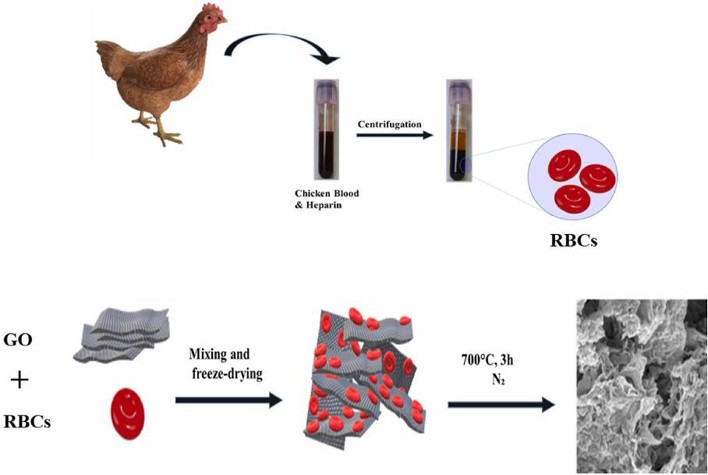
Chicken red blood cells (RBCs) were used as raw materials for synthesizing graphene-based composites. GO-RBCs hybrids were formed by stirring a mixture containing a suspension of GO and RBCs for 5 hours. Subsequently, a freeze-drying method was employed to produce the macro-porous hybrids (GO-RBCs-F). Finally, to enhance the micro-porosity and improve the conductivity of the composites, the material was pyrolyzed under a nitrogen atmosphere, resulting in the product denoted as GO-RBCs-F-P. Before using the freeze casting method to produce the macro-porous hybrid, the interaction between RBCs and GO was investigated by examining the zeta potentials of the reactants and products. Since the pH of graphene oxide suspension is around 3.5, the zeta potential investigation was conducted at this pH. As shown in Figure 1A, the zeta potential of the RBCs solution at pH 3.5 is about 15 mV. The zeta potential of GO (Fig. 1B) was -28 mV, which is consistent with other reports on GO. After mixing the RBCs solution with GO, the zeta potential of the GO-RBCs mixture changed to -18 mV, indicating successful interaction between GO and RBCs (Fig. 1C). In this step, as expected, the surface of the GO sheets was covered with RBCs or hemoglobin, facilitating further separation of the GO sheets.
Ask a Question
Write your own review
Description: Gallus embryonic kidney epithelial cells provided by Creative Bioarray are isolated from the Embryo tissue of chicken. Our isolation protocol combines established methods with proprietary techniques. ...
Description: Gallus embryonic cardiomyocytes (GECMCs) provided by Creative Bioarray are isolated from the heart tissue of chicken embryo. Our isolation protocol combines established methods with proprietary ...
Description: Gallus articular chondrocytes (GACs) provided by Creative Bioarray are isolated from the embryonic articular cartilage of chicken. Our isolation protocol combines established methods with proprietary ...
Description: Gallus fetal dermal fibroblasts (GFDFs) provided by Creative Bioarray are isolated from the fetal dermis tissue of chicken embryo. Our isolation protocol combines established methods with proprietary ...
Description: Chicken Preadipocytes from Creative Bioarray are isolated from the chicken adipose tissue. The method we use to isolate chicken preadipocytes was developed based on a combination of established and ...
Description: Gallus embryonic fibroblasts (GEFs) provided by Creative Bioarray are isolated from the embryo tissue of chicken. Our isolation protocol combines established methods with proprietary techniques. The ...