
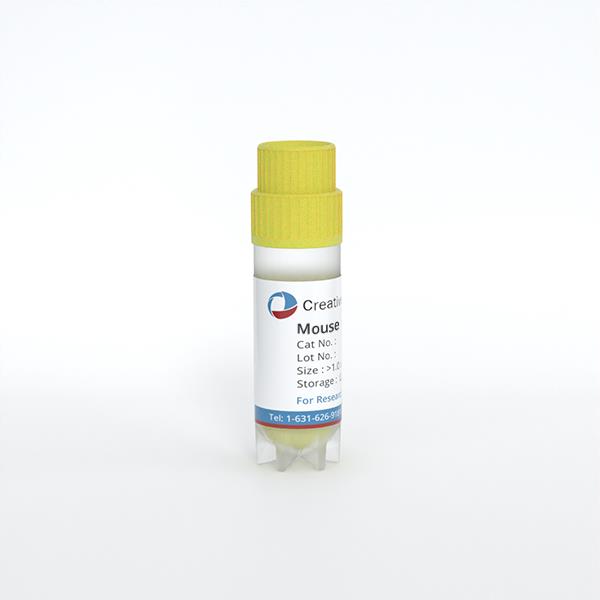
Mouse NK Cells
Cat.No.: CSC-C5336S
Species: Mouse
Source: Peripheral Blood; Blood
Cell Type: NK Cell; Lymphocyte
- Specification
- Background
- Scientific Data
- Q & A
- Customer Review
Mouse NK cells from Creative Bioarray are isolated from the mouse peripheral blood. The method we use to isolate mouse NK cells was developed based on a combination of established and our proprietary methods. The mouse NK cells are characterized by immunofluorescence with antibodies specific to CD16 or CD56.
Mouse NK cells are important effector cells of the innate immune system and are involved in early immune defense, tumor control, and immune regulation. Mouse NK cells are produced in the bone marrow from hematopoietic stem cells and found in peripheral tissues such as the spleen, blood, liver, lungs, and lymph nodes. Splenic NK cells can be considered the prototypical cytotoxic NK cell subset, while resident NK cells in the liver are frequently immunoregulatory, illustrating a tissue-based heterogeneity in the NK cell compartment.
Mouse NK cells are non-adherent, round lymphoid cells with a high content of cytotoxic granules that contain perforin and granzymes. They require cytokine signals for survival and proliferation, most notably IL-2 and IL-15. They are capable of fast cytotoxicity against transformed or infected cells via granule exocytosis and death receptor pathways and produce key cytokines like IFN-γ and TNF-α to help coordinate other aspects of the innate and adaptive immune response. They can also influence dendritic cell maturation, macrophage activation, and T-cell priming, and as such are an interface between many different immune mechanisms.
Mouse NK cells are used as a foundational system for studies on tumor immunology, antiviral immunity, cytokine signaling, and NK cell development. Due to their compatibility with existing mouse genetic systems, they have been instrumental in helping to dissect the many details of NK cell receptor-ligand interactions, MHC-I recognition, and the molecular mechanisms behind NK cell activation. Mouse NK cells remain an important, versatile system for immunological research and NK-based immunotherapy development.
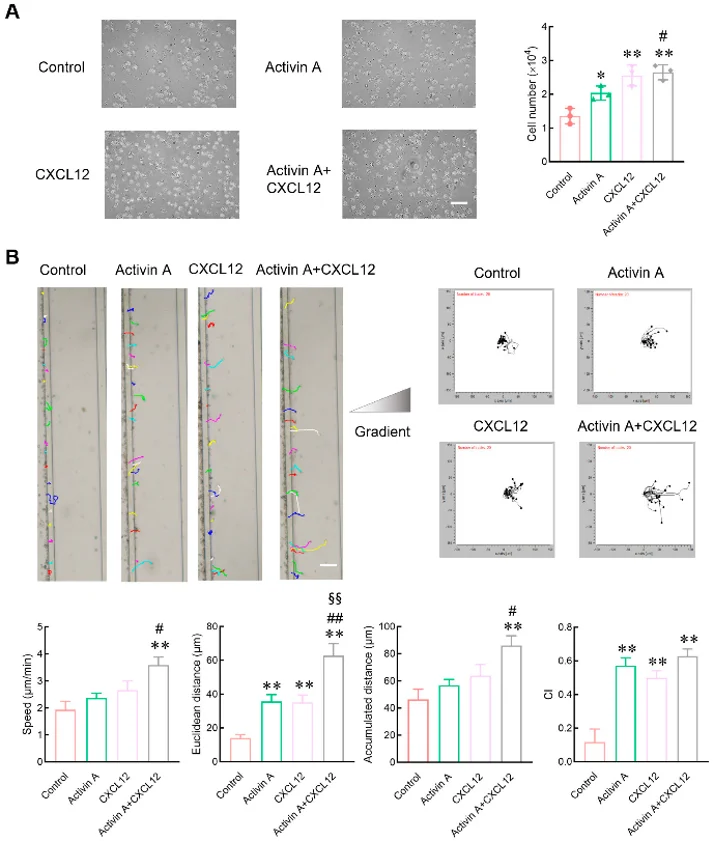
Activin A Induces Mouse NK Cell Migration
NK cells migrate to tumor sites to kill cancer cells, regulated by chemokines. Activin A, involved in tumor development, is highly expressed in tumors. Here, Wang's team examined activin A's effects on NK cell migration in vitro and in vivo.
To determine the effect of activin A on NK cell migration, a transwell assay was used. CXCL12, as a positive control, significantly increased the number of migrated mouse NK cells compared to the control group, consistent with literature reports, and activin A also increased the number of migrated mouse NK cells (Fig. 1A). Microfluidic chips were used to examine the migration of mouse NK cells, providing suitable environments for real-time measurements of migration direction and speed. CXCL12 significantly increased the Euclidean distance and chemotaxis index (CI) of mouse NK cells compared to the control group. Activin A also significantly increased these parameters, and the combined group of activin A and CXCL12 showed the most potent effect on inducing NK cell migration (Fig. 1B). These results indicate that activin A can induce mouse NK cell migration and has a synergistic effect with CXCL12.
Ask a Question
Write your own review
Description: C57BL/6-GFP Mouse Skeletal Muscle Microvascular Endothelial Cells from Creative Bioarray are isolated from C57BL/6-Tg (CAG-EGFP) 1Osb/J mouse skeletal muscle tissue of pathogen-free laboratory mice. ...
Description: eNOS KO Mouse Stomach Epithelial Cells from Creative Bioarray are isolated from stomach tissue of pathogen-free laboratory mice. eNOS KO Mouse Stomach Epithelial Cells are grown in a T25 tissue ...
Description: eNOS KO Mouse Liver Fibroblasts from Creative Bioarray are isolated from liver tissue of pathogen-free laboratory mice. eNOS KO Mouse Liver Fibroblasts are grown in T75 tissue culture flasks ...
Description: C57BL/6-GFP Mouse Corneal Epithelial Cells from Creative Bioarray are isolated from C57BL/6-GFP-Tg(CAG-EGFP)1Osb/J mouse corneal tissue of pathogen-free laboratory mice. C57BL/6-GFP Mouse Corneal ...
Description: BALB/c Mouse Retinal Microvascular Endothelial Cells from Creative Bioarray are isolated from retinal tissue of pathogen-free laboratory mice. BALB/c Mouse Retinal Microvascular Endothelial Cells are ...