

Immortalized Human Neonatal Fibroblasts (MRC-5)
Cat.No.: CSC-I2297Z
Species: homo sapiens
Morphology: Polygonal
Culture Properties: Adherent
- Specification
- Background
- Scientific Data
- Q & A
- Customer Review
MRC-5 is a well-characterized, diploid human fetal lung fibroblast cell line derived from a 14-week-old male fetus. It is not immortalized and not neonatal; it retains a finite in vitro lifespan and normal cell-cycle checkpoints, making it a physiologically relevant, non-transformed model. MRC-5 expresses fibroblast markers such as vimentin, collagen I/III, and fibronectin, and is highly permissive to many human and animal viruses, including varicella-zoster, poliovirus, hepatitis A, rabies, and cytomegalovirus.
Key advantages:
- Regulatory acceptance: MRC-5 is approved for human vaccine production (e.g., varicella, hepatitis A, polio, rabies) due to its stable diploid karyotype, genetic fidelity, and low tumorigenicity.
- Reproducibility: Extensive historical data, standardized culture protocols, and broad availability support consistent, comparable results.
- Broad viral susceptibility: Ideal for virus isolation, propagation, titration, neutralization assays, and vaccine development.
- Safety testing: Widely used for cytotoxicity, genotoxicity, and biocompatibility assessment.
- Senescence research: Its finite lifespan enables studies of replicative senescence and ageing.
- Genetic tractability: Amenable to transfection, siRNA, and CRISPR for mechanistic studies.
Overall, MRC-5 offers a robust, regulatory-compliant, and human-relevant platform for virology, vaccine development, safety testing, and translational research.
Development and Characterization of MRC-5 and Vero Cell-Adapted Enterovirus D68 Strains for Vaccine Production
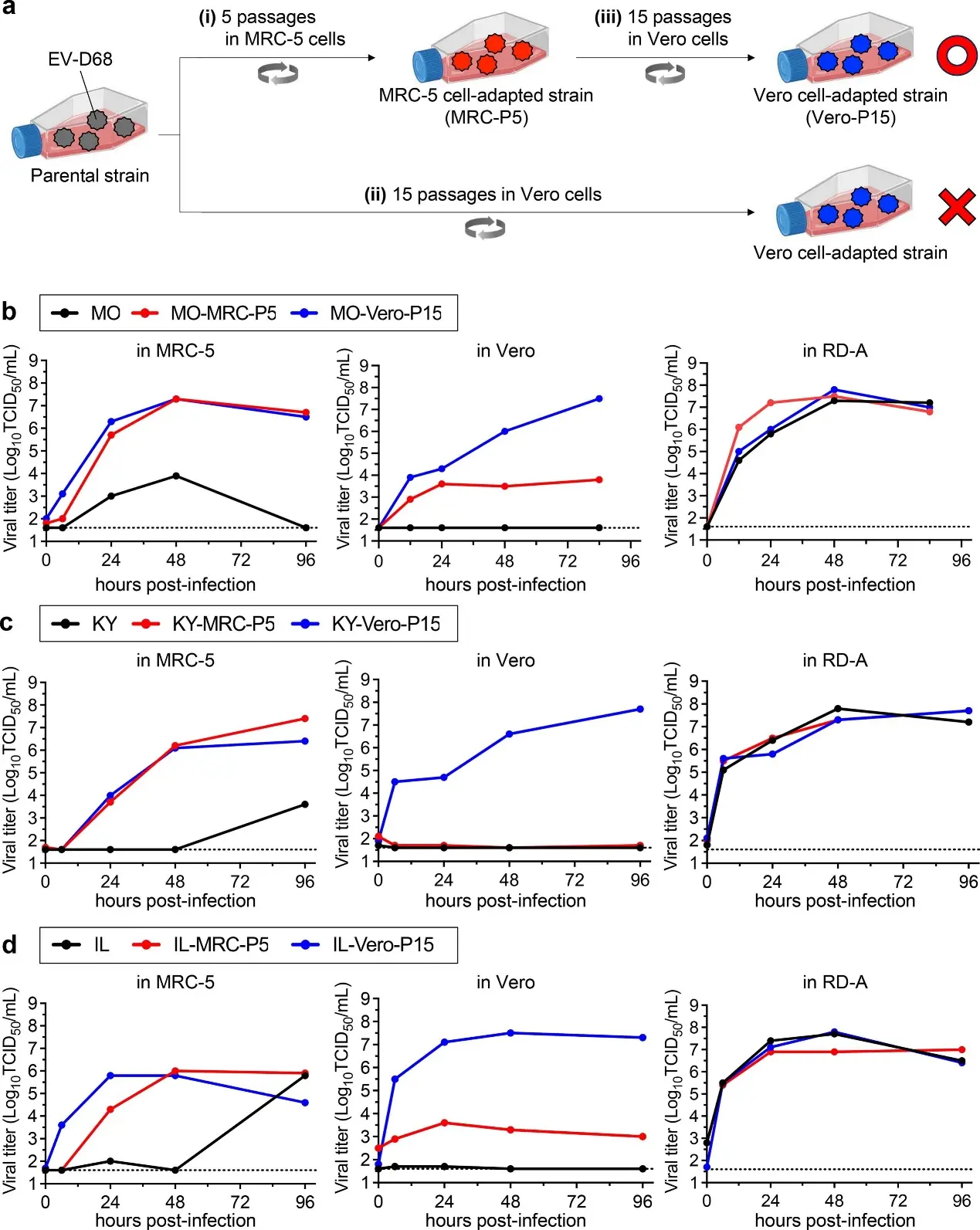
Enterovirus D68 (EV-D68) is a pathogen that causes respiratory and neurological diseases. Currently, there are no licensed vaccines for EV-D68. Here, we adapted EV-D68 to MRC-5 and Vero cells, which are widely used in vaccine manufacturing, to develop EV-D68 strains applicable for vaccine production. We successfully isolated MRC-5 cell-adapted strains by serial passaging in MRC-5 cells. Although efforts to isolate Vero cell-adapted strains through serial passaging of EV-D68 in Vero cells were unsuccessful, we isolated Vero cell-adapted strains by serial passaging of MRC-5 cell-adapted strains in Vero cells. Inactivated whole-virion vaccines were prepared from vaccine-manufacturing cell-adapted strains and mice were immunized with these vaccines. We found that in some cases, the parental and cell-adapted strains induced similar levels of protective immunity against EV-D68, whereas in other cases, the cell-adapted strains were significantly less effective than the parental strains. These data provide valuable information for EV-D68 vaccine production.
Ask a Question
Write your own review
Description: Immortalized Human Gastric Epithelial Cells-SV40 have been obtained immortalizing Human Gastric Epithelial Cells with Lenti-SV40 Lentivirus. Immortalized cells were controlled passaging side by side ...

Description: Immortalized Human Kidney Podocytes-SV40 have been obtained immortalizing Human Kidney Podocytes with Lenti-SV40 Lentivirus. Immortalized cells were controlled passaging side by side with the primary ...
Description: Nasal epithelial cells form the outermost protective layer against environmental factors. They clean, humidify, and warm inhaled air. They produces mucus, which binds particles that are subsequently ...
Description: Immortalized Human Splenic Endothelial Cells-SV40 have been obtained immortalizing Human Splenic Endothelial Cells with SV40LT expressing lentiviral particles. Immortalized cells were controlled ...
Description: Immortalized Human Corneal Epithelial Cells-SV40 have been obtained immortalizing Human Corneal Epithelial Cells with Lenti-SV40 Lentivirus. Immortalized cells were controlled passaging side by side ...
- Adipose Tissue-Derived Stem Cells
- Human Neurons
- Mouse Probe
- Whole Chromosome Painting Probes
- Hepatic Cells
- Renal Cells
- In Vitro ADME Kits
- Tissue Microarray
- Tissue Blocks
- Tissue Sections
- FFPE Cell Pellet
- Probe
- Centromere Probes
- Telomere Probes
- Satellite Enumeration Probes
- Subtelomere Specific Probes
- Bacterial Probes
- ISH/FISH Probes
- Exosome Isolation Kit
- Human Adult Stem Cells
- Mouse Stem Cells
- iPSCs
- Mouse Embryonic Stem Cells
- iPSC Differentiation Kits
- Mesenchymal Stem Cells
- Immortalized Human Cells
- Immortalized Murine Cells
- Cell Immortalization Kit
- Adipose Cells
- Cardiac Cells
- Dermal Cells
- Epidermal Cells
- Peripheral Blood Mononuclear Cells
- Umbilical Cord Cells
- Monkey Primary Cells
- Mouse Primary Cells
- Breast Tumor Cells
- Colorectal Tumor Cells
- Esophageal Tumor Cells
- Lung Tumor Cells
- Leukemia/Lymphoma/Myeloma Cells
- Ovarian Tumor Cells
- Pancreatic Tumor Cells
- Mouse Tumor Cells