
Immortalized Human Glomerular Podocytes-SV40 (Tet-on)
Cat.No.: CSC-I1910Z
Species: homo sapiens
Morphology: Polygonal
Culture Properties: Adherent
- Specification
- Background
- Scientific Data
- Q & A
- Customer Review
CIK-HT004 HT? Lenti-SV40 (tsA58 temperature sensitive mutant) Lentivirus Immortalization Kit
Note: Never can cells be kept at -20 °C.
Immortalized human glomerular podocytes-SV40 (Tet-on) are conditionally immortalized podocytes derived from human glomeruli and engineered with a doxycycline-inducible (Tet-on) SV40 large T antigen. In the presence of doxycycline, T antigen drives proliferation, enabling scalable expansion and cryopreservation. Upon doxycycline withdrawal, proliferation ceases and cells differentiate into a mature podocyte-like phenotype, expressing nephrin, podocin, CD2AP, WT1, synaptopodin, podocalyxin, α-actinin-4, and ZO-1. They develop an arborized actin cytoskeleton and slit-diaphragm-associated structures essential for glomerular filtration barrier function.
Their key advantage is controllable immortality. Unlike constitutive SV40 lines, Tet-on allows temporal control: expansion when needed, then differentiation with reduced T-antigen interference. This improves physiological relevance while retaining batch consistency, human origin, and reduced donor variability. They are widely used to model podocyte injury, proteinuria, nephrotic syndrome, diabetic nephropathy, focal segmental glomerulosclerosis, and drug/toxin nephrotoxicity. They support mechanistic studies of insulin signaling, autophagy, apoptosis, cytoskeletal remodeling, and crosstalk with glomerular endothelial cells.
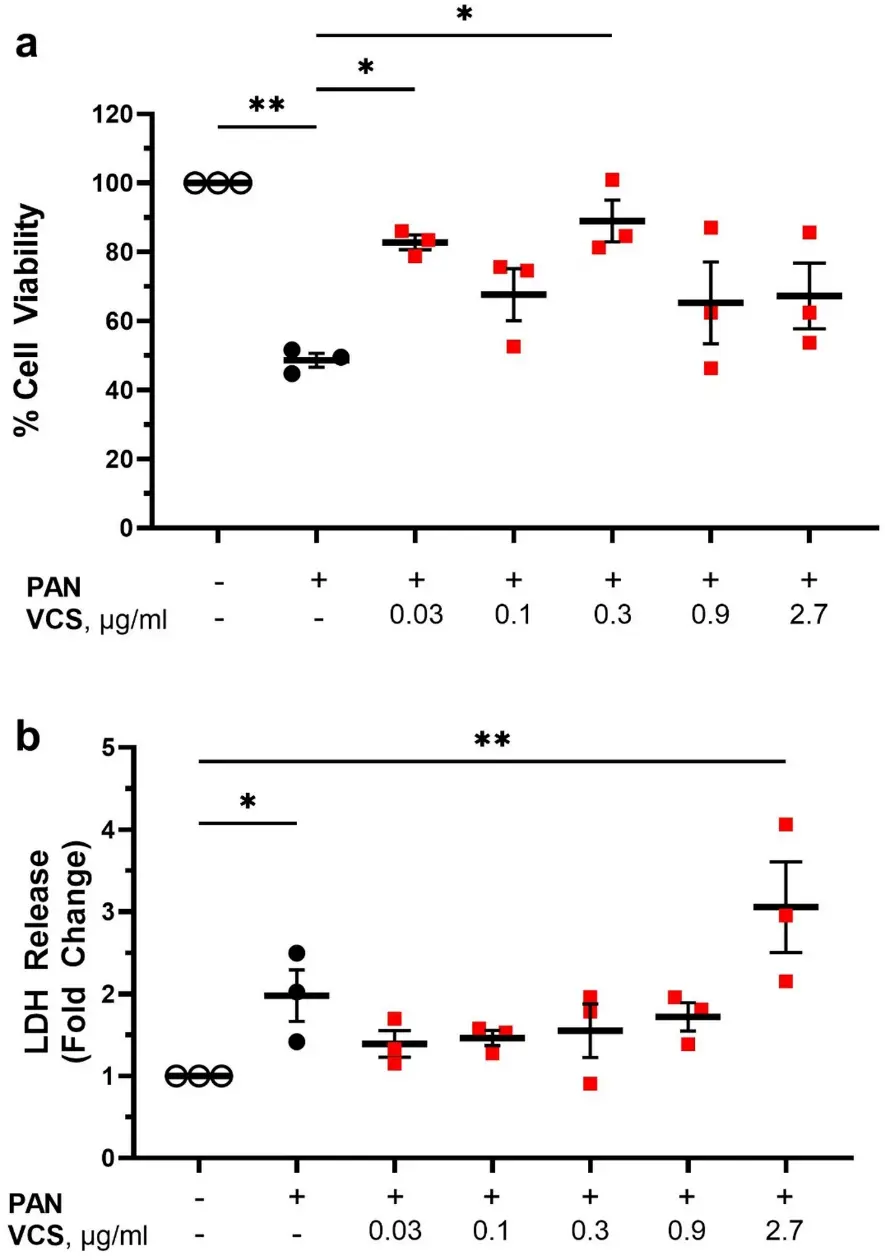
Voclosporin (VCS) Improved In Vitro Podocyte Viability and Decreased Cellular Stress after PAN Treatment
Voclosporin (VCS) is a second generation calcineurin inhibitor (CNI), which is currently approved for use only in adults with lupus nephritis (LN) on a background of immunosuppression. However, VCS is not yet approved for use in children or adults with any other renal diseases. Based on this, we assessed the ability of VCS to protect conditionally immortalized human podocytes (hiPODs) from puromycin aminonucleoside (PAN)-induced toxicity and stress. Differentiated hiPODs were challenged with 50 µg/ml PAN (or Saline control) and treated with VCS (or DMSO vehicle control) over a dose curve (0.01, 0.03, 0.1, 0.3, 0.9, and 2.7 µg/ml). After 24 h, results showed that PAN treatment significantly reduced cell viability to 49% (Fig. 1a) vs. No PAN + DMSO treated cells (set at 100%). VCS rescued cell viability in PAN-treated cells at all doses and was significantly increased at 0.03 µg/ml (83%) and 0.3 µg/ml (85%) vs. PAN + DMSO-treated cells. For cellular stress analyses, LDH release was significantly increased 1.98-fold in PAN + DMSO treated cells (Fig. 1b) vs. No PAN + DMSO cells. VCS decreased cellular stress in PAN-treated hiPODs at 0.03–0.9 µg/ml, but this was not significant. The dose-response curve showed that at 2.7 µg/ml VCS treatment in PAN-treated cells significantly increased cellular stress as compared to PAN + DMSO-treated cells (1.46-fold) (Fig. 1b). These results demonstrate that VCS protected hiPODs by reducing cell death and cellular stress induced by PAN treatment.
Ask a Question
Write your own review

Description: Immortalized Human Gastric Epithelial Cells-SV40 have been obtained immortalizing Human Gastric Epithelial Cells with Lenti-SV40 Lentivirus. Immortalized cells were controlled passaging side by side ...
Description: Immortalized Human Kidney Podocytes-SV40 have been obtained immortalizing Human Kidney Podocytes with Lenti-SV40 Lentivirus. Immortalized cells were controlled passaging side by side with the primary ...
Description: Nasal epithelial cells form the outermost protective layer against environmental factors. They clean, humidify, and warm inhaled air. They produces mucus, which binds particles that are subsequently ...
Description: Immortalized Human Splenic Endothelial Cells-SV40 have been obtained immortalizing Human Splenic Endothelial Cells with SV40LT expressing lentiviral particles. Immortalized cells were controlled ...

Description: Immortalized Human Corneal Epithelial Cells-SV40 have been obtained immortalizing Human Corneal Epithelial Cells with Lenti-SV40 Lentivirus. Immortalized cells were controlled passaging side by side ...
- Adipose Tissue-Derived Stem Cells
- Human Neurons
- Mouse Probe
- Whole Chromosome Painting Probes
- Hepatic Cells
- Renal Cells
- In Vitro ADME Kits
- Tissue Microarray
- Tissue Blocks
- Tissue Sections
- FFPE Cell Pellet
- Probe
- Centromere Probes
- Telomere Probes
- Satellite Enumeration Probes
- Subtelomere Specific Probes
- Bacterial Probes
- ISH/FISH Probes
- Exosome Isolation Kit
- Human Adult Stem Cells
- Mouse Stem Cells
- iPSCs
- Mouse Embryonic Stem Cells
- iPSC Differentiation Kits
- Mesenchymal Stem Cells
- Immortalized Human Cells
- Immortalized Murine Cells
- Cell Immortalization Kit
- Adipose Cells
- Cardiac Cells
- Dermal Cells
- Epidermal Cells
- Peripheral Blood Mononuclear Cells
- Umbilical Cord Cells
- Monkey Primary Cells
- Mouse Primary Cells
- Breast Tumor Cells
- Colorectal Tumor Cells
- Esophageal Tumor Cells
- Lung Tumor Cells
- Leukemia/Lymphoma/Myeloma Cells
- Ovarian Tumor Cells
- Pancreatic Tumor Cells
- Mouse Tumor Cells