
SU-DHL-2
Cat.No.: CSC-C7068J
Species: Homo sapiens (Human)
Source: Pleural Effusion
Morphology: Lymphoblast-like
Culture Properties: Suspension
- Specification
- Background
- Scientific Data
- Q & A
- Customer Review
SU-DHL-2 is a well-characterized human diffuse large B-cell lymphoma (DLBCL) cell line established from the pleural effusion of a 73-year-old Caucasian female with diffuse histiocytic lymphoma in relapse following chemotherapy with prednisone and chlorambucil. The cells exhibit lymphoblast-like morphology and grow in suspension as multicellular aggregates. Karyotypically, SU-DHL-2 is predominantly hyperdiploid with a sharp modal number of 51 chromosomes; occasional hypertetraploid cells are observed, along with a consistently present minute marker chromosome and increased chromosome numbers in groups A, B, C, and F. Immunophenotypically, the cells are positive for CD20, CD37, and CD80, while negative for surface immunoglobulin, CD3, CD10, CD34, CD38, CD138, and HLA-DR. The line is negative for Epstein-Barr virus nuclear antigen but positive for EBV DNA sequences by PCR.
A defining feature of SU-DHL-2 is its classification as the activated B-cell-like (ABC) molecular subtype of DLBCL, characterized by chronic active B-cell receptor (BCR) signaling, constitutive NF-κB pathway activation, and impaired apoptosis. Genetically, the cell line harbors a BCL2 rearrangement, with MYC negative, and carries a TP53 missense mutation (p.Y234S). SU-DHL-2 xenografts closely recapitulate human DLBCL pathology, demonstrating diffuse infiltration of large atypical lymphoid cells with prominent nucleoli and brisk mitotic activity. Its well-defined ABC-DLBCL background, consistent tumorigenicity, and proven translational relevance render SU-DHL-2 an indispensable platform for dissecting DLBCL pathogenesis and developing therapeutic interventions.
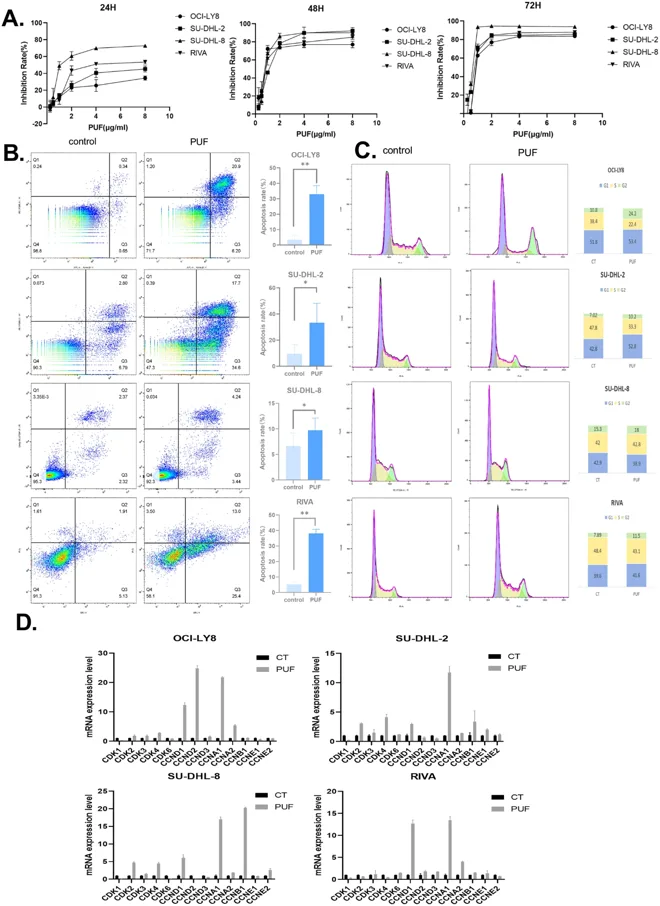
PUF Exerts Anti-Tumor Activity by Inhibiting Proliferation, Inducing Apoptosis, and Arresting the Cell Cycle in DLBCL Cells
This study aimed to elucidate the antitumor efficacy of pulvinatabiflavone (PUF), a novel biflavonoid monomer isolated from Selaginella cuspidata, against diffuse large B-cell lymphoma (DLBCL).
Four DLBCL cell lines-OCI-LY8, SU-DHL-2, SU-DHL-8, and RIVA-were selected for the study. The CCK-8 method was used to verify the inhibitory effect of different concentrations of PUF on DLBCL cell lines (Fig. 1A). PUF had significant inhibitory effects on all four cell lines. After each cell line was treated with PUF at the cell line-specific IC50, apoptosis and cell cycle changes were evaluated by flow cytometry (Fig. 1B-C). The percentage of apoptotic DLBCL cells clearly increased under the action of PUF. The cell cycle of DLBCL cells was also blocked, and most DLBCL cells were arrested in the G2 phase. PCR revealed that the mRNA levels of cyclin in DLBCL cells were also affected by PUF (Fig. 1D).
Ask a Question
Write your own review
Description: Established in 2007 from the bone marrow mononuclear cells of an 82-year-old Japanese man with diffuse large B-cell lymphoma in the leukemic phase
Description: Established from the bone marrow of a 28-year-old man who developed the terminal leukemic phase of lymphosarcoma in 1976
Description: This cell line was derived from the bone marrow aspirate of a 59 year old male with erythroleukemia that became acute myelogenous leukaemia.The cells form colonies in soft-agar in the presence of ...
Description: Established from the pleural effusion of a 24-year-old woman with recurrent anaplastic large cell lymphoma (ALCL); cells were described to clonally derive from T-lineage lymphoid cells and to be ...
Description: Established from a 37-year-old man at second (refractory/terminal) relapse of Hodgkin lymphoma (nodular sclerosing -> lymphocyte depleted/stage IIISA -> stage IV) after both combined chemo- and ...
Description: Established from the peripheral blood of a 10-year-old Caucasian boy with acute lymphoblastic leukemia (pre B-ALL) at diagnosis in 1993
- Adipose Tissue-Derived Stem Cells
- Human Neurons
- Mouse Probe
- Whole Chromosome Painting Probes
- Hepatic Cells
- Renal Cells
- In Vitro ADME Kits
- Tissue Microarray
- Tissue Blocks
- Tissue Sections
- FFPE Cell Pellet
- Probe
- Centromere Probes
- Telomere Probes
- Satellite Enumeration Probes
- Subtelomere Specific Probes
- Bacterial Probes
- ISH/FISH Probes
- Exosome Isolation Kit
- Human Adult Stem Cells
- Mouse Stem Cells
- iPSCs
- Mouse Embryonic Stem Cells
- iPSC Differentiation Kits
- Mesenchymal Stem Cells
- Immortalized Human Cells
- Immortalized Murine Cells
- Cell Immortalization Kit
- Adipose Cells
- Cardiac Cells
- Dermal Cells
- Epidermal Cells
- Peripheral Blood Mononuclear Cells
- Umbilical Cord Cells
- Monkey Primary Cells
- Mouse Primary Cells
- Breast Tumor Cells
- Colorectal Tumor Cells
- Esophageal Tumor Cells
- Lung Tumor Cells
- Leukemia/Lymphoma/Myeloma Cells
- Ovarian Tumor Cells
- Pancreatic Tumor Cells
- Mouse Tumor Cells