
STR-428
Cat.No.: CSC-C6653J
Species: Homo sapiens (Human)
Source: Ascites
Morphology: Lymphocyte-Like
- Specification
- Background
- Scientific Data
- Q & A
- Customer Review
The STR-428 cell line is a human diffuse large B-cell lymphoma (DLBCL) cell line established from the ascitic tumor cells of a male patient with malignant effusion lymphoma. Unlike classical primary effusion lymphoma, STR-428 is negative for human herpesvirus-8 (HHV-8) and thus provides a novel model for study of HHV-8-independent lymphomatous effusions and aggressive B-cell malignancies. The cell line is lymphocyte-like in morphology and grows in suspension culture. It has been reported to have an approximate doubling time of 48 hours under standard culture conditions.
Immunophenotypic analysis has shown the expression of mature B-cell markers like CD19, CD20, CD22, CD10 and HLA-DR, but not of T-cell-associated markers. Cytogenetics showed complex abnormalities involving both the BCL2 and MYC oncogenes, including t(14;18)(q32;q21) translocation and additional MYC-associated rearrangements. These genetic alterations are related to aggressive behavior of lymphoma and therefore STR-428 may be a useful model to study the molecular mechanisms of B-cell lymphoma development and progression. The STR-428 has been used in studies of lymphoma biology, oncogenic signaling, regulation of apoptosis, and therapeutic response. This cell line has also been used in more recent studies to investigate the metabolic pathways involved in the survival and proliferation of lymphoma cells. As a well characterized model for B-cell lymphoma, STR-428 provides a relevant in vitro platform for research on lymphoma pathogenesis, discovery of biomarkers and evaluation of potential anti-cancer agents.
Bim Downregulation Mediates Resistance to Polatuzumab Vedotin in DLBCL Cell Models
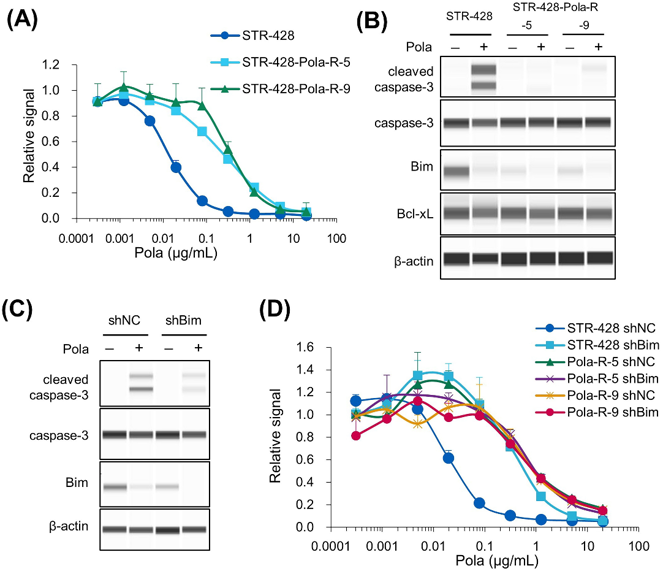
Polatuzumab vedotin (Pola) has improved outcomes for diffuse large B-cell lymphoma (DLBCL) in both relapsed/refractory and frontline settings, yet management of post-Pola progression remains a clinical challenge. To evaluate retreatment feasibility, Kawasaki et al. developed two Pola-resistant DLBCL models-SU-DHL-4 and STR-428-via long-term exposure. STR-428-derived resistant clones (STR-428-Pola-R-5 and -9) exhibited 17.6- and 27.7-fold higher IC₅₀ values than parental cells (Fig. 1A).
Mechanistic analysis revealed that resistance was not due to loss of CD79b or upregulation of multidrug resistance protein MDR1 and was not associated with increased Bcl-xL expression (Fig. 1B). Instead, immunoblotting showed marked downregulation of the pro-apoptotic Bcl-2 family member Bim in both resistant clones, an effect also induced by short-term Pola exposure (Fig. 1B). Stable knockdown of Bim in parental STR-428 cells reduced Pola-induced caspase-3 cleavage (Fig. 1C) and significantly decreased sensitivity to Pola (Fig. 1D).
These findings identify Bim downregulation as a novel mechanism of Pola resistance in DLBCL, independent of target loss or drug efflux pumps. This suggests that strategies to restore Bim expression may overcome resistance and improve responses in patients progressing after Pola-based therapy.
Ask a Question
Write your own review
- You May Also Need
Description: Established in 2007 from the bone marrow mononuclear cells of an 82-year-old Japanese man with diffuse large B-cell lymphoma in the leukemic phase
Description: Established from the bone marrow of a 28-year-old man who developed the terminal leukemic phase of lymphosarcoma in 1976
Description: This cell line was derived from the bone marrow aspirate of a 59 year old male with erythroleukemia that became acute myelogenous leukaemia.The cells form colonies in soft-agar in the presence of ...
Description: Established from the pleural effusion of a 24-year-old woman with recurrent anaplastic large cell lymphoma (ALCL); cells were described to clonally derive from T-lineage lymphoid cells and to be ...
Description: Established from a 37-year-old man at second (refractory/terminal) relapse of Hodgkin lymphoma (nodular sclerosing -> lymphocyte depleted/stage IIISA -> stage IV) after both combined chemo- and ...
Description: Established from the peripheral blood of a 10-year-old Caucasian boy with acute lymphoblastic leukemia (pre B-ALL) at diagnosis in 1993
- Adipose Tissue-Derived Stem Cells
- Human Neurons
- Mouse Probe
- Whole Chromosome Painting Probes
- Hepatic Cells
- Renal Cells
- In Vitro ADME Kits
- Tissue Microarray
- Tissue Blocks
- Tissue Sections
- FFPE Cell Pellet
- Probe
- Centromere Probes
- Telomere Probes
- Satellite Enumeration Probes
- Subtelomere Specific Probes
- Bacterial Probes
- ISH/FISH Probes
- Exosome Isolation Kit
- Human Adult Stem Cells
- Mouse Stem Cells
- iPSCs
- Mouse Embryonic Stem Cells
- iPSC Differentiation Kits
- Mesenchymal Stem Cells
- Immortalized Human Cells
- Immortalized Murine Cells
- Cell Immortalization Kit
- Adipose Cells
- Cardiac Cells
- Dermal Cells
- Epidermal Cells
- Peripheral Blood Mononuclear Cells
- Umbilical Cord Cells
- Monkey Primary Cells
- Mouse Primary Cells
- Breast Tumor Cells
- Colorectal Tumor Cells
- Esophageal Tumor Cells
- Lung Tumor Cells
- Leukemia/Lymphoma/Myeloma Cells
- Ovarian Tumor Cells
- Pancreatic Tumor Cells
- Mouse Tumor Cells